AI Customer Feedback Analysis: Best Tools, Platforms & Strategies for 2026
Editorial note: Some links in this article are affiliate links — we may earn a commission if you sign up, at no extra cost to you. Every tool is independently tested by our team before being recommended. Read our editorial standards →
Imagine walking into your office on a Monday morning and being handed a stack of 15,000 sticky notes. On each note is a customer comment from last week: a Zendesk support ticket, an App Store review, an NPS survey response, or an angry tweet.
The Unstructured Data Nightmare
On each note is a customer comment from last week: a Zendesk support ticket, an App Store review, an NPS survey response, or an angry tweet.
Your boss looks at you and says, "Read all of these and tell me exactly what we should build in our next product sprint."
It sounds absurd, but this is exactly how most companies handle the Voice of the Customer (VoC). If your company is growing, you are likely drowning in a sea of unstructured text data. Historically, businesses tried to solve this by hiring teams of human analysts to manually tag tickets, or they relied on basic "word clouds" that provided zero actual context.
But in 2026, trying to manually categorize customer feedback is like trying to mow a golf course with a pair of scissors.
Artificial Intelligence has completely solved the unstructured data problem. As a data scientist, I have watched the technology evolve from clunky keyword-matchers into hyper-intelligent systems capable of understanding human sarcasm, urgency, and emotion. Today, companies leveraging AI-driven feedback platforms are seeing a 35% improvement in customer satisfaction (CSAT) and 2x faster product iteration cycles.
In this guide, we break down the data science behind modern sentiment analysis, review the top AI customer feedback tools on the market, and show you how to build a VoC engine that actually drives revenue.
The Evolution: Beyond Basic Sentiment Analysis
To understand why the 2026 crop of tools is so powerful, we need to talk about how AI actually reads text.
A few years ago, "Sentiment Analysis" was very binary. An algorithm would scan a review, look for words like "great" or "terrible," and score the text as Positive, Negative, or Neutral. This was deeply flawed.
Consider this customer review:
"The new user interface is absolutely gorgeous and so easy to use, but the checkout page takes five minutes to load and keeps declining my credit card."
A legacy system would see the words "gorgeous" and "easy," average them against "declining," and label the whole review as "Neutral." That is a disaster for a product team. You don't have a neutral customer; you have a customer who loves your design but is abandoning their cart because your payment gateway is broken.
Enter Aspect-Based Sentiment Analysis (ABSA)
Modern AI uses Natural Language Processing (NLP) and Large Language Models (LLMs) to perform Aspect-Based Sentiment Analysis (ABSA).
This means the AI breaks down a single sentence into multiple components. In the example above, the AI autonomously tags "User Interface" with a positive sentiment of 9/10, and tags "Checkout Speed" with a negative sentiment of 1/10. It then automatically routes a high-priority alert to your engineering team to fix the payment bug, bypassing the design team entirely.
By mapping vector embeddings — the mathematical relationships between words — AI can now understand context, industry jargon, and even localized slang across dozens of languages.
Quick Comparison: Top AI Feedback Analysis Platforms of 2026
Before we dive into the deep reviews, here is a quick overview of the market leaders dominating the VoC space this year.
| Platform | Best For | Standout AI Capability | Starting Price |
|---|---|---|---|
| Viable | Product & UX Teams | Generative AI natural-language reports | $500/mo |
| Thematic | Autonomous Discovery | Unsupervised theme extraction | Custom |
| Chattermill | Omnichannel CX | Deep multi-channel integration & ABSA | Custom |
| MonkeyLearn | Custom NLP Models | No-code text classifier training | $299/mo |
| Qualtrics XM | Enterprise VoC | Voice and acoustic emotion tracking | Enterprise |
| SupportLogic | Support/Success Teams | Predictive escalation & churn alerts | Custom |
Deep Dive: The Best AI Customer Feedback Tools in 2026
1. Viable — Best for Product Managers and UX
If you are a Product Manager who is tired of staring at confusing dashboards, Viable is going to feel like magic.
The Tech: Viable leverages advanced Large Language Models (similar to ChatGPT) to completely automate the qualitative research process.
How it Works in Practice: You connect Viable to your Zendesk, Intercom, and Typeform accounts. Instead of building complex data filters, you simply type a question: "Why did our churn rate increase among enterprise users in November?" The AI instantly reads thousands of recent support tickets and generates a plain-English executive summary detailing the exact bugs, missing features, or pricing complaints driving the churn.
The Verdict: It replaces the need for a junior data analyst. It's perfect for agile teams who need rapid, readable insights to plan their next sprint.
2. Thematic — Best for Autonomous Theme Discovery
Most feedback tools require you to set up a "taxonomy" — a human has to tell the AI what keywords to look for (e.g., "shipping," "bugs," "login issues"). Thematic flips this model on its head.
The Tech: Thematic excels at unsupervised machine learning.
How it Works in Practice: Thematic's AI discovers themes autonomously without you telling it what to look for. If Apple releases a new iOS update that accidentally breaks your app's dark mode, your taxonomy won't catch it because you didn't know to track "dark mode." Thematic, however, will instantly notice a sudden cluster of complaints about "screen colors" and "iOS," group them together, and alert your team before the issue impacts your App Store rating.
The Verdict: Essential for large B2C companies receiving massive volumes of unpredictable daily feedback.
3. Chattermill — Best for Unified Customer Experience
Customer feedback doesn't live in one place. It's scattered across app stores, social media, support emails, and third-party review sites.
The Tech: Chattermill is an omnichannel powerhouse built around industry-leading Aspect-Based Sentiment Analysis.
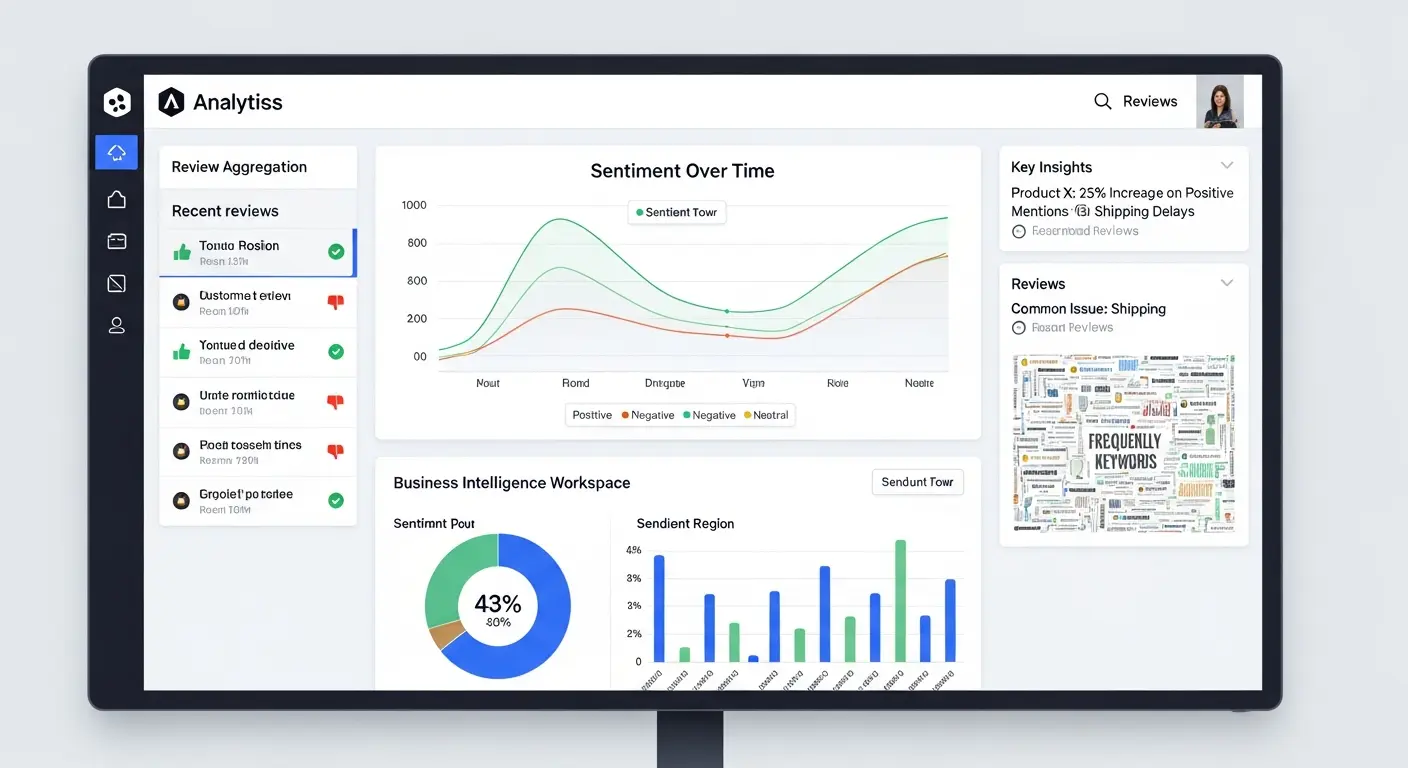
How it Works in Practice: It pulls data from Trustpilot, Salesforce, iOS/Android stores, and call center transcripts into one unified dashboard. It scores specific features of your entire business — telling your executives that "Brand Perception" is 8/10, "Product Quality" is 9/10, but "Return Policy" sentiment just plummeted to 3/10.
The Verdict: The absolute best choice for e-commerce, retail, and direct-to-consumer (DTC) brands with highly fragmented customer touchpoints.
4. MonkeyLearn — Best for Custom, No-Code Models
Sometimes off-the-shelf AI simply doesn't understand your business. If you work in complex B2B software, medical tech, or industrial manufacturing, your customers use highly specific jargon that standard AI might misinterpret.
The Tech: MonkeyLearn is a highly visual, no-code machine learning platform.
How it Works in Practice: It allows you to build and train your own text classifiers and entity extractors. You upload a spreadsheet of your specific data, highlight words and tag them, and within a few hours you have a bespoke AI model that understands your industry vocabulary perfectly.
The Verdict: Ideal for niche B2B industries or data-savvy RevOps teams who want deep control over how their data is classified.
5. Qualtrics XM Discover — Best for Global Enterprises
Qualtrics acquired Clarabridge a few years ago and has successfully integrated world-class natural language understanding into their massive enterprise suite.
The Tech: XM Discover analyzes not just text, but voice.
How it Works in Practice: It ingests live call center audio recordings. The AI analyzes acoustic emotional markers — literally detecting if a customer is raising their voice, sighing heavily, or speaking with urgency. It cross-references this acoustic data with the spoken words to flag high-risk churn accounts directly to Account Managers in real-time.
The Verdict: The necessary heavy-hitter for Fortune 500 companies, major airlines, healthcare networks, and global banks.
The 3-Step Playbook for Implementing Feedback AI
Buying software is easy; deploying it effectively is hard. If you are transitioning from manual tagging to an AI analytics workflow, follow this data-science-backed blueprint.
Step 1: Centralize the Data Ingestion (The Data Lake)
AI models need high volume to be statistically accurate. If you only plug in your NPS surveys, you are getting a fraction of the picture. Use native APIs to ingest everything: App Store reviews, G2/Capterra reviews, Intercom chat transcripts, HubSpot support emails, and CRM sales notes. The more unstructured data you feed the machine, the smarter its clustering becomes.
Step 2: Establish the Baseline (The Learning Period)
Do not make drastic product decisions on day one. Once the data is flowing, let the AI run in the background for 14 to 30 days. This allows the machine learning models to establish a "normal" baseline for your company's sentiment and topic volume — so the AI can accurately flag anomalies like a sudden 40% spike in login complaints.
Step 3: Automate the Routing (Actionable Intelligence)
Insights are useless if they die in a dashboard. Set up intelligent, automated routing rules:
- Negative sentiment around "billing" or "invoice" → route automatically to Finance's Slack channel
- Detects "crash" or "bug" → trigger a webhook that creates a Jira ticket for Engineering
- High positive sentiment about a specific feature → route to Marketing for testimonial content
Data Privacy in the Age of AI (A Crucial Warning)
You must be careful about which AI tools you use to process customer data. When a customer emails support, they often include Personally Identifiable Information (PII) — phone numbers, home addresses, or credit card digits. Using a cheap, non-compliant AI wrapper to analyze these emails could violate GDPR or CCPA regulations.
The enterprise tools listed above — Chattermill, Viable, and Qualtrics — feature Automated PII Redaction. Before the AI processes the sentiment of a ticket, a separate algorithm sweeps the text and replaces phone numbers and emails with asterisks, keeping your customer data secure and compliant. Always ask about PII redaction before signing an AI software contract.
Frequently Asked Questions
Q: Can AI sentiment analysis detect sarcasm?
Yes. In the past, algorithms struggled heavily with sarcasm (e.g., "Oh great, another price hike!"). In 2026, thanks to context-aware LLMs that read the entire paragraph rather than isolated words, leading platforms achieve up to 95% accuracy on complex human sentiment.
Q: Can these AI platforms analyze feedback in multiple languages?
Absolutely. Platforms like Chattermill and Thematic natively process and translate 50+ languages simultaneously. A user in Tokyo can leave an App Store review in Japanese, and your product manager in New York will see the clustered theme summarized in English in real-time.
Q: Will AI eventually replace my human customer support team?
No. AI is a diagnostic tool, not a cure. It acts like an MRI for your business — telling your Product team exactly what is broken, where it hurts, and why customers are angry. But human engineers still fix the code, human marketers update the messaging, and human support agents rebuild trust with frustrated clients.
Conclusion
The era of making product and marketing decisions based on gut feeling is over. Your customers are already telling you exactly how to build a better product; the data is buried inside thousands of support tickets.
By leveraging AI platforms like Viable, Thematic, or MonkeyLearn, you can turn that unstructured chaos into a prioritized, revenue-driving roadmap. Stop forcing your team to read spreadsheets, and let the algorithms show you what your customers actually want.
Tags
Written by

Sourabh Gupta
Founder & Data Scientist, AI Tools Specialist · 2+ years in AI/ML
Sourabh tests every AI tool he writes about — hands-on, with real use cases. His background in data science means he goes beyond marketing claims to benchmark actual performance, cost, and reliability for developers and creators.
Full bio & editorial process →