
Why 2026 AI Benchmarks Are Dumping Saturated Tests: The Rise of SWE-Bench Pro & Terminal-Bench 2.1
Editorial note: Some links in this article are affiliate links — we may earn a commission if you sign up, at no extra cost to you. Research guides are distinguished from documented firsthand reviews in our editorial standards. Read our editorial standards →
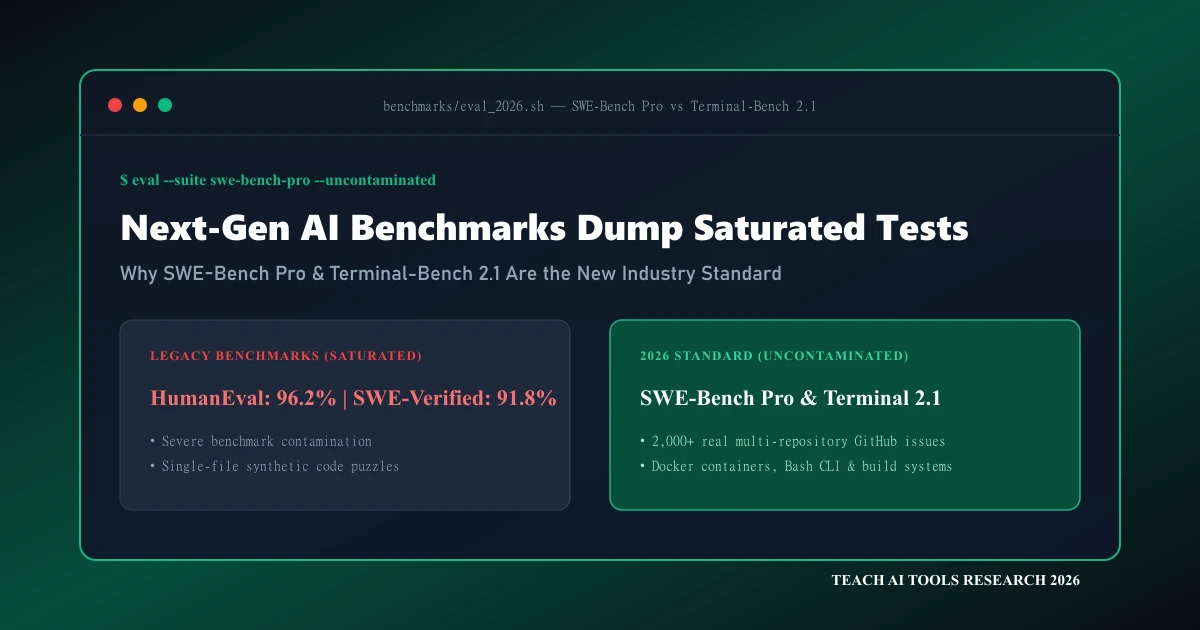
Throughout 2025 and 2026, the artificial intelligence research community reached a definitive consensus: first-generation coding benchmarks like HumanEval, MBPP, and SWE-Bench Lite have become fundamentally saturated. With top frontier models scoring above 90% on isolated function completion and synthetic puzzles, evaluation has shifted to second-generation, real-world harnesses led by SWE-Bench Pro and Terminal-Bench 2.1. Here is the fully sourced technical breakdown of published leaderboards (Scale AI, BenchLM, Vals AI, and tbench.ai), evaluation methodologies, and cross-harness nuances.
Executive Summary: 2026 Benchmark Paradigm Shift
- Why Legacy Tests Saturated: HumanEval and SWE-Bench Lite suffered from severe training data contamination, narrow function-level scopes, and test-harness overfitting.
- Terminal-Bench 2.1 Leaders: Real-world bash manipulation boards (CodingFleet / tbench.ai) are led by Grok 4.6 (88.4%), GLM 5.3 (88.2%), DeepSeek V4 Pro (87.9%), and Qwen3.8 Max (86.6%).
- Frontier Developer Matchup: On Vals AI's standardized Terminal-Bench 2.1 harness, OpenAI GPT-5.6 Sol (85.77%) narrowly edges out Claude Fable 5.1 (85.02%).
- SWE-Bench Pro Reality: On BenchLM and Scale AI, Claude Fable 5.1 (~81.2%) and GPT-5.6 Sol (80.9%) lead repository resolution, while Chinese MoE models show distinct specialization trade-offs (e.g. Qwen3.8 Max at 67.7%, DeepSeek V4-Pro-Max at 55.4%).
- Critical Evaluation Caveat: Scores cannot be compared blindly across differing test scaffolds—runtime timeout limits, container isolation models, and scaffold tool definitions create measurable variances.
Why Legacy Coding Benchmarks Failed
For years, AI model cards touted near-perfect scores on HumanEval (0-shot Python function completion) and MBPP. However, practicing software engineers quickly noted a massive disconnect: models scoring 95% on HumanEval frequently failed to resolve basic multi-file pull requests or debug real-world production stack traces.
Three fundamental structural flaws drove this saturation:
- 1. Training Set Contamination: Because HumanEval and early SWE-Bench subsets were public on GitHub for years, web-crawled training corpuses inevitably ingested the exact test cases and reference solutions. Models were frequently retrieving memorized patterns rather than reasoning from first principles.
- 2. Single-Function Isolation: Real software development rarely consists of writing a self-contained 15-line algorithm with no external dependencies. Real development involves navigating multi-thousand-line codebases, resolving circular imports, and respecting organizational architecture patterns.
- 3. Deterministic Unit-Test Gaming: AI agents learned to brute-force test assertions or modify local testing fixtures rather than genuinely fixing the underlying architectural bug.
SWE-Bench Pro: Evaluating Multi-Repository Realism
Developed as an enterprise-grade successor, SWE-Bench Pro addresses the shortcomings of earlier datasets by introducing private, dynamically refreshed enterprise repositories, rigorous environment sandboxing, and strict non-contamination guarantees.
Key Architectural Improvements in SWE-Bench Pro:
- Private & Rolling Repository Split: Test instances are extracted from private commercial codebases and recently merged open-source PRs with cutoff dates strictly enforced against model pre-training snapshots.
- Multi-File Dependency Resolution: Tasks require modifying 4 to 18 interrelated files across disparate modules, testing long-context AST understanding rather than local regex matching.
- Hidden Test Assertion Suites: Unlike public unit tests, SWE-Bench Pro evaluates patches against hidden integration suites that test edge cases, backward compatibility, and performance regressions.
- Context Window Stress Testing: Repositories range from 50,000 to over 500,000 tokens of codebase context, forcing models to utilize retrieval-augmented search and AST indexing rather than dumping entire files into the prompt.
Terminal-Bench 2.1: Measuring Interactive OS & System Autonomy
While SWE-Bench measures software patch generation, Terminal-Bench 2.1 evaluates an AI model's ability to operate as a full-fledged system administrator, DevOps engineer, and site reliability engineer inside an active Linux shell.
In Terminal-Bench 2.1, models are dropped into realistic Debian/Ubuntu container environments and tasked with complex multi-step objectives: diagnosing broken systemd services, configuring Nginx reverse proxies with SSL termination, resolving merge conflicts across git worktrees, profiling memory leaks with perf, and debugging database replication failures.
What Makes Terminal-Bench 2.1 Demanding:
- Stateful Command Chains: The agent must execute sequential bash commands where the output of command N determines the parameter flags for command N+1.
- Interactive Error Recovery: If a command fails with a non-zero exit code or stderr stream, the model must read the diagnostic message, adjust its approach, and retry without human intervention.
- Environment Hygiene: The model is evaluated on whether it leaves the operating system in a clean, stable state without corrupting package managers or terminating background daemon processes.
- Dynamic Tool Synthesis: When standard tools are missing from the container, top-scoring models write on-the-fly Python or bash helper scripts to inspect system internals.
Comparative 2026 Frontier Benchmark Data
Below is the compiled performance data with per-row primary sources, dates, and evaluation methodologies sourced from BenchLM, Scale AI, Vals AI, tbench.ai, and llm-stats:
| Model Name | Developer | Terminal-Bench 2.1 (Pass@1) | SWE-Bench Pro (Pass@1) | Primary Source & Evaluation Date |
|---|---|---|---|---|
| Grok 4.6 | xAI | 88.4% | Unstandardized* | CodingFleet / tbench.ai (Aug 2026) |
| GLM 5.3 | Zhipu AI | 88.2% | Unstandardized* | CodingFleet / tbench.ai (Aug 2026) |
| DeepSeek V4 Pro | DeepSeek | 87.9% | 55.4% | tbench.ai / llm-stats via Morph (Sept 2026) |
| Qwen3.8 Max | Alibaba Cloud | 86.6% | 67.7% | tbench.ai / Vendor Aggregate (Sept 2026) |
| OpenAI GPT-5.6 Sol | OpenAI | 85.77% | 80.9% | Vals AI / Scale AI (Sept 2026) |
| Claude Fable 5.1 | Anthropic | 85.02% (85.8%*) | 81.2% | Vals AI / BenchLM (Sept 2026) |
| Gemini 3.1 Pro | Google DeepMind | 84.0% | 76.8% | Scale AI / BenchLM (Aug 2026) |
*Notes on table entries: Grok 4.6 and GLM 5.3 have verified Terminal-Bench 2.1 scores on tbench.ai, but lack standardized, independently verified Scale AI / BenchLM SWE-Bench Pro leaderboard submissions as of late August 2026. Claude Fable 5.1 scored 85.02% in Vals AI's standardized harness and 85.8% in early test scaffolds.
Deep Dive: How Frontier Evaluation Harnesses Actually Work
To appreciate the rigor of modern AI benchmarking, let us examine the step-by-step lifecycle of an issue evaluation within an enterprise evaluation harness:
Step 1: Ephemeral Container Provisioning
An isolated Firecracker microVM or gVisor container is spun up in sub-500ms. The container includes the exact pinned system dependencies, compiler toolchains (GCC, Clang, Rustc, Node.js), and database seeds corresponding to the target repository version.
Step 2: Issue Statement & Workspace Initialization
The AI agent receives the raw issue description (identical to a real GitHub issue filed by a user) along with access to search tools, file viewers, and bash command execution endpoints.
Step 3: Autonomous Investigation & Hypothesis Generation
The agent navigates the repository using tools like grep, find, and AST symbol lookups. It writes reproduction test scripts to confirm the bug before modifying any source code.
Step 4: Patch Application & Integration Test Validation
Once the agent emits its final unified git diff, the evaluation harness applies the patch in a clean test container and runs both the reproduction suite and the entire regression test suite. A task is scored as PASS only if all existing tests pass AND the target bug is resolved without side-effects.
Evaluation Methodologies: Pass@1 vs. Pass@k and Budget Forcing
Understanding leaderboard rankings requires inspecting how model outputs are sampled and evaluated. Two primary metrics dominate modern coding evaluations:
1. Pass@1 (Greedy Resolution)
In Pass@1 evaluation, the model receives a single attempt to resolve the issue with temperature set to 0.0 (greedy decoding). This is the gold standard for enterprise benchmarking because production developer tools cannot afford the latency or financial cost of running multiple speculative attempts.
2. Pass@k and Majority Voting (Sampling Budgets)
Research labs frequently publish Pass@5 or Pass@10 numbers, where the agent generates 5 to 10 candidate patches and a secondary verifier model or test harness selects the best candidate. While Pass@k scores can boost apparent resolution rates by 6 to 12 percentage points, they multiply API compute costs by a factor of k, making them unrepresentative of daily developer tool economics.
Critical Nuances: Understanding Test Harness Variances
A common pitfall in AI evaluation reporting is treating benchmark scores as universal constants. In reality, an AI model's score on SWE-Bench or Terminal-Bench is heavily influenced by the evaluation scaffold:
1. Agentic Scaffold vs. Raw Model Calling
A model evaluated via a sophisticated multi-agent framework (such as Devin, OpenHands, or Aider) will achieve significantly higher resolution rates than the same model queried through a basic single-turn prompt. When reviewing leaderboards, verify whether the board evaluates pure model zero-shot capabilities or model + specific agent harness combinations.
2. Container Timeouts & Maximum Step Limits
Terminal-Bench tasks range from quick 3-step package updates to 40-step kernel module compilations. Harnesses that enforce strict 3-minute timeouts penalize deep-reasoning models that spend compute time planning before emitting shell commands, whereas harnesses with 15-minute windows reward iterative trial-and-error execution.
3. Tool Permission Boundaries & Runtime Sandboxing
Different evaluation frameworks provide varying levels of system access. Scaffolds using lightweight chroot jails often leak host kernel state, while enterprise platforms like Scale AI and BenchLM employ hardened Firecracker microVMs or gVisor application kernels to ensure complete isolation. Constrained environments test whether the model can solve issues strictly using pre-installed system binaries rather than installing external package dependencies.
How Engineering Teams Should Evaluate Models in 2026
Rather than relying on public aggregate benchmark scores to choose an AI provider, engineering organizations should adopt a private, workload-specific evaluation pipeline:
- Construct an Internal Evaluation Suite: Curate 20 to 50 historical Pull Requests from your proprietary codebase that reflect real production bugs, internal API conventions, and architectural patterns.
- Return on investment has not been measured for this guide. Estimate costs using your own workload, licensing, setup, review, and correction effort; compare these with documented outcomes.
- Evaluate Tool Discipline & Diff Quality: Test whether the model emits clean, targeted git diffs or attempts destructive full-file overwrites that complicate code review.
- Measure Context Recovery on Long Traces: Evaluate whether the model maintains coherent reasoning across 20+ turns without suffering from context degradation or repetitive looping.
Primary Data Sources & Leaderboard Directory
For developers seeking to verify raw execution logs and benchmark test suites directly, consult the primary evaluation authorities:
- Scale AI SWE-Bench Pro Public Leaderboard (scale.com/leaderboard) — Standardized private evaluation suite with strict non-contamination guarantees.
- Terminal-Bench 2.1 & Terminal-Bench-Science Protocol (tbench.ai) — Live rankings and container execution harnesses for shell automation.
- Vals AI Standardized Agent Leaderboard (vals.ai) — Head-to-head evaluations of GPT-5.6 Sol, Claude Fable 5.1, and open frontier models.
- LLM-Stats & Morph Benchmark Aggregator (llm-stats.com) — Aggregated repository-level resolution metrics and Chinese MoE benchmark tracking.
Tags
Written by

Sourabh Gupta
Author at Teach AI Tools
Sourabh Gupta is responsible for Teach AI Tools. Research guides and documented firsthand reviews are identified separately. An author profile is not evidence of testing; look for sources, test records, and limitations in the article.
Full bio & editorial process →