Best AI Cybersecurity Tools 2026
Editorial note: Some links in this article are affiliate links — we may earn a commission if you sign up, at no extra cost to you. Every tool is independently tested by our team before being recommended. Read our editorial standards →
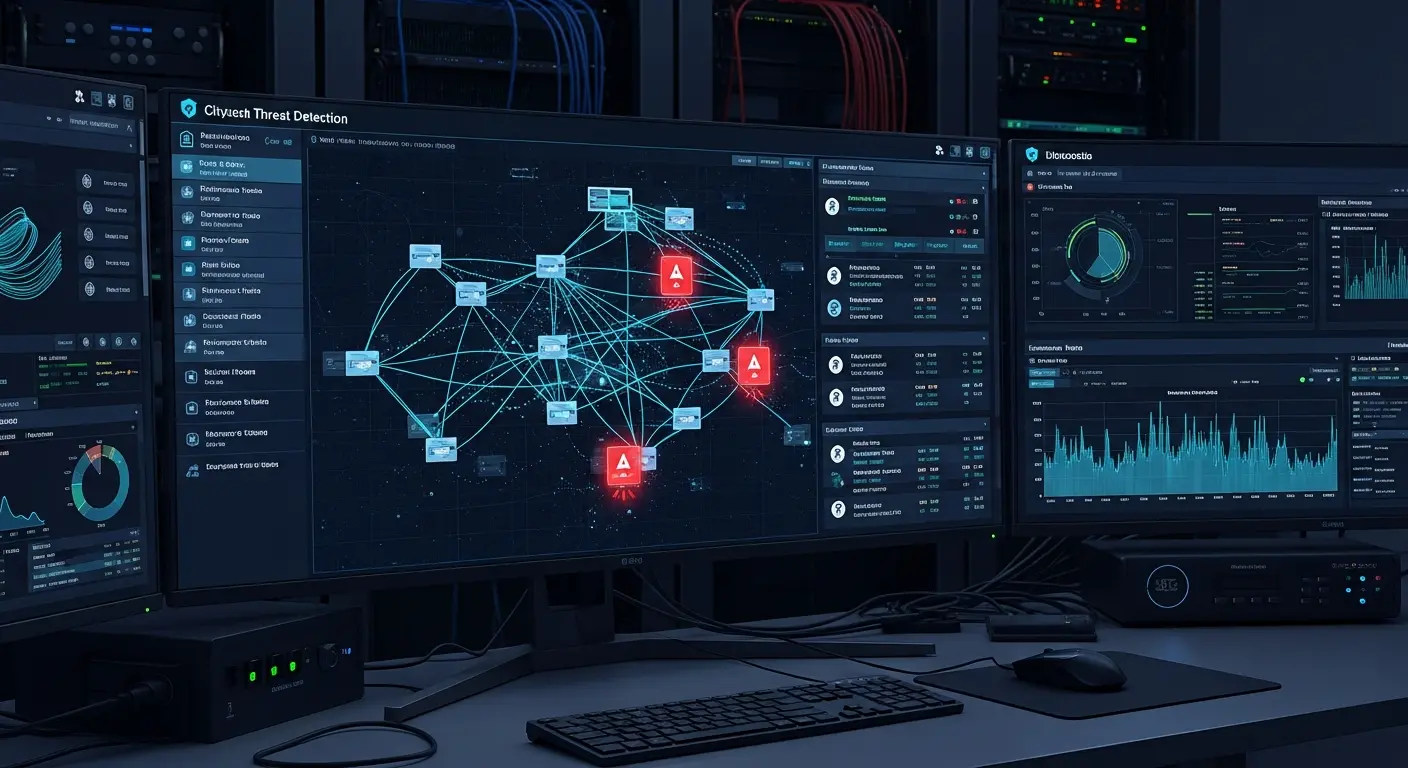
Security teams are right to be skeptical of a product that promises to “stop threats automatically.” The better question is where a tool improves visibility, cuts repetitive triage, or helps a team respond faster without creating a new blind spot.
This comparison focuses on practical fit: the data each platform needs, the types of alerts it handles well, and the human review that should remain in the loop.
How AI Transforms Cybersecurity
Behavioral Analysis and Anomaly Detection
AI learns normal behavior patterns across networks, users, and devices to identify suspicious deviations:
What AI Monitors:
- User login patterns and access behaviors
- Network traffic flows and data transfers
- Application usage and system processes
- File system modifications
- External communication patterns
AI Detection Capabilities:
- Identifies zero-day exploits (never-seen-before attacks)
- Detects insider threats from compromised credentials
- Recognizes advanced persistent threats (APTs)
- Catches subtle data exfiltration attempts
- Identifies lateral movement within networks
Result: AI detects sophisticated attacks that signature-based systems (traditional antivirus) completely miss.
Automated Threat Response
AI doesn't just detect threats—it responds autonomously:
- Isolates infected endpoints from network instantly
- Blocks suspicious IP addresses and domains
- Terminates malicious processes automatically
- Rolls back ransomware encryption
- Quarantines compromised accounts
Speed: AI responds in milliseconds vs hours for manual security operations teams, limiting damage before threats spread.
Predictive Threat Intelligence
AI analyzes global threat data to predict and prevent attacks:
- Learns from millions of attacks across customer base
- Identifies attack patterns and TTPs (Tactics, Techniques, Procedures)
- Predicts likely attack vectors for your specific environment
- Prioritizes vulnerabilities based on exploitation probability
- Updates defenses proactively before attacks occur
Leading AI Cybersecurity Tools
1. Darktrace - Autonomous AI Defense
Price: Custom enterprise pricing (typically $100K-$1M+ annually depending on deployment)
Darktrace uses unsupervised machine learning to learn your organization's "pattern of life" and autonomously responds to threats in real-time.
Best For: Enterprise organizations, complex networks, advanced threat detection Deployment: 50+ employees, distributed networks
Key Features:
- Self-learning AI (learns normal behavior without pre-training)
- Autonomous response via Antigena module
- Detects insider threats and compromised credentials
- Cloud, email, network, and endpoint coverage
- Zero-day exploit detection
- Incident investigation and forensics
- Integration with SIEM and SOC platforms
- Threat visualizations and executive reporting
Standout Feature: Autonomous "Cyber AI Analyst" investigates incidents and writes reports like a human security analyst, triaging thousands of alerts to the critical few requiring human attention.
Enterprise Security: "Darktrace detected ransomware spreading laterally through our network and autonomously isolated infected systems in 3 seconds, preventing $5M+ in potential damage." - CISO, Fortune 500 Manufacturing Company
2. CrowdStrike Falcon - Cloud-Native Endpoint Protection
Price: Starting at $8.99/endpoint/month | Complete at $15.99/endpoint/month
CrowdStrike provides AI-powered endpoint protection, threat intelligence, and managed hunting services via lightweight cloud-native platform.
Best For: Endpoint protection, remote workforces, ransomware defense Deployment: All company sizes (startups to enterprise)
Key Features:
- AI-powered malware detection (no signatures required)
- Behavioral analysis for fileless attacks
- Ransomware protection with rollback capability
- 24/7 managed threat hunting (optional)
- Threat intelligence from 150+ nations
- Instant deployment with no on-premise hardware
- Integration with SIEM, SOAR, and IT management tools
- USB device control and data loss prevention
Standout Feature: Threat Graph processes 1+ trillion events weekly from global customer base, providing real-time threat intelligence benefiting all customers—attacker uses a new technique anywhere, everyone's protected.
Remote Workforce Hero: "CrowdStrike protected our remote workforce during COVID when VPN traffic exploded. Detected and blocked ransomware on employee laptop before it reached our network." - IT Director, Professional Services Firm
3. SentinelOne - Autonomous Endpoint Security
Price: Starting at $3.50/endpoint/month | Varies by tier and features
SentinelOne combines AI detection with automated response and rollback capabilities, specializing in ransomware protection and threat remediation.
Best For: Ransomware protection, automated remediation, small to enterprise businesses Deployment: All company sizes
Key Features:
- AI malware detection with behavioral monitoring
- One-click rollback for ransomware attacks
- Autonomous threat remediation
- Fileless and script-based attack detection
- Network visibility and IoT device monitoring
- Storyline technology (attack timeline visualization)
- Integration with third-party security tools
- Incident forensics and investigation tools
Standout Feature: One-click rollback completely reverses ransomware encryption, restoring files to pre-attack state—like "undo" for cyberattacks.
Ransomware Defense: "SentinelOne detected and rolled back a ransomware attack in 90 seconds. Our files were recovered instantly with zero downtime or ransom payment." - CTO, Healthcare Organization
4. Vectra AI - Network Detection and Response (NDR)
Price: Custom enterprise pricing (typically $50K-$500K annually)
Vectra specializes in AI-powered network traffic analysis, detecting threats inside the network that perimeter defenses miss.
Best For: Network security, insider threat detection, cloud workload protection Deployment: Enterprise organizations with complex networks
Key Features:
- AI-powered network traffic analysis
- Cloud workload security (AWS, Azure, GCP)
- Insider threat and lateral movement detection
- Automated threat prioritization
- Integration with firewalls and SIEM
- Account takeover and privilege escalation detection
- Attack campaign correlation
- Executive-level threat dashboards
Standout Feature: Detects attacker behavior after they've bypassed perimeter defenses—catching insider threats, stolen credentials, and lateral movement that traditional tools miss.
Breach Prevention: "Vectra detected an attacker who'd compromised employee credentials and was exfiltrating data. We stopped the breach before sensitive data left the network." - Security Director, Financial Services
5. Cybereason - AI-Powered Endpoint Detection & Response (EDR)
Price: Starting at $5/endpoint/month
Cybereason combines AI detection with expert threat hunting and incident response services.
Best For: EDR, managed detection and response (MDR), incident response Deployment: Mid-market to enterprise
Key Features:
- AI malware and ransomware detection
- Behavioral analysis with MalOp engine
- Incident response and remediation tools
- Threat hunting and forensics
- Managed detection and response (MDR) service
- Integration with Microsoft, SIEM, SOAR platforms
- Insider threat detection
- Executive summary reporting
Standout Feature: "MalOp" (Malicious Operation) engine connects individual alerts into complete attack stories, showing exactly what attackers did and how they moved through your network.
Investigation Efficiency: "Cybereason reduced our incident investigation time from 8 hours to 20 minutes by automatically correlating attack activities into single MalOps." - SOC Manager, Retail Company
6. Microsoft Defender for Endpoint - Enterprise Integration
Price: Included with Microsoft 365 E5 ($57/user/month) or standalone at $5.20/user/month
Microsoft's AI-powered endpoint security integrates deeply with Windows, Office 365, and Azure ecosystems.
Best For: Microsoft-centric organizations, enterprise Microsoft 365 users Deployment: Small business to enterprise
Key Features:
- AI threat detection with behavioral analysis
- Automated investigation and remediation
- Threat and vulnerability management
- Attack surface reduction rules
- Integration with entire Microsoft security stack
- Zero-trust architecture support
- Mobile threat defense (iOS, Android)
- Cloud app security
Standout Feature: Deep integration with Windows and Microsoft 365—detects threats across email (phishing), documents (malicious macros), and endpoints in unified platform.
Microsoft Shop Advantage: "For organizations already on Microsoft 365, Defender provides enterprise-grade protection without adding another vendor. Integration is seamless." - IT Manager, Education Institution
Feature Comparison Matrix
| Feature | Darktrace | CrowdStrike | SentinelOne | Vectra AI | Cybereason | MS Defender |
|---|---|---|---|---|---|---|
| Focus | Enterprise | Endpoint | Endpoint/Remediation | Network | EDR/MDR | Microsoft Ecosystem |
| Price Range | $$$$ | $$ | $$ | $$$$ | $$ | $-$$ |
| Autonomous Response | ⭐⭐⭐⭐⭐ | ⭐⭐⭐⭐ | ⭐⭐⭐⭐⭐ | ⭐⭐⭐ | ⭐⭐⭐⭐ | ⭐⭐⭐⭐ |
| Threat Intelligence | ⭐⭐⭐⭐⭐ | ⭐⭐⭐⭐⭐ | ⭐⭐⭐⭐ | ⭐⭐⭐⭐ | ⭐⭐⭐⭐ | ⭐⭐⭐⭐ |
| Ransomware Defense | ⭐⭐⭐⭐ | ⭐⭐⭐⭐⭐ | ⭐⭐⭐⭐⭐ | ⭐⭐⭐ | ⭐⭐⭐⭐ | ⭐⭐⭐⭐ |
| Network Visibility | ⭐⭐⭐⭐⭐ | ⭐⭐⭐ | ⭐⭐⭐ | ⭐⭐⭐⭐⭐ | ⭐⭐⭐ | ⭐⭐⭐⭐ |
| Cloud Security | ⭐⭐⭐⭐⭐ | ⭐⭐⭐⭐⭐ | ⭐⭐⭐⭐ | ⭐⭐⭐⭐⭐ | ⭐⭐⭐⭐ | ⭐⭐⭐⭐⭐ |
| Deployment Speed | ⭐⭐⭐ | ⭐⭐⭐⭐⭐ | ⭐⭐⭐⭐⭐ | ⭐⭐⭐ | ⭐⭐⭐⭐ | ⭐⭐⭐⭐⭐ |
Choosing the Right AI Cybersecurity Solution
By Organization Size
Small Business (1-50 employees):
- Best: Microsoft Defender (if using Microsoft 365)
- Alternative: SentinelOne Core ($3.50/endpoint)
- Budget: $200-500/month for comprehensive protection
Mid-Market (50-500 employees):
- Best: CrowdStrike or SentinelOne
- Network Addition: Vectra for network visibility
- Budget: $5,000-$25,000/month
Enterprise (500+ employees):
- Best: Darktrace + CrowdStrike or Vectra + SentinelOne
- Managed Service: Cybereason MDR for 24/7 monitoring
- Budget: $100,000-$1M+ annually
By Primary Threat Concern
Ransomware Protection:
- Best: SentinelOne (rollback capability)
- Alternative: CrowdStrike (strong detection)
Insider Threats:
- Best: Darktrace (behavioral analysis)
- Network Layer: Vectra (lateral movement detection)
Remote Workforce:
- Best: CrowdStrike (cloud-native, lightweight)
- Budget: Microsoft Defender (if already on M365)
Complex Networks:
- Best: Darktrace (autonomous learning)
- Network Focus: Vectra AI
Zero-Day Exploits:
- Best: Darktrace or CrowdStrike (behavioral detection)
By Budget
$0-$500/month (very small business):
- Microsoft Defender (included with Microsoft 365)
- SentinelOne Core for critical endpoints
$500-$5,000/month (small to mid-market):
- CrowdStrike or SentinelOne (endpoint protection)
- Add network monitoring as budget allows
$5,000-$50,000/month (mid-market to enterprise):
- Comprehensive endpoint (CrowdStrike/SentinelOne)
- Network security (Vectra or Darktrace)
- Managed services (Cybereason MDR)
$50,000+/month (large enterprise):
- Multi-layered defense (Darktrace + CrowdStrike + Vectra)
- Full SOC with threat hunting
- Incident response retainers
Implementation Best Practices
Deployment Strategy
Phase 1: Assessment (Week 1-2)
- Audit current security posture and gaps
- Identify critical assets and data
- Define security requirements and budget
- Test AI security tools in evaluation mode
Phase 2: Pilot (Week 3-6)
- Deploy to limited subset of endpoints/networks
- Run in detection-only mode initially
- Fine-tune AI models for your environment
- Train security team on platform
Phase 3: Production (Week 7-8)
- Expand to full deployment
- Enable automated response capabilities
- Integrate with existing security tools
- Establish incident response procedures
Phase 4: Optimization (Ongoing)
- Review threat detections and false positives
- Adjust response policies based on experience
- Update integration with new security tools
- Conduct regular security audits
Maximizing AI Security Effectiveness
Combine with Human Expertise:
- AI detects threats faster and more comprehensively than humans
- Humans provide context, judgment, and strategic response
- Best results: AI + dedicated security operations center (SOC)
Integrate Across Security Stack:
- Connect AI tools with SIEM, firewalls, identity management
- Automate response workflows across tools
- Centralize logging and reporting
- Create unified security dashboards
Continuous Improvement:
- Review AI recommendations and false positives
- Provide feedback to improve detection accuracy
- Stay current with AI model updates
- Participate in threat intelligence sharing
Measuring ROI
Quantifiable Benefits
Time Savings:
- 60-80% reduction in time to detect threats
- 70-90% reduction in incident investigation time
- 50-70% reduction in remediation time
Cost Savings:
- Average breach cost: $4.45M without AI, $1.76M with AI (IBM 2023)
- Reduced need for large security teams
- Lower cyber insurance premiums (10-20% with advanced AI)
- Avoided business disruption and recovery costs
Security Improvements:
- 95%+ threat detection accuracy (vs 60-70% traditional)
- Detection of zero-day exploits that signature-based systems miss
- Automated response limits damage before human intervention
Common Questions and Concerns
Challenge: High false positive rates overwhelming teams Solution: AI tools improve with feedback; invest 2-3 months in tuning for significant reduction
Challenge: Integration complexity with existing security tools Solution: Choose vendors with robust APIs and pre-built integrations for common platforms
Challenge: Cost justification to management Solution: Calculate cost of potential breach ($4.45M average) vs AI tool investment ($50-500K annually); ROI is clear
Challenge: Skills gap in security team for AI tools Solution: Vendors provide training; AI tools actually reduce skill requirements vs manual threat hunting
Frequently Asked Questions
Q: Can AI cybersecurity tools replace human security analysts? A: No. AI handles high-speed detection and routine response, but humans provide strategic thinking, context, investigation of complex attacks, and policy decisions. AI makes security teams more effective, not obsolete.
Q: How long does AI take to learn my environment? A: 7-30 days depending on the tool. Darktrace's unsupervised learning typically trains in 7-14 days. Behavioral-based tools improve accuracy over 30-90 days as they learn more patterns.
Q: Do AI security tools work for small businesses? A: Yes. Cloud-based tools (CrowdStrike, SentinelOne) start under $10/endpoint/month, providing enterprise-grade protection affordable for small businesses. Microsoft Defender is included with Microsoft 365.
Q: Can AI detect insider threats? A: Yes. Behavioral analysis (Darktrace, Vectra) excels at detecting insider threats by identifying abnormal user behavior, data access patterns, and privilege abuse that traditional tools miss.
Q: What happens if AI makes a mistake and blocks legitimate activity? A: Start in detection-only mode to establish baselines. When automated response is enabled, whitelist critical systems and gradually expand automation. Most tools allow quick override of AI actions.
Q: How do AI tools handle zero-day exploits? A: Behavioral analysis detects malicious behavior even from unknown exploits. Unlike signature-based tools requiring known threat signatures, AI identifies suspicious behavior patterns regardless of whether the specific attack has been seen before.
Conclusion
AI-powered cybersecurity has evolved from optional enhancement to essential defense against modern cyber threats. The sophistication, speed, and adaptability of today's attacks require AI-powered detection and response capabilities that human teams and traditional tools simply cannot match at the necessary scale and speed.
Your Action Plan:
- This Week: Assess current security gaps and evaluate AI tool demos
- This Month: Deploy AI security pilot on critical endpoints/networks
- Quarter 1: Expand to full deployment with automated response
- Ongoing: Monitor, tune, and integrate AI tools with broader security strategy
For Small Businesses: Start with cloud-based endpoint protection (CrowdStrike, SentinelOne, or Microsoft Defender). Protection starts under $500/month for comprehensive coverage.
For Enterprises: Multi-layered AI defense (network + endpoint + cloud) with managed services provides protection against advanced persistent threats and nation-state actors.
The organizations breached in 2026 aren't those using AI cybersecurity—they're those relying on outdated signature-based defenses against attackers using AI-powered attack tools. The threat landscape has evolved; your defenses must evolve with it.
Ready to protect your organization with AI-powered security? Choose your cybersecurity solution and deploy protection before the next attack.
External Resources:
Pro Tips from Power Users
To maximize the effectiveness of AI cybersecurity tools, power users recommend the following expert-level tips:
- Implement a hybrid approach: Combine AI-powered tools with traditional security measures to create a layered defense system. This approach ensures that while AI handles complex, evolving threats, traditional systems continue to block known threats, thereby enhancing overall security posture.
- Continuously update training data: Regularly feed your AI system with the latest threat intelligence and internal security data to improve its accuracy in detecting new and sophisticated threats. This includes updating models with information from recent breaches and incorporating feedback from security incidents.
- Monitor AI-driven false positives: Regularly review alerts generated by AI cybersecurity tools to identify and mitigate false positives. This not only reduces unnecessary resource allocation but also helps in fine-tuning the AI algorithms for better precision over time.
- Integrate with existing security tools: Ensure that your AI cybersecurity solutions integrate seamlessly with existing security information and event management (SIEM) systems, intrusion detection systems (IDS), and other security tools. This integration enhances the ability to correlate threats across different vectors and responds more effectively to complex attacks.
- Conduct regular security audits: Utilize AI tools to perform comprehensive security audits, identifying vulnerabilities and compliance issues before they can be exploited. This proactive approach helps in patching vulnerabilities and ensuring that security protocols are up to date and aligned with regulatory requirements.
- Invest in employee training: Educate your team on how to effectively use and interpret data from AI cybersecurity tools. Well-trained personnel can leverage these tools more efficiently, improving response times to threats and enhancing the overall cybersecurity posture of the organization.
Frequently Asked Questions
-
Q: What is the primary advantage of using AI in cybersecurity? A: The primary advantage of using AI in cybersecurity is its ability to detect and respond to threats in real-time, significantly reducing the time to detect and contain breaches. AI-powered systems can analyze vast amounts of data much faster than human analysts, identifying patterns and anomalies that may indicate a security threat. This capability is particularly valuable in combating advanced threats that evade traditional security measures. Moreover, AI can automate many security processes, freeing up human resources for more strategic and complex tasks.
-
Q: How does AI cybersecurity handle zero-day exploits? A: AI cybersecurity tools are uniquely positioned to handle zero-day exploits through their ability to recognize patterns and anomalies in real-time, without relying on known signatures. By analyzing behavior and identifying deviations from the norm, AI systems can detect never-seen-before attacks. This capability is crucial because zero-day exploits, by definition, have no known signature and can bypass traditional security systems. AI's adaptive nature allows it to learn from each new threat, improving its detection capabilities over time.
-
Q: Can AI replace human cybersecurity professionals? A: While AI significantly enhances cybersecurity capabilities, it is not intended to replace human professionals entirely. Instead, AI acts as a powerful tool that augments human capabilities, automating routine tasks and providing insights that humans might miss. Human cybersecurity professionals are essential for interpreting AI-generated data, making strategic decisions, and overseeing the response to complex threats. The collaboration between AI systems and human experts creates a more robust cybersecurity posture than either could achieve alone.
-
Q: How do I choose the right AI cybersecurity tool for my organization? A: Choosing the right AI cybersecurity tool involves considering several factors, including the specific security needs of your organization, the complexity of your infrastructure, and the tool's ability to integrate with your existing security systems. It's also crucial to evaluate the tool's performance in detecting and responding to threats, its scalability, and the level of support provided by the vendor. Conducting thorough research, reading reviews, and possibly conducting pilot tests can help in making an informed decision.
-
Q: What kind of training data do AI cybersecurity tools need? A: AI cybersecurity tools require a diverse and continuously updated set of training data to remain effective. This includes historical threat data, current network traffic patterns, information on known vulnerabilities, and data from various sources such as firewalls, intrusion detection systems, and endpoint security solutions. The quality and quantity of the training data directly impact the AI's ability to learn, adapt, and accurately identify threats. Regular updates to the training dataset are essential to keep the AI system aware of the latest threats and tactics used by attackers.
-
Q: How can I measure the effectiveness of my AI cybersecurity tools? A: Measuring the effectiveness of AI cybersecurity tools involves tracking several key performance indicators (KPIs), including the number of threats detected, the time to detect (TTD) and time to respond (TTR) to threats, the reduction in false positives over time, and the overall impact on breach costs and security incidents. Regular security audits and penetration testing can also provide insights into the effectiveness of the AI tools in identifying and mitigating vulnerabilities.
-
Q: Are AI cybersecurity tools vulnerable to cyberattacks themselves? A: Like any other software, AI cybersecurity tools can potentially be vulnerable to cyberattacks. However, most AI cybersecurity solutions are designed with robust security measures to protect themselves, including encryption, secure data storage, and regular updates to patch vulnerabilities. It's essential to choose a reputable vendor that prioritizes the security of their products and to follow best practices for securing AI tools, such as limiting access and regularly updating software.
-
Q: What is the future of AI in cybersecurity? A: The future of AI in cybersecurity is promising, with advancements in machine learning, natural language processing, and predictive analytics expected to further enhance threat detection and response capabilities. As AI technologies evolve, they will play an increasingly critical role in defending against sophisticated and evolving cyber threats. The integration of AI with other emerging technologies, such as the Internet of Things (IoT) and cloud computing, will also be pivotal in shaping the cybersecurity landscape. Organizations must stay abreast of these developments to leverage AI effectively in their cybersecurity strategies.
Tags
Written by

Sourabh Gupta
Founder & Data Scientist, AI Tools Specialist · 2+ years in AI/ML
Sourabh tests every AI tool he writes about — hands-on, with real use cases. His background in data science means he goes beyond marketing claims to benchmark actual performance, cost, and reliability for developers and creators.
Full bio & editorial process →