AI Tools for Language Learning: How to Actually Reach Fluency in 6 Months
Editorial note: Some links in this article are affiliate links — we may earn a commission if you sign up, at no extra cost to you. Every tool is independently tested by our team before being recommended. Read our editorial standards →
Let me give you a harsh reality check: traditional language learning is fundamentally broken. You can sit in a high school Spanish class or a corporate Mandarin seminar for three years, ace every written grammar test, and still freeze in absolute panic when a barista in Madrid or Beijing asks you a basic question.
The Death of the Traditional Language Classroom
You can sit in a high school Spanish class or a corporate Mandarin seminar for three years, ace every written grammar test, and still freeze in absolute panic when a barista in Madrid or Beijing asks you a basic question.
Historically, the only way to actually become fluent was immersion — moving to a foreign country or paying a private tutor $50 an hour to force you to speak out loud.
As a data scientist, I look at language acquisition not as a magical talent, but as a biological pattern recognition problem. Your brain needs two things to learn a language: massive amounts of comprehensible input, and a high-frequency, low-latency feedback loop. Traditional apps like early Duolingo gave you the input (reading and tapping), but they failed miserably at the feedback loop (actually speaking and being corrected).
In 2026, Artificial Intelligence has completely closed that gap.
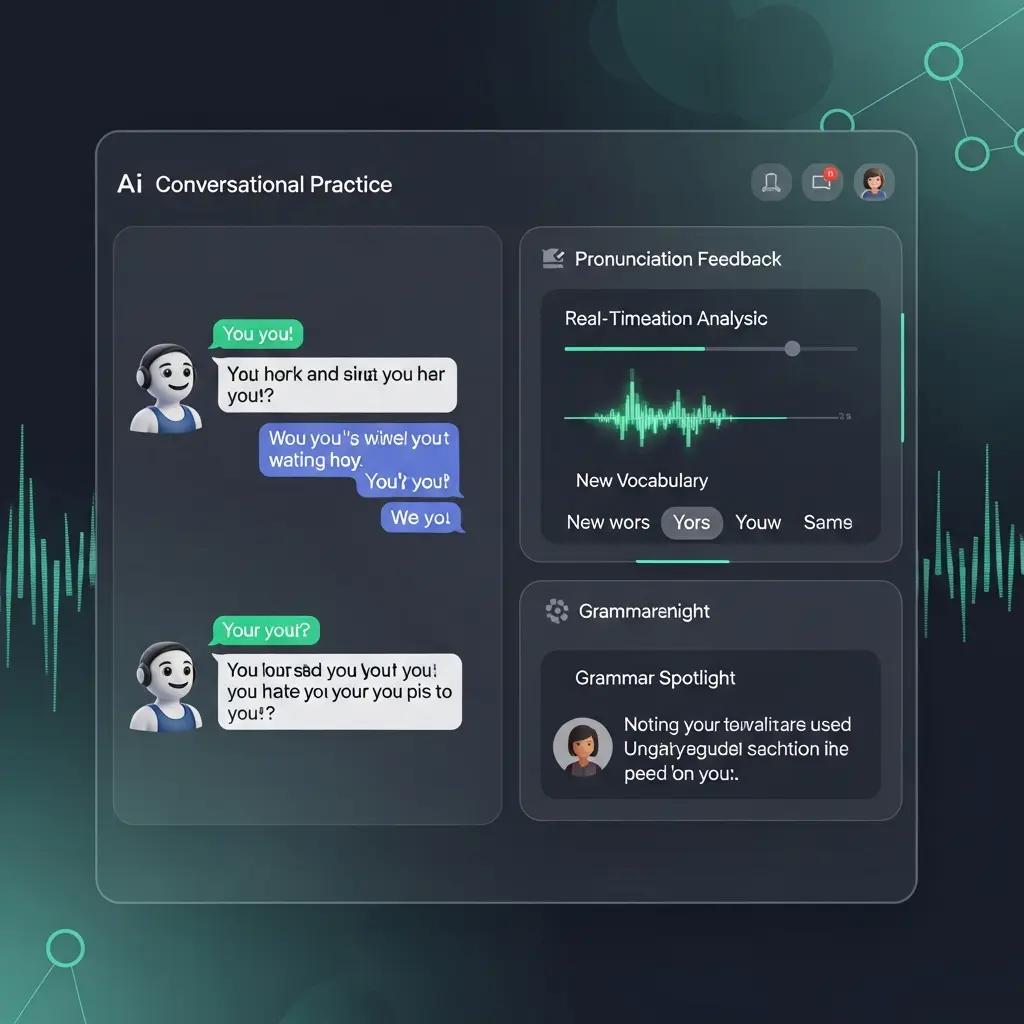
Today's generative AI language tutors don't just ask you to translate "The cat is on the table." They roleplay as a frantic taxi driver in Tokyo, or a strict customs officer in Berlin, forcing you to speak out loud. They analyze the exact acoustic waveforms of your pronunciation and adjust their vocabulary dynamically to match your precise learning curve.
The Candor Reality Check: Can AI make you a native-level, C2-certified poet in six months? No. But can a streamlined AI tech stack get you to B2 Conversational Fluency — where you can confidently travel, date, and hold business meetings in a foreign language — in six months? Absolutely.
Here is the data-driven guide to the top AI language learning platforms dominating 2026, and exactly how to orchestrate them for maximum fluency.
The Data Science of AI Language Tutors: Why 2026 is Different
Before downloading an app, you need to understand the underlying machine learning models that make these tools so much more effective than the software we had even two years ago.
1. Multi-Agent LLM Architecture
In the past, chatting with an AI felt robotic because it lacked "memory" and pedagogical structure. In 2026, apps like Praktika use sophisticated multi-agent systems (often powered by GPT-5.2):
- The Lesson Agent handles the live conversation, adopting a persona.
- The Progress Agent runs silently in the background, logging every time you misuse a past-tense verb.
- The Planning Agent analyzes that data to autonomously structure your next lesson, ensuring you are forced to practice the exact grammar rules you keep failing.
2. Phoneme-Level Acoustic Analysis
Early voice recognition just transcribed what you said. If you mumbled, it guessed. Modern AI language tools utilize deep learning acoustic models that analyze your speech down to the phoneme (the smallest unit of sound). It compares your audio waves against thousands of native speakers, visually showing you exactly where your tongue and lips are placed incorrectly.
3. Ultra-Low Latency Voice
The biggest barrier to speaking a new language is anxiety. The new wave of AI tutors respond in under 300 milliseconds. This ultra-low latency mimics the cadence of a real human conversation, completely eliminating the awkward "waiting for the bot to load" pauses that ruin immersion.
Quick Comparison: The AI Language Stack in 2026
| Platform | Core Strength | Standout AI Feature | Average Pricing |
|---|---|---|---|
| Speak | Getting you talking | OpenAI-backed real-time conversation & drills | $15/mo |
| Langua | Deep immersion | Native voice cloning & alternative phrasing | $10/mo |
| Praktika | Structured learning | Multi-agent Teacher Avatars | $15/mo |
| ELSA Speak | Accent reduction | Phoneme-level acoustic pronunciation grading | $13/mo |
| Duolingo Max | Habit building | GPT-4 "Explain My Answer" & Roleplay | $30/mo |
| TalkPal | Dialect support | Hyper-local regional dialect practice | $10/mo |
Deep Dive: The Top 5 AI Language Learning Apps
1. Speak — Best Overall for Conversational Fluency
Backed by the OpenAI Startup Fund, Speak has exploded in popularity (over 15 million downloads) because it fundamentally understands the assignment: you cannot learn to speak without speaking.
The Tech: A heavily optimized, voice-first generative AI engine.
How the AI Works: Speak's philosophy is brutal but effective. You will speak over 1,000 phrases out loud in your first week. It combines structured video lessons with intensive, rapid-fire speaking drills. Once you learn a concept, you are thrown into the "Speak Tutor" for a custom roleplay. If you say something incorrectly, the AI doesn't just fail you — it provides real-time coaching on why your phrasing was awkward and suggests a more natural alternative.
The Verdict: If you only download one app from this list, make it Speak. It is the fastest way to overcome the anxiety of speaking out loud.
2. Praktika — Best for Structured Avatar Tutoring
If you thrive in a classroom environment but hate the pace of group learning, Praktika provides the most advanced "virtual teacher" experience on the market.
The Tech: A multi-agent AI system utilizing animated 3D avatars.
How the AI Works: Praktika feels like having a private Zoom call with a hyper-intelligent tutor. The avatars have distinct personalities and remember your past conversations. If you told your AI tutor on Tuesday that you were traveling to Hong Kong, on Thursday the AI will organically ask you how your packing is going — in your target language. It dynamically adjusts the lesson plan based on the mistakes you made three days ago.
The Verdict: Unmatched for learners who want deep, highly contextualized conversations rather than rigid flashcards.
3. Langua — Best for Realistic Voice & Vocabulary
Many language apps sound like text-to-speech robots. Langua fixes this by partnering with popular YouTube polyglots and cloning their actual voices.
The Tech: Advanced native voice cloning and context-aware spaced repetition.
How the AI Works: Langua offers the most "human-sounding" interactions. During a chat, if you get stuck, you can speak in your native language, and the AI will gracefully translate and guide you back. Its standout feature is its vocabulary engine: if you stumble on a word during a voice chat, Langua automatically saves it and seamlessly weaves that exact word into your next conversation to force active recall.
The Verdict: The most natural-sounding AI on the market, perfect for intermediate learners trying to break through to advanced fluency.
4. ELSA Speak — Best for Accent Reduction
If you are learning English for career advancement, vocabulary isn't enough. You need to be easily understood in boardrooms and Zoom meetings.
The Tech: Deep acoustic analysis and speech recognition trained specifically on non-native accents.
How the AI Works: ELSA (English Language Speech Assistant) does not care about teaching you new words — it cares about how you sound. You read a sentence into your microphone, and the AI breaks your audio down syllable by syllable. It provides color-coded feedback (Green, Yellow, Red) on your intonation, rhythm, and phoneme accuracy, showing you diagrammatic feedback on how to reshape your mouth to hit the correct vowel sound.
The Verdict: The absolute gold standard for accent reduction and professional pronunciation.
5. Duolingo Max — Best for Gamified Habit Building
We cannot talk about language learning without mentioning the green owl. In 2026, Duolingo's highest tier, "Max," is fully powered by LLMs.
The Tech: Integration with OpenAI's GPT models for contextual learning.
How the AI Works: Duolingo's gamification remains unmatched for keeping you consistent. The "Max" tier adds two crucial features: Roleplay, which acts as an interactive chatbot for specific scenarios (like ordering coffee in Paris), and Explain My Answer, where the AI breaks down exactly why your grammar was wrong in a specific exercise, rather than just buzzing red and making you guess.
The Verdict: At roughly $30/month, it is expensive. Best used as a secondary tool to build a daily habit, but it should not be your primary speaking engine.
The Data Scientist's 6-Month Fluency Workflow
To achieve conversational fluency in six months, you need a disciplined, data-driven workflow. You must avoid the trap of "passive clicking." Do not use 10 different apps — a messy, fragmented workflow will destroy your momentum.
Here is the exact, streamlined tech stack you need:
Months 1–2: The Foundation (Overcoming the Friction) The Tool: Speak (20 minutes daily). Build muscle memory in your mouth. Focus entirely on the structured lessons and repetitive speaking drills. Do not worry about perfect grammar — your only goal is to get comfortable making sounds in the new language.
Months 3–4: The Immersion (Breaking the Script) The Tool: Praktika or Langua (30 minutes daily). It is time to go off-script. Use the AI avatars to simulate unpredictable, real-world conversations. Try to debate the AI, ask it questions about its "life," and practice switching topics rapidly. Let the background agents log your recurring grammar mistakes so you can isolate and fix them.
Months 5–6: The Polish (Real-World Stress Testing) The Tools: Your AI Tutor + Real Human Interaction. By month five, the AI has given you the confidence and vocabulary to survive. Now, you need the stress of human unpredictability. Keep using the AI to warm up, but start booking weekly 30-minute sessions with native speakers on platforms like Preply or italki. Use the AI to practice the exact conversations you plan to have with your human tutor later that day.
Frequently Asked Questions
Q: Will practicing with an AI make me sound like a robot?
Two years ago, yes. Today, no. Platforms like Langua use cloned native voices complete with natural pauses, filler words (like "um" and "uh"), and regional slang. Furthermore, tools like TalkPal allow you to select highly specific dialects — so you can learn Colombian Spanish rather than standard Castilian Spanish, ensuring you sound culturally accurate.
Q: Can AI completely replace a human language tutor?
AI replaces the repetition and drilling that you used to pay a human $50/hour to sit through. AI is infinitely patient — it will let you mispronounce the word "croissant" 400 times without judging you. However, human tutors are still necessary for cultural nuances, advanced idioms, and the genuine emotional connection that makes language beautiful. Use AI for the heavy lifting, and humans for the final polish.
Q: Are there any good free AI language tools?
If you are on a strict budget, the voice-mode feature of the standard ChatGPT app is incredibly powerful. You can prompt it: "Act as a native French speaker. Have a casual conversation with me about movies, and correct my grammar after every response." It lacks the structured curriculum and progress tracking of dedicated apps like Praktika, but it is an exceptional free resource for open-ended conversation.
Conclusion
The era of sitting in a quiet room, filling out grammar workbooks, and hoping to one day be fluent is over. The technology to place a hyper-intelligent, infinitely patient native speaker directly into your pocket is already here.
By leveraging Speak for rapid-fire vocal drilling, Praktika for contextual conversation, and ELSA for precision pronunciation, you are effectively downloading a language directly into your vocal cords.
Stop tapping multiple-choice buttons. Download one of these AI tools today, go to a quiet room, and start talking.
Tags
Written by

Sourabh Gupta
Founder & Data Scientist, AI Tools Specialist · 2+ years in AI/ML
Sourabh tests every AI tool he writes about — hands-on, with real use cases. His background in data science means he goes beyond marketing claims to benchmark actual performance, cost, and reliability for developers and creators.
Full bio & editorial process →