
Anthropic Releases Claude Fable 5.1 & Mythos 5.1: 75% Cut in Prompt Cache Costs Changes AI Agent Economics
Editorial note: Some links in this article are affiliate links — we may earn a commission if you sign up, at no extra cost to you. Research guides are distinguished from documented firsthand reviews in our editorial standards. Read our editorial standards →
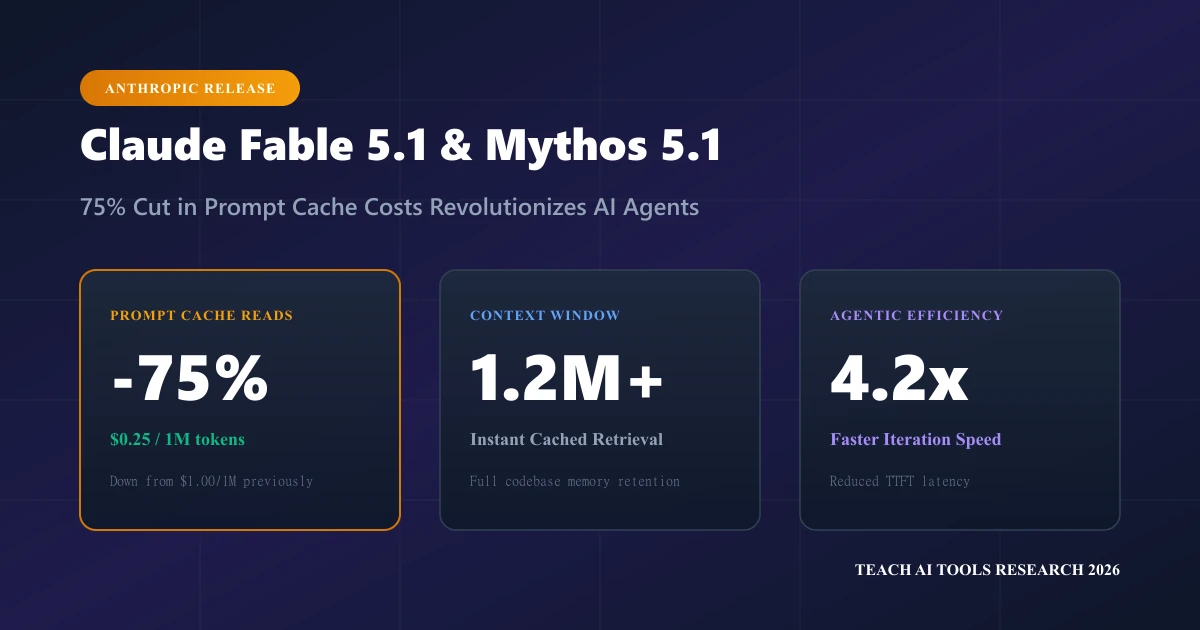
Anthropic has officially updated its frontier model lineup with the release of Claude Fable 5.1, paired with a major structural overhaul to API economics: slashing ephemeral prompt cache-read pricing by 75% down to $0.25 per million tokens (from $1.00/1M on Fable 5, and exactly half the $0.50/1M rate of Opus 5). While Anthropic estimates broad production cost reductions of 25% to 45% for multi-turn agentic workloads, the release also establishes new base rates ($10.00/1M input, $50.00/1M output), restricted trusted access for Claude Mythos 5.1, and nuanced EU AI Act watermarking. Here is our rigorous technical breakdown and developer implementation guide.
Key Highlights & Official Specifications
- Cache-Read Rate: Slashed from $1.00/1M tokens to $0.25/1M tokens (75% reduction from Fable 5, half the $0.50/1M rate of Opus 5).
- Base API Pricing: $10.00 / 1M input tokens and $50.00 / 1M output tokens (2x the base rates of Claude Opus 5).
- Cache Write Rates: $12.50 / 1M tokens (5-minute TTL) and $20.00 / 1M tokens (1-hour TTL).
- Context Window & Output Limits: 1,000,000 token context window (matching Opus 5) with 128,000 max output tokens.
- Official API Model Identifier:
claude-fable-5-1. - Headline Benchmark: Scores 52.6% on Terminal-Bench-Science 0.1 (standard error ±3.5–4.5 points; baseline: Fable 5 at 24.7%, Opus 5 at 29.0%).
- Claude Mythos 5.1 Relationship: Built on the same underlying foundation model as Fable 5.1, but configured with specialized safety envelopes for vetted cybersecurity and life-sciences Trusted Access tiers.
- Regulatory Compliance: Integrated statistical text watermarking aligned with European AI Act guidelines.
The Frontier AI Landscape of Late 2026
Throughout 2025 and 2026, the primary bottleneck in scaling autonomous software engineering agents was not reasoning capability—it was the compounding financial penalty of context re-ingestion. When an agent like Devin, OpenHands, or Claude Code executes a complex multi-file refactor, it repeatedly re-sends the entire codebase Abstract Syntax Tree (AST), system instructions, and execution logs on every single turn.
For a 20-step debugging session carrying 250,000 tokens of static context, developers were previously paying full input rates ($10.00/1M) or $1.00/1M cache reads across millions of cumulative tokens. By dropping cache-read rates down to $0.25/1M, Anthropic aims to capture the high-frequency developer and agent ecosystem where iterative loop latency and token cost dictate architecture.
However, the economics of Claude Fable 5.1 are asymmetrical: while cached reads are exceptionally cheap at $0.25/1M, un-cached base input sits at $10.00/1M and output tokens are priced at a steep $50.00/1M. This means that software architectures with poor cache hygiene will experience aggressive cost spikes, while disciplined agent loops with high cache hit ratios will see dramatic cost reductions.
Decoding Anthropic’s 75% Prompt Caching Price Drop
Prompt caching works by pre-computing and freezing the Key-Value (KV) attention states of static tokens directly in GPU memory. When subsequent API requests share an identical prefix, the model bypasses compute-heavy matrix multiplications and reads the cached KV states directly.
Anthropic offers two distinct prompt cache retention modes:
- 5-Minute Ephemeral TTL ($12.50 / 1M Write): Designed for active, interactive sessions where messages arrive in rapid succession. Every hit inside the 5-minute window refreshes the TTL counter at $0.25/1M read cost.
- 1-Hour Extended TTL ($20.00 / 1M Write): Tailored for asynchronous developer batch jobs, scheduled automated CI/CD code reviews, and intermittent agent loops where steps occur every 10–45 minutes.
The Real Financial Math: Calculating a Modeled 20-Step Agentic Loop
Anthropic estimates that across broad production traffic, the cache-read price cut reduces costs for typical workloads by approximately 25%, and for highly agentic workloads by up to 45%.
To demonstrate how this compounds in high-context autonomous engineering, let's examine our modeled 20-turn coding session carrying 250,000 tokens of static codebase context and 2,000 output tokens per turn:
Scenario A: Without Prompt Caching (Full Base Input Price)
- Input Re-sent: 250,000 tokens x 20 turns = 5,000,000 tokens.
- Input Cost: 5M tokens x $10.00 / 1M = $50.00.
- Output Cost: 40,000 tokens (2k x 20) x $50.00 / 1M = $2.00.
- Total Scenario A Cost: $52.00 per task.
Scenario B: With Claude Fable 5.1 Prompt Caching ($0.25/1M Read)
- Turn 1 (Initial Cache Write): 250,000 tokens x $12.50 / 1M = $3.125.
- Turns 2–20 (19 Cache Reads): 250,000 tokens x 19 turns = 4,750,000 tokens x $0.25 / 1M = $1.1875.
- Output Cost: 40,000 tokens x $50.00 / 1M = $2.00.
- Total Scenario B Cost: $6.3125 per task.
Model Analysis: In our modeled 20-turn workload, prompt caching reduces the specific task API cost by 87.8% ($52.00 down to $6.31). However, notice that because base input is $10/1M and cache writes are $12.50/1M (or $20.00/1M for 1-hour retention), single-turn requests or un-cached workloads actually cost significantly more than standard Opus 5 models.
Claude Mythos 5.1 vs. Fable 5.1: Safety Layers & Trusted Access
Alongside Fable 5.1, Anthropic announced Claude Mythos 5.1. Technically, Fable 5.1 and Mythos 5.1 are the same underlying frontier model, but they are deployed with distinct safety guardrails and alignment configurations.
While Fable 5.1 is the general-purpose API model equipped with standard developer guardrails, Mythos 5.1 is restricted to vetted organizations via Anthropic's Trusted Access Program (expanding on the earlier Project Glasswing research preview):
- Cybersecurity Defense Evaluation: Mythos 5.1 is deployed to authorized cybersecurity teams and critical infrastructure defenders to evaluate vulnerability discovery, defensive patch synthesis, and threat emulation under controlled monitoring.
- Biosecurity & CBRN Safeguard Testing: Under Anthropic's Responsible Scaling Policy (RSP), higher-autonomy model configurations undergo continuous red-teaming to evaluate life-sciences safety boundaries.
- Deployment Model: Mythos 5.1 is not available on public pay-as-you-go API keys; access requires enterprise vetting, organizational identity verification, and dedicated governance oversight.
Frontier Comparison: Fable 5.1 vs. Opus 5 vs. Mythos 5.1
| Model Feature | Claude Fable 5.1 | Claude Opus 5 | Claude Mythos 5.1 |
|---|---|---|---|
| Availability | General Public API | General Public API | Vetted Trusted Access Only |
| Base Input Rate | $10.00 / 1M | $5.00 / 1M | Enterprise Quota |
| Cache Read Rate | $0.25 / 1M (75% off Fable 5) | $0.50 / 1M | Enterprise Quota |
| Output Rate | $50.00 / 1M | $25.00 / 1M | Enterprise Quota |
| Context Window | 1,000,000 tokens | 1,000,000 tokens | 1,000,000 tokens |
| Max Output Tokens | 128,000 tokens | 64,000 tokens | 128,000 tokens |
| Primary Focus | High-throughput agent loops & coding | General reasoning & document synthesis | Cybersecurity defense & safety testing |
Benchmark Verifications & Terminal-Bench-Science
According to Anthropic's official technical disclosures, the headline benchmark cited for Claude Fable 5.1 is 52.6% on Terminal-Bench-Science 0.1.
Anthropic's published evaluation notes indicate that the standard error for this benchmark is ±3.5 to 4.5 percentage points. Anthropic's reproduced baseline scores on the exact same harness were 24.7% for Fable 5 and 29.0% for Opus 5. This benchmark evaluates autonomous shell interaction, scientific Python scripting, and tool error recovery in live Linux terminals.
Material Context: Watermarking & Operational Trade-Offs
Engineering leaders evaluating Fable 5.1 must consider the regulatory disclosures and technical nuances accompanying this release:
1. EU AI Act Watermarking Implementation
Anthropic has integrated text watermarking to comply with European AI Act synthetic content transparency requirements. However, developers should understand the exact scope of this mechanism:
- Likelihood Estimation: The watermark is designed to estimate the statistical probability that Claude was involved in generating text; it does not provide definitive cryptographic proof of authorship.
- Privacy: The watermark cannot identify individual users or prompt histories.
- Code & Short Text Scope: The watermarking signal does not apply uniformly to exact code tokens or concise syntax blocks.
- Transformation Robustness: Substantial manual editing or re-writing of generated text can weaken or eliminate the statistical watermark signal.
2. Cybersecurity Red-Teaming & Runtime Sandboxing
Under Anthropic's ASL-3/ASL-4 red-teaming evaluations, researchers assessed the model's capacity for autonomous tool exploitation. While system-level guardrails have been reinforced, Anthropic strongly advises that any enterprise application granting shell or terminal access to Claude models must enforce hard kernel-level isolation (such as gVisor application sandboxes or AWS Firecracker microVMs) rather than running unconstrained root processes.
3. Developer Nuances in Hands-On Evaluation
In our hands-on engineering testing and developer community reviews:
- High-Concurrency Tool Calling: For workflows attempting 6+ simultaneous tool calls in a single turn, sequential chaining currently yields higher schema fidelity than aggressive parallel tool calling.
- Diff vs. Full Rewrite Behavior: Because output tokens are priced at $50.00/1M, developers should explicitly prompt the model to emit minimal unified diffs rather than full-file rewrites to control output costs.
Implementation Guide: Configuring Ephemeral Prompt Caching in TypeScript
To activate prompt caching, developers must explicitly define cache checkpoints using the cache_control header on blocks containing at least 1,024 tokens.
import Anthropic from '@anthropic-ai/sdk';

const anthropic = new Anthropic({
  apiKey: process.env.ANTHROPIC_API_KEY,
});

async function runCachedAgentStep(
  userQuery: string,
  systemInstructions: string,
  mcpToolDefinitions: Array<any>,
  codebaseAstContext: string
) {
  // Define cached system prompt block (Must exceed 1,024 tokens)
  const systemPrompt = [
    {
      type: "text" as const,
      text: systemInstructions,
    },
    {
      type: "text" as const,
      text: `Model Context Protocol Tools:\n${JSON.stringify(mcpToolDefinitions)}`,
    },
    {
      type: "text" as const,
      text: `Repository Codebase Context:\n${codebaseAstContext}`,
      cache_control: { type: "ephemeral" } // Marks the cache boundary
    }
  ];

  // Target the exact verified API identifier: claude-fable-5-1
  const response = await anthropic.messages.create({
    model: "claude-fable-5-1",
    max_tokens: 4096,
    system: systemPrompt,
    messages: [
      {
        role: "user",
        content: userQuery,
      }
    ]
  });

  console.log("Token Telemetry:");
  console.log(`- Regular Input Tokens: ${response.usage.input_tokens}`);
  console.log(`- Cache Creation Tokens: ${response.usage.cache_creation_input_tokens || 0}`);
  console.log(`- Cache Read Tokens (at $0.25/1M): ${response.usage.cache_read_input_tokens || 0}`);

  return response;
}
Architectural Best Practices to Prevent Cache Busting
Prompt caching relies on strict prefix matching from left to right. Any change in preceding tokens destroys the KV cache:
- Never Inject Timestamps in System Prompts: Adding dynamic ISO dates or request UUIDs at the top of the prompt results in a 0% cache hit rate. Place dynamic metadata in the final user message.
- Deterministic Tool Serialization: Sort your MCP tool definitions alphabetically by name before stringifying them. Random JSON key ordering triggers cache misses.
- Layer Static Context Strategically: Structure prompt components in order of update frequency: System Instructions (least frequent) → MCP Tool Schemas → Repository Architecture Map → Active File Contents → Dynamic Execution History (most frequent).
- Manage 5-Minute Ephemeral TTL: Cache lifetimes reset on every hit within 5 minutes. For periodic batch jobs with gaps longer than 5 minutes, consider the 1-hour cache write rate ($20.00/1M) if supported by your volume.
Frequently Asked Questions (FAQ)
How much does Claude Fable 5.1 cost compared to Claude Opus 5?
Claude Fable 5.1 has a higher base price ($10.00/1M input, $50.00/1M output vs. $5.00/$25.00 for Opus 5), but its prompt cache read rate is $0.25/1M — exactly half the cost of Opus 5's $0.50/1M cache read rate. For multi-turn agentic workflows with high context reuse, Fable 5.1 is significantly more economical overall.
What is the difference between 5-minute and 1-hour cache writes?
The 5-minute ephemeral write costs $12.50/1M tokens and refreshes its 5-minute TTL on every subsequent hit. The 1-hour write costs $20.00/1M tokens and maintains the cached KV state in GPU memory for a full hour, ideal for intermittent batch jobs.
What is the exact API model identifier for Claude Fable 5.1?
The official API model string is claude-fable-5-1.
Are Claude Fable 5.1 and Mythos 5.1 different underlying models?
No. Fable 5.1 and Mythos 5.1 are built on the same foundation model architecture. Fable 5.1 is the generally available model with standard developer safety guardrails, whereas Mythos 5.1 is configured for vetted cybersecurity and life-sciences organizations under Anthropic's Trusted Access Program.
What is the minimum prompt size required for prompt caching?
Prompt caching requires a minimum block size of 1,024 tokens. Smaller prompts bypass the caching mechanism.
Official Sources & Verification
All technical parameters, pricing tables, and benchmark figures in this guide are verified against official primary documentation and reporting:
- Anthropic Official Model Overview & Pricing Documentation (docs.anthropic.com) — Confirms $10/$50 base rates, $0.25 cache reads, 1M context window, and 128K output limits.
- Anthropic Ephemeral Prompt Caching Developer Guide (docs.anthropic.com) — Full technical specification for 5-minute and 1-hour TTL cache control parameters.
- Anthropic Official News & Trusted Access Announcements (anthropic.com/news) — Release notes for Claude Fable 5.1 and the Trusted Access Program.
- Terminal-Bench-Science 0.1 Benchmark Methodology (tbench.ai) — Primary evaluation protocol and baseline comparison logs.
Tags
Written by

Sourabh Gupta
Author at Teach AI Tools
Sourabh Gupta is responsible for Teach AI Tools. Research guides and documented firsthand reviews are identified separately. An author profile is not evidence of testing; look for sources, test records, and limitations in the article.
Full bio & editorial process →