
DeepSeek R1 and Open-Source Reasoning Models: What Changed for the AI Industry
Editorial note: Some links in this article are affiliate links — we may earn a commission if you sign up, at no extra cost to you. Every tool is independently tested by our team before being recommended. Read our editorial standards →
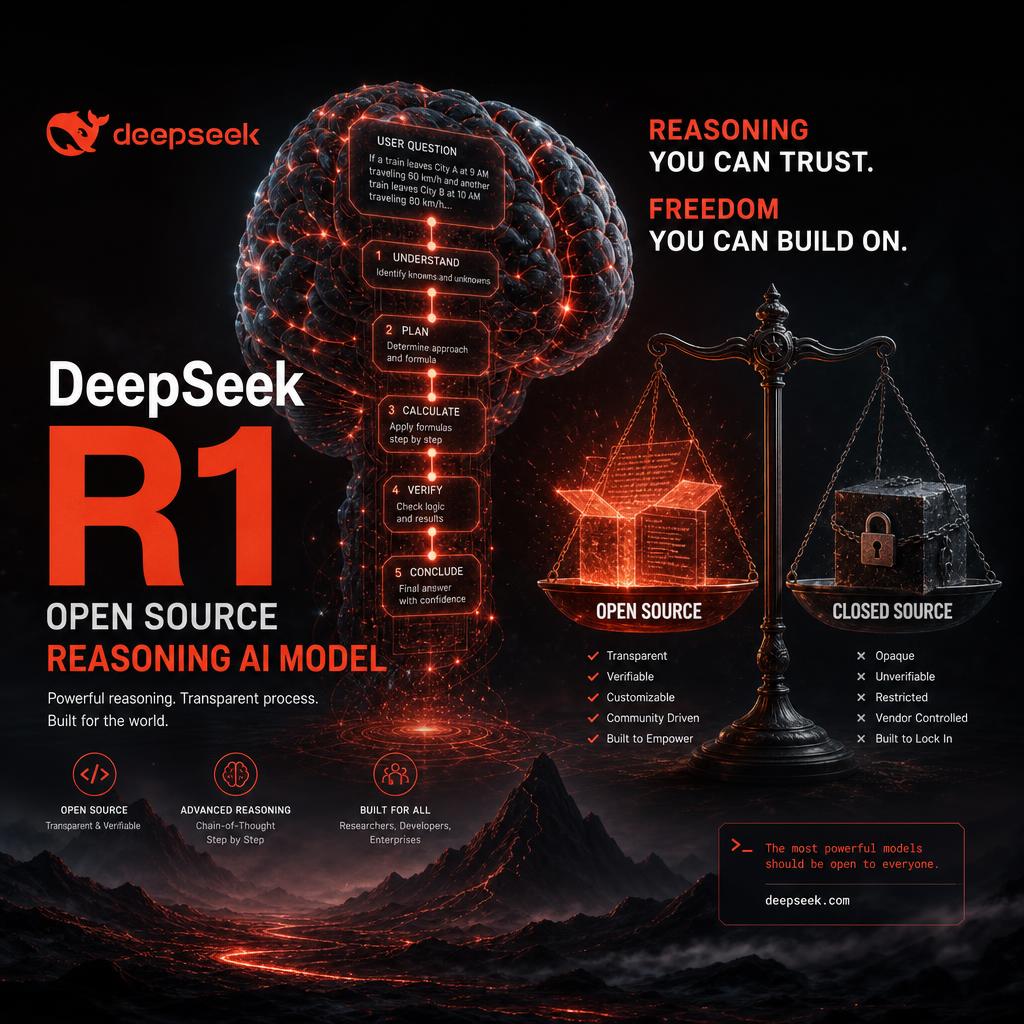
In January 2025, a Chinese AI company called DeepSeek released a model that shocked the AI industry. DeepSeek R1 matched OpenAI's o1 on math, science, and coding benchmarks — and was available as an open-source download.
DeepSeek R1 and Open-Source Reasoning Models: What Changed for the AI Industry
For free. The model that supposedly cost over $100M to train at OpenAI was matched by a model that reportedly cost a fraction of that to train, and the weights were available for anyone to run.
This guide explains what reasoning models are, why DeepSeek R1 matters, what other reasoning models exist in 2026, and when to use them.
What Is a Reasoning Model?
Standard language models generate responses word-by-word based on patterns learned in training. They are fast and good at most language tasks, but they struggle with multi-step problems that require planning, backtracking, and verification.
Reasoning models take a different approach. Before generating a final answer, they produce an extended internal "thinking" process — exploring approaches, checking their work, abandoning dead ends, and refining. This thinking process is usually shown to the user as a scratchpad labeled "thinking" or "reasoning".
The result: dramatically better performance on problems that require step-by-step logic — complex math, multi-step code debugging, scientific reasoning, and strategic planning.
The tradeoff: reasoning models are slower and more expensive per query than standard models, because they generate thousands of tokens of internal reasoning before producing an answer.
DeepSeek R1: What It Is and Why It Matters
DeepSeek R1 is a 671B parameter mixture-of-experts model that uses reinforcement learning to develop its reasoning capabilities. In reinforcement learning for reasoning (RLVR), the model is rewarded for correct answers and penalized for wrong ones — with no human labeling of intermediate reasoning steps. The model learns to think through problems by discovering what works.
Benchmark performance at release:
- MATH-500: 97.3% (vs OpenAI o1's 96.4%)
- AIME 2024: 79.8% (vs OpenAI o1's 79.2%)
- Codeforces rating: 2029 (vs OpenAI o1's 1891)
- MMLU: 90.8% (vs OpenAI o1's 91.8%)
These are extraordinary numbers for an open-source model. But the impact went beyond benchmarks.
What really changed:
-
Open weights. Anyone can download and run DeepSeek R1. Any company can fine-tune it on their data. Any researcher can study it.
-
Affordable API. DeepSeek's API prices R1 at approximately $0.55/M input tokens — roughly 10–20x cheaper than OpenAI o1.
-
Distilled versions. DeepSeek released distilled versions of R1 — smaller models (1.5B to 70B parameters) that inherit R1's reasoning capabilities. DeepSeek-R1-Distill-Qwen-7B achieves 55.5% on AIME 2024, outperforming OpenAI o1-mini while running locally on a standard laptop.
-
Competitive pressure. R1's release directly accelerated price reductions across the entire AI API market. OpenAI, Anthropic, and Google all adjusted pricing within weeks.
Other Reasoning Models in 2026
DeepSeek's success catalyzed a wave of open-source reasoning models.
QwQ-32B (Alibaba)
QwQ is a 32B parameter model from Alibaba's Qwen team that achieves near-R1 performance at a much smaller size. Its reasoning traces are notably thorough — it often considers multiple solution approaches before committing. QwQ-32B is particularly strong at mathematical reasoning and is one of the best freely available models for STEM tasks.
Access: Available on Hugging Face, runs via Ollama (ollama pull qwq)
Best for: Math, science, step-by-step problem solving
Phi-4-Reasoning (Microsoft)
Microsoft's Phi-4 family includes a reasoning variant that achieves exceptional performance for its size (14B parameters). Phi-4-Reasoning uses a combination of supervised fine-tuning on reasoning traces and reinforcement learning. It runs on consumer hardware and outperforms much larger models on many reasoning benchmarks.
Access: Available on Hugging Face, Ollama
Best for: Running reasoning capability on limited hardware
OpenAI o3 and o4-mini
OpenAI responded to DeepSeek by releasing o3 (their strongest reasoning model) and o4-mini (a smaller, faster reasoning model with strong cost efficiency). o4-mini in particular represents the best reasoning performance per dollar on OpenAI's platform.
Access: ChatGPT Plus, Pro, and API
Pricing: o4-mini at $1.10/M input tokens, o3 at $10/M input tokens
Claude 3.7 Sonnet with Extended Thinking
Anthropic added an "extended thinking" mode to Claude 3.7 Sonnet that enables explicit reasoning traces. When activated, Claude works through complex problems step-by-step before responding. This is Anthropic's answer to reasoning models without a completely separate model — the same Claude, but with thinking turned on.
Access: API with thinking parameter, or Claude Pro (reasoning visible in UI)
Gemini 2.5 Pro (Google)
Gemini 2.5 Pro consistently tops the LM Arena leaderboard in 2026, with strong reasoning capabilities that rival o3 on many benchmarks. Its 2M token context window combined with reasoning capability makes it uniquely powerful for document-heavy reasoning tasks.
When to Use a Reasoning Model (and When Not To)
Use reasoning models for:
- Complex math problems (algebra, calculus, combinatorics)
- Multi-step logic puzzles and strategic planning
- Debugging complex code with unclear root causes
- Scientific hypothesis analysis
- Legal and financial analysis requiring careful step-by-step thinking
- Any problem where you have seen standard models confidently give wrong answers
Use standard models for:
- Conversational chat and simple Q&A
- Creative writing (reasoning models can be awkward here)
- Summarization and classification
- Fast, high-volume API calls where latency matters
- Tasks where the reasoning overhead adds cost without benefit
How to Run DeepSeek Locally
The distilled versions of DeepSeek R1 run on consumer hardware:
# 7B version — runs on 8GB RAM
ollama pull deepseek-r1:7b
ollama run deepseek-r1:7b

# 14B version — runs on 16GB RAM
ollama pull deepseek-r1:14b
ollama run deepseek-r1:14b
The model will show its thinking process in <think> tags before the final answer. For coding and math tasks, the thinking process alone is often more instructive than the answer.
The Broader Implication
DeepSeek R1 changed the narrative around AI development. The assumption that only trillion-dollar companies could produce frontier models proved to be wrong, or at least incomplete. Highly efficient training techniques, open-source collaboration, and distillation pipelines allow smaller teams to compete.
For users, this means: reasoning capability is no longer locked behind expensive proprietary APIs. You can run a reasoning model on your laptop, for free, right now.
The competition is good. Prices have fallen, capabilities have risen, and the open-source ecosystem is now a genuine alternative to proprietary models for a wide range of tasks.
Frequently Asked Questions About DeepSeek R1 and Reasoning Models
What is DeepSeek R1?
DeepSeek R1 is an open-source reasoning model released by DeepSeek AI in January 2025. It achieved benchmark scores comparable to OpenAI o1 on math, coding, and graduate-level science tasks — while being freely downloadable and usable at a fraction of the API cost. It was a landmark moment for open-source AI, showing that frontier reasoning capability no longer required a $100M+ training budget.
How does DeepSeek R1 compare to GPT-4o?
On structured reasoning tasks — mathematics (MATH-500), competitive programming (Codeforces), and graduate-level science (GPQA Diamond) — R1 matches or exceeds GPT-4o. For creative writing, nuanced conversation, and tasks requiring broad general knowledge, GPT-4o still has an edge. For coding and step-by-step problem solving, R1 is the better choice at a lower cost.
Is DeepSeek R1 safe to use for business data?
For most general use cases, yes. If you use the DeepSeek API, your data is processed on their servers (in China), which may raise compliance concerns for regulated industries. The safest enterprise option is running a distilled version locally via Ollama — your data never leaves your infrastructure. Always review DeepSeek's current privacy policy for commercial use.
Can I run DeepSeek R1 on my own computer?
Yes — distilled versions are available via Ollama. DeepSeek R1 Distill 7B runs on a 16GB RAM machine. The 14B distill needs 24GB RAM or a good GPU. The full 671B model requires cluster-scale infrastructure. Install Ollama and run ollama pull deepseek-r1:7b to get started in minutes.
What are reasoning models and why do they matter?
Reasoning models generate an internal "thinking" or "chain-of-thought" process before producing their final answer — visible as a scratchpad in tools like DeepSeek and OpenAI o1. This approach dramatically improves performance on multi-step problems: math proofs, complex debugging, logic puzzles, and scientific analysis. It trades speed for accuracy.
What other open-source reasoning models exist besides DeepSeek R1?
QwQ-32B (Alibaba/Qwen) is a strong competitor with excellent reasoning at a manageable size. Phi-4 (Microsoft) punches above its weight at 14B parameters. Llama 3.3 70B with chain-of-thought prompting is also competitive. The open-source reasoning field advanced rapidly in 2025-2026, with new releases every few months.
Tags
Written by

Sourabh Gupta
Data Scientist & AI Tools Specialist · 5+ years in AI/ML
Sourabh tests every AI tool he writes about — hands-on, with real use cases. His background in data science means he goes beyond marketing claims to benchmark actual performance, cost, and reliability for developers and creators.
Full bio & editorial process →