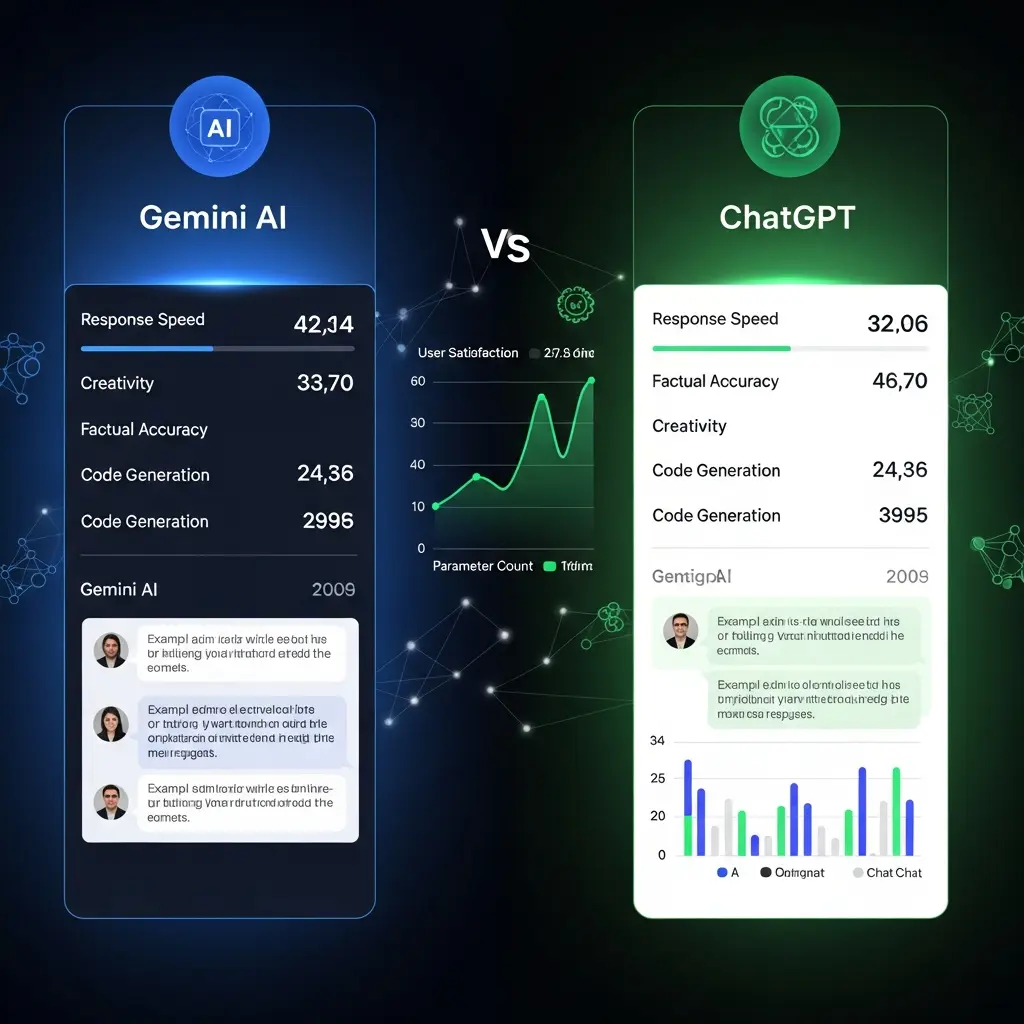
Google Gemini 2.5 Pro: The Thinking Model Redefining AI Reasoning
Editorial note: Some links in this article are affiliate links — we may earn a commission if you sign up, at no extra cost to you. Research guides are distinguished from documented firsthand reviews in our editorial standards. Read our editorial standards →
It is the latest leap forward for power users who need their AI to handle complex, multi-step logical tasks without getting stuck.
Google Gemini 2.5 Pro: The Thinking Model Redefining AI Reasoning
In mid-2026, Google's Gemini 2.5 Pro stands as one of the most technically impressive AI models commercially available. It holds state-of-the-art positions on multiple reasoning benchmarks, offers the largest context window of any commercially available model at 1 million tokens, and introduces an extended thinking mode that fundamentally changes how the model approaches difficult problems. For developers, researchers, and enterprises with demanding workloads, understanding Gemini 2.5 Pro — its capabilities, limitations, pricing, and optimal use cases — is essential.
This guide covers everything: how thinking mode works and when to use it, what you can actually do with a 1 million token context window, benchmark comparisons against GPT-5.6, Claude Sonnet 5, and o3, practical cost optimization strategies, and integration examples.
What Is Gemini 2.5 Pro?
Gemini 2.5 Pro is Google DeepMind's flagship reasoning model, positioned at the top of the Gemini 2.5 model family. Unlike standard language models that generate responses token-by-token without explicit deliberation, Gemini 2.5 Pro incorporates an extended thinking mode — a chain-of-thought reasoning mechanism that allows the model to work through complex problems step-by-step before producing a final answer.
The model is natively multimodal from its architecture: it does not treat text, images, audio, and video as separate capabilities bolted together post-training, but as unified modalities it reasons across simultaneously. This architectural choice is responsible for its leadership in video understanding benchmarks and its ability to reason about information across different media types within a single context.
The Extended Thinking Mode: How It Actually Works
The Mechanism
When thinking mode is enabled, Gemini 2.5 Pro generates a chain-of-thought reasoning trace before producing its final response. This trace is visible to the developer and shows the model's working: hypotheses it considered, approaches it evaluated, and conclusions it reached step by step.
This is conceptually similar to OpenAI's o3 model reasoning, but with a key practical difference: Gemini 2.5 Pro allows thinking mode to be toggled per request, and thinking tokens are billed separately from output tokens — giving you granular control over the cost/quality tradeoff.
API Implementation
import google.generativeai as genai

model = genai.GenerativeModel('gemini-2.5-pro')

# With thinking enabled
response = model.generate_content(
    "Prove that the square root of 2 is irrational",
    generation_config=genai.GenerationConfig(
        thinking_config={"thinking_budget": 8192}
    )
)

# Access the thinking trace
print(response.candidates[0].content.parts[0].thought)
print(response.candidates[0].content.parts[1].text)
Thinking Token Budget
You control how many tokens the model can use for reasoning via a budget parameter. Higher budgets allow more thorough reasoning but cost more and take longer.
| Task Complexity | Recommended Budget | Use Case Examples |
|---|---|---|
| Simple | 0 (disabled) | Summarization, classification, simple Q&A |
| Moderate | 1,024–2,048 | Multi-step reasoning, moderate code tasks |
| Complex | 4,096–8,192 | Advanced math, complex debugging, research synthesis |
| Maximum | 16,384+ | Olympiad-level problems, architecture design |
When to Enable Thinking Mode
Enable thinking for:
- Complex mathematical proofs and derivations
- Multi-step algorithm design and analysis
- Research synthesis requiring logical inference chains
- Security vulnerability analysis requiring deep reasoning
- Architectural decisions with many interdependencies
- Ambiguous problems requiring explicit assumption-stating
Disable thinking for:
- Simple factual lookups and classification
- Text summarization and reformatting
- High-volume, cost-sensitive production applications
- Creative writing (thinking can constrain creative output)
- Simple conversational interactions
The 1 Million Token Context Window
Gemini 2.5 Pro's 1 million token context window was among the largest commercially available at launch in early 2025. By mid-2026, GPT-5.6 Sol ships with 1.05M tokens, making Gemini 2.5 Pro's window effectively equivalent. To put this in concrete perspective:
| Content Type | Approximate Tokens | Fits in 1M Context? |
|---|---|---|
| Average novel | ~90,000 tokens | Yes — 11+ novels simultaneously |
| Full codebase (medium app, 50K LOC) | ~200,000–400,000 tokens | Yes |
| Complex legal contract package | ~50,000–150,000 tokens | Yes |
| 1-hour video transcript | ~60,000 tokens | Yes |
| Full research paper | ~30,000 tokens | Yes — 30+ papers |
| GPT-5.6 full context | 128,000 tokens | Yes — fits 7.8x over |
| Claude Sonnet 5 full context | 200,000 tokens | Yes — fits 5x over |
Real-World Applications of 1M Context
Full Codebase Review
Load an entire Node.js or Python application — all source files, configuration, and documentation — into a single context and ask:
- "Find all places where user input is not sanitized before database queries"
- "Which functions are never called? Generate a dead code report"
- "Rewrite the authentication module to use JWT, maintaining compatibility with all existing callers"
This is qualitatively different from code review with smaller context windows, where you are forced to chunk files and lose cross-file relationships.
Entire Book or Document Analysis
Upload a full academic textbook or novel and perform:
- Thematic analysis across all chapters simultaneously
- Character or concept relationship mapping
- Contradiction detection — claims in chapter 3 conflicting with chapter 17
- Comprehensive Q&A grounded in the full text
Legal Contract Review
Process complete legal agreements and ask:
- "Identify all clauses that could restrict our ability to use open-source libraries"
- "Compare this agreement to our standard template and highlight all deviations"
- "Flag automatic renewal clauses and their associated deadlines"
Multi-Document Research Synthesis
Feed 20–30 research papers simultaneously and generate:
- Synthesis of conflicting findings
- Methodology comparison tables
- Research gap identification
- Structured literature review
Benchmark Performance
Reasoning and Mathematics
| Benchmark | Gemini 2.5 Pro | GPT-5.6 | Claude Sonnet 5 | Claude Opus 4 | o3 |
|---|---|---|---|---|---|
| MATH-500 | 96.2% | 88.1% | 85.4% | 91.3% | 97.1% |
| GPQA Diamond | 84.1% | 79.3% | 77.8% | 83.2% | 87.7% |
| AIME 2025 | 73.4% | 58.2% | 52.1% | 68.9% | 79.3% |
| ARC-AGI | 61.3% | 55.8% | 49.2% | 59.7% | 68.4% |
Coding
| Benchmark | Gemini 2.5 Pro | GPT-5.6 | Claude Sonnet 5 | o3 |
|---|---|---|---|---|
| SWE-bench Verified | 58.3% | 54.8% | 62.4% | 60.1% |
| HumanEval | 91.8% | 92.4% | 93.1% | 92.8% |
| LiveCodeBench | 72.1% | 68.4% | 71.3% | 74.2% |
Multimodal and General Intelligence
| Benchmark | Gemini 2.5 Pro | GPT-5.6 | Claude Sonnet 5 |
|---|---|---|---|
| MMLU | 92.3% | 91.2% | 90.1% |
| MMMU (multimodal) | 84.7% | 82.1% | 78.3% |
| Video-MME | 82.3% | 71.4% | 68.9% |
| EgoSchema (video understanding) | 79.2% | 68.1% | Not available |
Pricing Structure
| Usage Type | Price |
|---|---|
| Input tokens | $1.25 per 1M tokens |
| Output tokens (with thinking) | $10.00 per 1M tokens |
| Output tokens (without thinking) | $3.50 per 1M tokens |
| Thinking tokens | $3.50 per 1M tokens |
| Cached input tokens | $0.31 per 1M tokens |
Access Tiers
| Platform | Cost | Limits | Best For |
|---|---|---|---|
| Google AI Studio | Free | Rate limited | Development and testing |
| Gemini Advanced | $20/month | Generous daily limits | Individual power users |
| Vertex AI | Pay per token | Enterprise SLAs | Production workloads |
| Vertex AI (committed) | Discounted rates | Reserved capacity | High-volume enterprise |
Native Multimodal Capabilities
Gemini 2.5 Pro's multimodal architecture is native, not post-hoc. The model can reason across modalities in a single pass:
Text and Image
- Analyze diagrams and produce code implementations
- Extract and structure data from complex infographics
- Evaluate UI screenshots against design system specifications
- Medical image description with differential reasoning support
Audio Understanding
- Transcribe spoken content with speaker attribution and timing
- Identify emotional tone and conversational patterns
- Analyze meeting recordings for action items and decisions
- Process podcast audio for structured summaries
Video Analysis
- Understand video content semantically, not just frame-by-frame
- Identify key moments and generate timestamped summaries
- Answer questions about specific events in long videos
- Analyze movement, activity patterns, and scene changes
Code Execution Sandbox
A built-in code execution environment allows the model to verify its own answers in real time:
- Write and run Python to check mathematical computations
- Generate and execute data analysis pipelines
- Produce and verify visualizations
- Debug its own code in a feedback loop before responding
Developer Features
Function Calling with Parallel Dispatch
Gemini 2.5 Pro supports sophisticated function calling including parallel function dispatch — calling multiple functions simultaneously — and function call chaining, where results from one call inform the next.
Structured JSON Output
response = model.generate_content(
    "Extract the key financial metrics from this earnings report: ...",
    generation_config=genai.GenerationConfig(
        response_mime_type="application/json",
        response_schema={
            "type": "object",
            "properties": {
                "revenue": {"type": "number"},
                "growth_rate": {"type": "number"},
                "key_risks": {"type": "array", "items": {"type": "string"}}
            }
        }
    )
)
Grounding with Google Search
Enable real-time grounding to provide the model with access to current information from the web:
- Automatically searches Google when the query requires current data
- Cites sources directly in responses
- Dramatically reduces hallucination on recent events
- Available on Vertex AI as a configurable add-on
How Gemini 2.5 Pro Compares to the Competition
vs. GPT-5.6
| Dimension | Gemini 2.5 Pro | GPT-5.6 |
|---|---|---|
| Math reasoning | Significantly better | — |
| Context window | 1M vs 1.05M (GPT-5.6 Sol) — now comparable | — |
| Video understanding | Industry-leading | — |
| Thinking mode | Native, controllable | Not available |
| Output cost (no thinking) | $3.50/1M — lower | $10.00/1M |
| Token efficiency | — | Better |
| Ecosystem breadth | — | Larger |
| UI and design judgment | — | Better |
vs. Claude Sonnet 5
| Dimension | Gemini 2.5 Pro | Claude Sonnet 5 |
|---|---|---|
| Math and science | Better | — |
| Context window | 1M vs 200K — larger | — |
| Video understanding | Much better | — |
| Agentic coding (SWE-bench) | — | Better |
| Safety and values | — | More principled |
| Privacy guarantees | — | Stronger (API default) |
vs. o3
o3 remains the gold standard for extreme reasoning tasks, edging out Gemini 2.5 Pro on MATH-500 and GPQA Diamond. However, Gemini 2.5 Pro closes the gap significantly and wins decisively on cost and accessibility — o3 API access is substantially more expensive and rate-limited.
Cost Optimization Strategies
1. Calibrate Thinking Budgets Carefully
Do not use maximum thinking for everything. Benchmark your specific tasks to find the minimum thinking budget that maintains acceptable quality. Many tasks need much less than 8,192 thinking tokens.
2. Leverage Cached Input for Large Contexts
If you are repeatedly querying against the same large document (a codebase, legal agreement, or reference corpus), prefix caching at $0.31/1M tokens versus $1.25/1M uncached produces dramatic savings at scale.
3. Route Simple Tasks to No-Thinking Mode
Build a task complexity classifier that directs simple queries to no-thinking mode ($3.50/1M output) and reserves thinking for genuinely complex requests ($10.00/1M).
4. Use AI Studio for Development
Google AI Studio's free tier is generous enough for most development and testing workflows. Reserve Vertex AI spend for production traffic.
No documented firsthand test record was supplied for this guide. Treat proposed workflows as examples to evaluate, rather than measured outcomes.
5. Estimate Thinking Token Usage
Thinking tokens are billed separately. Monitor thinking token consumption across different task types to identify where you can reduce budgets without quality loss.
Real-World Use Cases
Scientific Research and Literature Review
Upload 30+ research papers and use thinking mode to synthesize contradictions, identify methodological limitations, and propose research directions. The combination of massive context and deep reasoning is unmatched for this use case.
Full Codebase Security Audit
Load an entire application codebase into the 1M context window and ask for a comprehensive security review — SQL injection points, authentication weaknesses, dependency vulnerabilities — in a single pass without chunking.
Video Content Intelligence
Process recorded meetings, webinars, or instructional videos to extract structured action items, decisions, key moments, and searchable transcripts without third-party transcription services.
Mathematical and Scientific Problem Solving
Enable maximum thinking budget for graduate-level mathematics, physics problem sets, or statistical analysis. Gemini 2.5 Pro's near-perfect MATH-500 scores translate to real-world accuracy on research-grade problems.
Limitations to Know
- Latency with maximum thinking: Very complex problems with large thinking budgets can produce response times of 30–60 seconds. Not suitable for real-time user-facing applications without streaming.
- Hallucination risk without grounding: The base model without Google Search grounding can still hallucinate on recent events. Always enable grounding for factual current-events queries.
- Middle-of-context degradation: Performance on tasks requiring retrieval from the middle of very long contexts degrades compared to beginning and end positions. Structure your inputs accordingly.
- Agentic task limitations: GPT-5.6 and Claude Sonnet 5 outperform Gemini 2.5 Pro on sustained multi-step agentic tasks. Thinking mode helps but the architecture is not optimized for extended autonomous execution.
Pros and Cons
| Pros | Cons |
|---|---|
| Best-in-class math and science reasoning | High latency with maximum thinking enabled |
| 1M token context window — among the largest (GPT-5.6 Sol: 1.05M) | Thinking tokens add to cost |
| Native video understanding — industry-leading | Agentic task performance behind Claude |
| Controllable thinking mode per request | Some Google ecosystem dependency for full features |
| Competitive output pricing without thinking ($3.50/1M) | Context utilization degrades at extremes |
| Built-in code execution sandbox | Less mature third-party ecosystem than OpenAI |
| Google Search grounding available on Vertex AI | |
| Free tier via Google AI Studio |
FAQ
1. What is thinking mode and should I always enable it?
Thinking mode causes Gemini 2.5 Pro to generate a chain-of-thought reasoning trace before answering. It significantly improves accuracy on complex reasoning tasks but adds latency and cost. Enable it for math, complex code, multi-step research, and demanding analysis. Disable it for simple queries, classification, and high-volume cost-sensitive applications.
2. Is the 1 million token context window actually useful or a marketing figure?
It is genuinely useful for specific high-value tasks: full codebase review, multi-document research synthesis, entire book analysis, and large-scale legal contract processing. For most everyday tasks, you will not approach 1M tokens — but having the headroom is transformative when you need it, enabling workflows that are literally impossible with smaller context models.
3. How does Gemini 2.5 Pro compare to OpenAI o3 for reasoning?
o3 still leads on the most extreme reasoning benchmarks — MATH-500 (97.1% vs 96.2%), GPQA Diamond (87.7% vs 84.1%). Gemini 2.5 Pro closes the gap substantially and is dramatically more accessible and affordable. For real-world reasoning tasks that are not at the absolute frontier, quality differences are minimal.
4. What is the difference between Google AI Studio and Vertex AI for Gemini 2.5 Pro?
Google AI Studio is the developer-facing interface — free up to rate limits, ideal for prototyping. Vertex AI is the enterprise platform with commercial SLAs, no data training by default, compliance certifications (SOC 2, HIPAA eligibility), and committed use discounts. Production applications should use Vertex AI.
5. Does Gemini 2.5 Pro train on my data?
Vertex AI does not use your data to train Google's models by default. Google AI Studio may use conversation data for model improvement — review and adjust privacy settings. Enterprise customers on Vertex AI with appropriate data processing agreements have contractual guarantees.
6. Can Gemini 2.5 Pro understand audio directly?
Yes. Gemini 2.5 Pro processes audio natively without requiring separate transcription. You can pass audio files directly and the model understands spoken content, tone, pacing, and speaker characteristics.
7. What are the context window sizes compared to competitors?
| Model | Context Window |
|---|---|
| Gemini 2.5 Pro | 1,000,000 tokens |
| Claude Sonnet 5 | 200,000 tokens |
| GPT-5.6 | 128,000 tokens |
| Mistral Large | 128,000 tokens |
8. Is Gemini 2.5 Pro good for coding tasks?
Yes, it is strong on coding — particularly on LiveCodeBench and mathematical or algorithmic problems. However, Claude Sonnet 5 leads on SWE-bench (fixing real GitHub issues in complex codebases), which is arguably the most realistic coding benchmark. For algorithm implementation and math-heavy code, Gemini 2.5 Pro excels. For sustained agentic coding in complex repositories, Claude Sonnet 5 has a current edge.
Conclusion
Gemini 2.5 Pro is a genuinely remarkable model that excels precisely where other frontier models struggle. Its combination of near-perfect mathematical reasoning, controllable thinking mode, and a 1 million token context window addresses real limitations that developers and researchers encounter in practice every week.
The pricing is competitive — particularly output without thinking at $3.50/1M tokens — and Google's infrastructure ensures low-latency access at scale. For teams doing serious research, complex codebase analysis, mathematical modeling, or multi-document intelligence work, Gemini 2.5 Pro belongs at the center of your AI stack.
Where GPT-5.6 wins on ecosystem breadth and token efficiency, and where Claude Sonnet 5 wins on agentic coding, Gemini 2.5 Pro wins on raw reasoning depth and contextual scale. The best AI teams in 2026 are using all three models strategically — and Gemini 2.5 Pro earns its place for any workflow where thinking depth and context size determine outcomes.
Thinking Mode in Production: Implementation Patterns
Moving thinking mode from experimentation to production requires structured approaches to balancing quality, cost, and latency across diverse request types.
Pattern 1: Task Complexity Routing
The most effective production pattern is a two-stage pipeline: classify the complexity of the incoming request, then route to an appropriately configured Gemini 2.5 Pro call.
import google.generativeai as genai

COMPLEX_INDICATORS = [
    'prove', 'derive', 'analyze comprehensively', 'compare in depth',
    'implement algorithm', 'optimize', 'design system', 'find the bug',
    'mathematical proof', 'security audit'
]

def get_thinking_budget(query: str) -> int:
    if any(indicator in query.lower() for indicator in COMPLEX_INDICATORS):
        return 8192
    elif len(query.split()) > 100:
        return 2048
    else:
        return 0

def generate_response(query: str) -> str:
    budget = get_thinking_budget(query)
    model = genai.GenerativeModel('gemini-2.5-pro')

    response = model.generate_content(
        query,
        generation_config=genai.GenerationConfig(
            thinking_config={'thinking_budget': budget}
        )
    )
    return response.text
Pattern 2: Streaming Thinking for UX
For user-facing applications where thinking latency is visible, stream the thinking trace to provide feedback that processing is happening:
def stream_with_thinking(query: str):
    model = genai.GenerativeModel('gemini-2.5-pro')

    for chunk in model.generate_content(
        query,
        generation_config=genai.GenerationConfig(
            thinking_config={'thinking_budget': 4096}
        ),
        stream=True
    ):
        if hasattr(chunk, 'candidates'):
            for part in chunk.candidates[0].content.parts:
                if hasattr(part, 'thought') and part.thought:
                    yield {'type': 'thinking', 'content': part.text}
                else:
                    yield {'type': 'answer', 'content': part.text}
Vertex AI Enterprise Integration
For production deployments on Vertex AI, Gemini 2.5 Pro integrates with Google Cloud enterprise services:
import vertexai
from vertexai.generative_models import GenerativeModel, GenerationConfig

vertexai.init(project="your-project-id", location="us-central1")
model = GenerativeModel("gemini-2.5-pro-002")

response = model.generate_content(
    "Analyze this codebase for security vulnerabilities: ...",
    generation_config=GenerationConfig(
        max_output_tokens=8192,
        temperature=0.1
    )
)
Vertex AI provides built-in integration with Cloud Logging and Cloud Monitoring for: request and response logging with PII redaction options, token usage metrics and cost tracking by project, latency percentile dashboards, and error rate alerting. For offline processing of large document sets, Vertex AI batch prediction offers significant cost reductions versus real-time API calls.
Gemini 2.5 Pro vs. OpenAI o3: The Reasoning Model Comparison
For teams using o3 for reasoning-intensive tasks, the Gemini 2.5 Pro comparison is directly relevant:
| Dimension | Gemini 2.5 Pro | o3 | o4-mini |
|---|---|---|---|
| MATH-500 | 96.2% | 97.1% | 93.4% |
| GPQA Diamond | 84.1% | 87.7% | 81.3% |
| Context window | 1M tokens | 200K tokens (Claude Sonnet 5) | 1.05M tokens (GPT-5.6 Sol) |
| Output cost with thinking | ~$10/1M | ~$40-60/1M | ~$4.50/1M |
| Video understanding | Yes | No | No |
| Thinking control | Per-request toggle | Always-on | Always-on |
| Availability | Generally available | Rate limited | Generally available |
The cost differential is substantial: o3 is approximately 4–6x more expensive per output token than Gemini 2.5 Pro with thinking enabled. For high-volume reasoning workflows, this difference justifies thorough evaluation of Gemini 2.5 Pro as the primary reasoning model, with o3 reserved for tasks at the absolute frontier where quality differences are critical.
Long Context Best Practices
Getting maximum value from the 1M context window requires attention to how information is structured within it:
Position Critical Information Strategically
Research consistently shows that the beginning and end of large contexts receive more reliable attention than the middle. For codebase review or document analysis, place the most critical sections at the start or end, and use explicit references to guide the model toward important middle sections.
Use Clear Document Delimiters
When loading multiple documents into a single context, use explicit delimiters to help the model track document boundaries and attributions:
=== DOCUMENT 1: Q4 Earnings Report (FY2024) ===
[content]

=== DOCUMENT 2: Q4 Earnings Report (FY2025) ===
[content]

=== ANALYSIS REQUEST ===
Compare revenue growth and risk factors across both documents.
Explicit Retrieval Instructions for Very Long Contexts
For contexts approaching 500K+ tokens, explicitly instruct the model on retrieval strategy: "Read all provided documents carefully. For each finding, cite the specific document name and section. If information is missing or ambiguous, state this explicitly rather than inferring."
Implement Prefix Caching Aggressively
For workflows querying the same large context repeatedly, prefix caching is the single highest-leverage cost optimization available. The difference between $1.25/1M and $0.31/1M cached input tokens on a 500K token context queried 100 times per day is approximately $940 per day in savings — over $340,000 annually for a single high-usage application.
Google AI Studio vs. Vertex AI: Choosing the Right Platform
Understanding the operational difference between Google's two access paths matters for production planning:
Google AI Studio
AI Studio is the developer-facing interface at aistudio.google.com. It is free up to rate limits, offers a visual prompting interface, direct API key generation, and supports every Gemini 2.5 Pro feature including thinking mode, code execution, and Google Search grounding.
Best for:
- Initial development and prototyping
- Testing thinking budgets across task types
- Experimenting with multimodal inputs
- Low-volume production use for personal or small-team applications
Limitations:
- Rate limited — typically 50–150 requests per minute depending on model and tier
- Not suitable for enterprise compliance requirements
- No SLA guarantees
- Data may be used for product improvement
Vertex AI
Vertex AI is Google Cloud's enterprise ML platform, offering Gemini 2.5 Pro as a managed API endpoint with enterprise-grade guarantees.
Best for:
- Production applications with uptime requirements
- Applications handling sensitive data (HIPAA, financial regulation, EU data protection)
- High-volume inference requiring committed throughput
- Integration with existing GCP infrastructure (BigQuery, Cloud Storage, Cloud Functions)
- Teams requiring SOC 2, ISO 27001, or FedRAMP compliance
Key Vertex AI features for Gemini 2.5 Pro:
- Committed use discounts (15–40% off pay-per-token pricing with 1-year commitments)
- Batch prediction endpoints for offline processing
- VPC Service Controls for network isolation
- Customer-managed encryption keys (CMEK)
- Data residency controls for EU and other regulated jurisdictions
Gemini 2.5 Pro for Specific Industries
Healthcare and Life Sciences
The combination of 1M context, native multimodal understanding, and code execution makes Gemini 2.5 Pro particularly well-suited for healthcare applications when deployed on HIPAA-eligible Vertex AI infrastructure:
- Clinical documentation: Process lengthy patient records, lab results, and imaging reports within a single context
- Drug interaction analysis: Load comprehensive pharmacological databases and reason about interaction risks
- Research synthesis: Process dozens of clinical trial papers simultaneously to identify relevant evidence
- Medical coding: Review complete medical records for ICD-10 and CPT code assignment with full document context
Legal and Compliance
The 1M context window enables legal workflows that simply are not possible with smaller context models:
- Due diligence packages: Process hundreds of contracts, financial statements, and regulatory filings in a single analysis session
- Contract comparison: Load entire contract portfolios against master templates and identify all deviations automatically
- Regulatory compliance review: Process complete regulatory texts against company procedures to identify gaps
Financial Services
- Earnings analysis: Load complete annual reports, earnings call transcripts, and SEC filings for comprehensive financial analysis
- Risk assessment: Process loan application packages, financial histories, and market data simultaneously
- Quantitative research: Use code execution to verify statistical analyses on financial datasets
Software Development Organizations
- Architecture review: Load entire microservice codebases to identify coupling issues, inconsistencies, and improvement opportunities
- Security auditing: Comprehensive SAST-style review with semantic understanding that goes beyond pattern matching
- Documentation generation: Generate complete API documentation, architecture decision records, and runbooks from codebase context
Measuring ROI From Gemini 2.5 Pro
For organizations considering Gemini 2.5 Pro adoption, establishing ROI measurement frameworks from the start is valuable:
Time Savings Metrics
- Document review time per analyst per week (before vs. after AI assistance)
- Code review cycle time reduction
- Research synthesis time for comparable deliverables
Quality Metrics
- Defect rate in AI-assisted code reviews vs. manual-only
- Accuracy of AI-generated analysis verified by domain experts
- Reduction in analyst escalations and clarification requests
Cost Metrics
- API cost per unit of work completed
- Effective hourly rate of AI-augmented analyst vs. baseline
- Infrastructure cost for Vertex AI vs. alternative approaches
Thinking Mode ROI
For thinking mode specifically, measure:
- Accuracy improvement on your specific task types with thinking enabled vs. disabled
- Cost increase from thinking tokens
- Calculate whether accuracy improvement justifies cost increase for each task category
This task-specific analysis is essential because the ROI of thinking mode varies dramatically: for routine summarization tasks, thinking mode may add cost with negligible quality improvement. For complex mathematical analysis or security review, thinking mode may prevent expensive errors that cost far more than the thinking token overhead.
Gemini 2.5 Pro is a formidable tool that earns its place in any serious AI stack if you are willing to navigate its complexity.
Tags
Written by

Sourabh Gupta
Author at Teach AI Tools
Sourabh Gupta is responsible for Teach AI Tools. Research guides and documented firsthand reviews are identified separately. An author profile is not evidence of testing; look for sources, test records, and limitations in the article.
Full bio & editorial process →