AI Stock Trading Platforms: Invest Smarter in 2026
Editorial note: Some links in this article are affiliate links — we may earn a commission if you sign up, at no extra cost to you. Every tool is independently tested by our team before being recommended. Read our editorial standards →
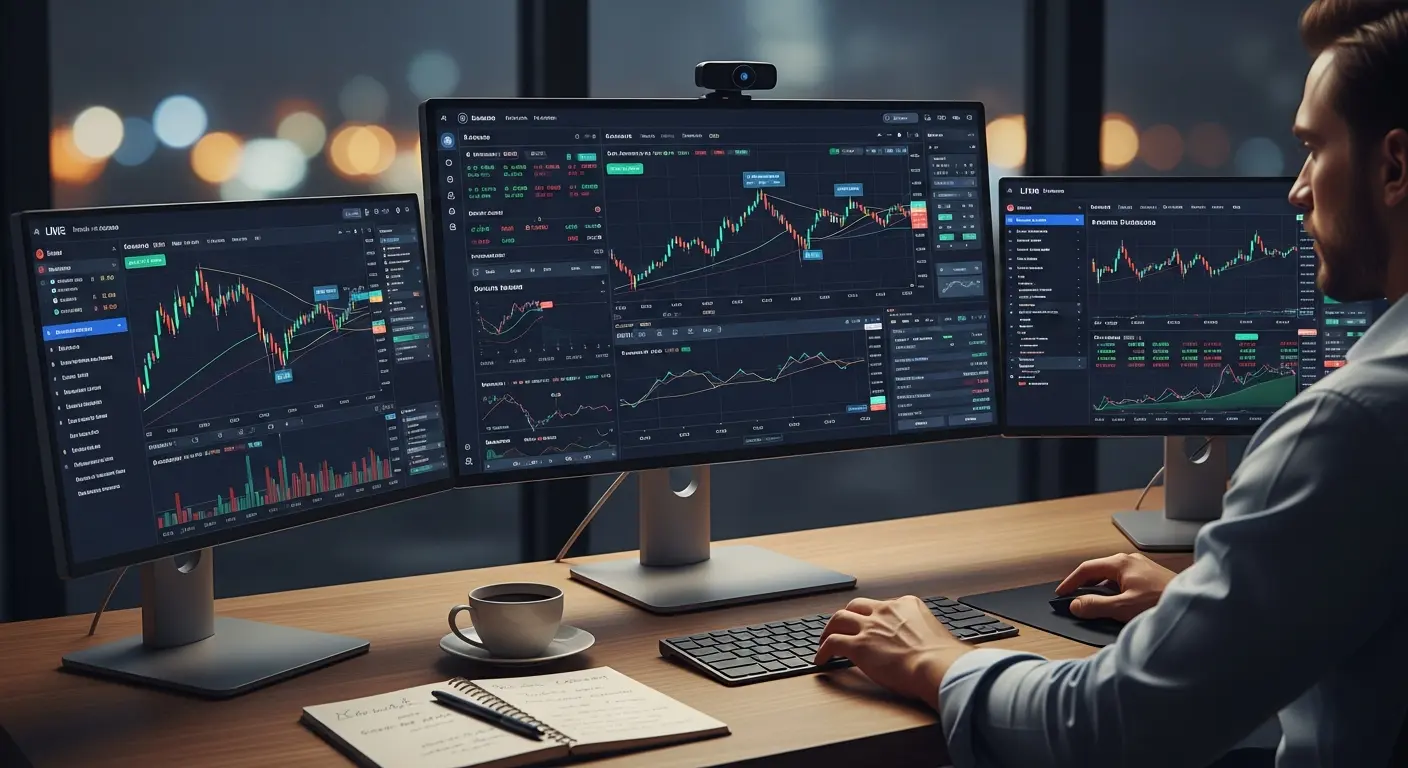
Artificial intelligence has revolutionized how individuals and institutions trade stocks. AI-powered trading platforms analyze millions of data points in seconds, identify patterns humans miss, and execute trades with precision timing that was previously impossible.
AI Transforms Stock Trading
AI-powered trading platforms analyze millions of data points in seconds, identify patterns humans miss, and execute trades with precision timing that was previously impossible.
Market Reality: Professional traders using AI platforms report 15-30% improvement in returns compared to manual trading, with significantly reduced emotional decision-making and faster reaction to market changes.
Top AI Stock Trading Platforms
1. Trade Ideas
What It Does: Real-time AI-powered stock scanner that identifies trading opportunities based on technical patterns and market data.
Key Features:
- Holly AI (artificial intelligence engine) for trade signals
- Real-time stock scanning across all US markets
- Backtesting with historical data
- Automated strategy optimization
- Risk management tools
Best For: Active day traders, swing traders, technical analysts Pricing: Starting at $118/month Performance: Claims 66% win rate on AI-selected trades
Pro Tip: Use Holly AI's "Top 3" feature for daily high-probability trade ideas verified by AI analysis.
2. TrendSpider
What It Does: All-in-one technical analysis platform with AI-powered pattern recognition and automated trendline drawing.
Key Features:
- Automated trendline and pattern recognition
- Multi-timeframe analysis
- Dynamic price alerts
- AI-powered chart patterns
- Backtesting and strategy optimization
Best For: Technical traders, chart analysts, swing traders Pricing: Starting at $49/month Time Saved: 10-15 hours/week on chart analysis
Standout Feature: Automatically identifies and draws trendlines across multiple timeframes simultaneously.
3. Kavout (K Score AI)
What It Does: Uses machine learning to rank stocks with a proprietary "K Score" that predicts stock performance.
Key Features:
- AI-driven stock ranking (K Score 1-9)
- Pattern recognition across 200+ factors
- Portfolio optimization
- Risk analysis
- ETF and mutual fund scoring
Best For: Long-term investors, portfolio managers Pricing: Free basic | Premium from $29.95/month Historical Performance: Top-ranked stocks (K Score 9) historically outperform S&P 500 by 20-30% annually
4. Tickeron
What It Does: AI-powered platform offering trade signals, pattern recognition, and automated trading robots.
Key Features:
- AI pattern recognition for stocks, forex, crypto
- Automated trading bots
- Real-time confidence indicators
- Portfolio backtesting
- Technical and fundamental analysis
Best For: Diverse traders (stocks, forex, crypto), algo traders Pricing: Plans from $59/month to $99/month Accuracy: Claims 70-80% confidence rate on pattern predictions
5. Robinhood (with AI Features)
What It Does: Commission-free trading app with growing AI-powered features for retail investors.
Key Features:
- Commission-free trades
- AI-driven market insights
- Personalized news feed
- Pattern day trading tools
- Fractional shares
Best For: Beginner investors, casual traders Pricing: Free basic | Robinhood Gold at $5/month Accessibility: Simple, mobile-first design
Note: While not purely AI-focused, Robinhood increasingly incorporates AI for insights and recommendations.
6. Composer
What It Does: No-code platform for building, backtesting, and deploying automated trading strategies using AI.
Key Features:
- Visual strategy builder (no coding required)
- AI-assisted strategy creation
- Backtesting with historical data
- Automated execution
- Pre-built strategy templates
Best For: Investors wanting automated strategies without coding Pricing: Free basic | Pro from $19/month Standout: Democratizes algorithmic trading for non-programmers
7. Magnifi
What It Does: AI investment assistant that uses natural language processing to help you find and invest in stocks, ETFs, and funds.
Key Features:
- Natural language search ("clean energy stocks with low P/E")
- AI-powered portfolio recommendations
- Thematic investing suggestions
- Performance analysis
- Integration with major brokerages
Best For: Thematic investors, beginners, conversational investing Pricing: Free tier | Premium features available Innovation: Ask questions like "tech stocks that are undervalued" and get AI-curated lists
8. Stock Rover
What It Does: Comprehensive research platform with AI-powered screening, analysis, and portfolio management.
Key Features:
- Advanced stock screening (600+ metrics)
- AI-driven alerts and signals
- Portfolio analysis and grading
- Research reports
- Comparison tools
Best For: Fundamental investors, value investors, portfolio analysis Pricing: Free basic | Premium from $7.99/month to $27.99/month Depth: One of the most comprehensive fundamental analysis platforms available
AI Trading Strategies & Applications
Day Trading with AI
Best Tools: Trade Ideas, TrendSpider AI Applications:
- Real-time pattern recognition
- Volume and price action analysis
- News sentiment analysis
- Momentum indicators
- Risk-reward calculation
Time Advantage: AI identifies setups in milliseconds vs minutes/hours for humans
Swing Trading with AI
Best Tools: Tickeron, TrendSpider, Kavout AI Applications:
- Multi-day pattern recognition
- Support/resistance identification
- Breakout predictions
- Sector rotation analysis
Performance Edge: 20-40% better timing on entries and exits
Long-Term Investing with AI
Best Tools: Kavout, Stock Rover, Magnifi AI Applications:
- Fundamental analysis at scale
- Valuation modeling
- Growth trajectory prediction
- Portfolio optimization
- Risk assessment
Benefit: Analyze 1000+ stocks in minutes vs weeks manually
Robo-Advisors (Passive AI Investing)
Popular Platforms:
- Betterment: AI-powered portfolio management and tax-loss harvesting
- Wealthfront: Automated investing with AI optimization
- M1 Finance: AI-assisted portfolio pie building and rebalancing
Best For: Hands-off investors, retirement accounts Typical Fees: 0.25-0.50% annually Performance: Generally match or slightly beat market indexes
How AI Improves Trading
Pattern Recognition
AI analyzes millions of chart patterns and identifies profitable setups with statistical confidence levels.
Human Limitation: Can track 10-20 patterns across 5-10 stocks AI Capability: Tracks 200+ patterns across 8,000+ stocks simultaneously
Emotion Elimination
AI executes trades based purely on data and predefined rules, eliminating fear, greed, and other emotional biases.
Impact: 40-60% of losses in retail trading come from emotional decisions. AI removes this factor entirely.
Speed and Timing
AI reacts to market changes in milliseconds, capturing opportunities that disappear before humans notice.
Example: AI detects breakout at 9:30:01 AM, executes trade. Human notices at 9:30:45 AM, opportunity missed.
Data Processing
AI analyzes news sentiment, social media trends, financial reports, and technical data simultaneously.
Data Volume: AI processes 100,000+ data points per stock daily vs 10-50 for human analysts
Backtesting
AI tests strategies across decades of historical data in minutes, optimizing for maximum returns.
Value: Identify what would have worked (and what wouldn't) before risking real money
Frequently Asked Questions
Q: Can AI guarantee profitable trades? A: No. AI improves probability of success but cannot guarantee profits. Markets are inherently unpredictable, and past patterns don't always predict future performance. Expect 60-75% win rates with proper AI tools, not 100%.
Q: Do I need to be a programmer to use AI trading platforms? A: Not anymore. Modern platforms like Composer, Tickeron, and Trade Ideas offer visual interfaces and no-code solutions. Basic computer literacy is sufficient.
Q: How much money do I need to start AI trading? A: Minimums vary: Day trading typically requires $25,000 (PDT rule). Long-term investing can start with as little as $100 using fractional shares and robo-advisors.
Q: Are AI trading platforms regulated? A: The platforms themselves are tools. You still trade through regulated brokerages (TD Ameritrade, Interactive Brokers, etc.). Always use platforms that connect to regulated brokers.
Q: Can AI predict market crashes? A: AI can identify elevated risk levels and unusual patterns but cannot predict exact timing of crashes. Most AI platforms include risk management features to protect against significant drawdowns.
Q: What's the difference between AI trading and algorithmic trading? A: Algorithmic trading follows pre-programmed rules. AI trading uses machine learning to adapt and improve strategies based on new data. AI is more dynamic and self-improving.
Risk Management with AI
Stop Loss Automation
AI platforms automatically set and adjust stop losses based on volatility and risk tolerance.
Benefit: Prevents catastrophic losses from single trades
Position Sizing
AI calculates optimal position sizes based on portfolio size, risk tolerance, and trade probability.
Rule of Thumb: Never risk more than 1-2% of portfolio on single trade
Portfolio Diversification
AI ensures your portfolio isn't overconcentrated in single sectors or correlated assets.
AI Advantage: Analyzes correlation matrices across 100+ positions instantly
Volatility Monitoring
AI adjusts trading frequency and position sizes based on current market volatility.
Adaptation: Reduces exposure during high volatility, increases during stable markets
Cost-Benefit Analysis
Traditional Trading (Manual):
- Research time: 10-15 hours/week
- Analysis paralysis and missed opportunities
- Emotional trading losses: 10-20% annually
- No backtesting capability
- Opportunity cost: Massive
AI-Assisted Trading:
- Platform cost: $50-200/month
- Research time: 2-4 hours/week (reduced 70%)
- Emotion-free execution
- Historical backtesting on all strategies
- 15-30% better returns on average
- ROI: Positive within 1-3 months for most traders
Example: $50/month platform fee on a $25,000 portfolio needs only 0.24% additional annual returns to break even (typically achieved in first month)
Implementation Strategy
Week 1: Education
- Take free trials of 2-3 platforms
- Watch tutorial videos
- Paper trade (simulated) to learn interface
- Join platform communities
Week 2-4: Testing
- Start with small position sizes
- Follow AI signals closely
- Track results vs your manual picks
- Adjust strategies based on performance
Month 2-3: Scaling
- Increase position sizes gradually
- Combine multiple AI signals
- Develop personal trading rules
- Optimize for your risk tolerance
Month 4+: Optimization
- Focus on highest-performing strategies
- Automate routine trades
- Spend time on high-level portfolio decisions
- Continuous learning and adaptation
Best Practices
Do's:
- ✅ Start with paper trading
- ✅ Diversify across multiple AI signals
- ✅ Maintain strict risk management
- ✅ Review and learn from all trades
- ✅ Use AI as a tool, not a guarantee
- ✅ Keep emotions out of trading decisions
Don'ts:
- ❌ Invest money you can't afford to lose
- ❌ Blindly follow AI without understanding
- ❌ Over-leverage positions
- ❌ Ignore risk management rules
- ❌ Chase losses with bigger bets
- ❌ Expect overnight wealth
Regulatory Considerations
U.S. Regulations:
- Pattern Day Trader (PDT) rule: $25,000 minimum for day trading
- SEC oversight of all brokerage activities
- FINRA regulations on algorithmic trading
Tax Implications:
- Short-term gains taxed as ordinary income
- Long-term gains (>1 year) taxed at preferential rates
- AI platforms often include tax-loss harvesting features
Consult: Always consult with tax professional and financial advisor before significant trading activity.
Conclusion
AI stock trading platforms have democratized access to sophisticated analysis and execution that was once exclusive to hedge funds and institutional traders. While no tool guarantees profits, AI significantly improves your probability of success by eliminating emotional decisions, processing vast amounts of data, and executing with perfect discipline.
Your Action Plan:
- This Week: Sign up for free trials of Trade Ideas and TrendSpider
- Week 2: Paper trade with AI signals to learn without risk
- Month 2: Start with small real positions using proven strategies
- Quarter 2: Scale up based on documented performance
The most successful retail traders in 2026 are those leveraging AI to level the playing field against institutions. Start your AI trading journey today with education, testing, and disciplined execution.
Important Disclaimer: This content is for educational purposes only and not financial advice. All investing involves risk. Past performance does not guarantee future results. Consult a licensed financial advisor before making investment decisions.
Related Resources:
Compare All AI Trading & FinTech Platforms
The FinTech AI Terminal ranks QuantConnect, Kensho, Alpaca, Polygon.io, and 26 more financial AI tools across algo trading, fraud detection, KYC/AML, and credit risk — with AI scoring and head-to-head comparisons.
Open FinTech AI Terminal →Tags
Written by

Sourabh Gupta
Founder & Data Scientist, AI Tools Specialist · 2+ years in AI/ML
Sourabh tests every AI tool he writes about — hands-on, with real use cases. His background in data science means he goes beyond marketing claims to benchmark actual performance, cost, and reliability for developers and creators.
Full bio & editorial process →