The Ultimate Guide to AI Virtual Event Platforms in 2026
Editorial note: Some links in this article are affiliate links — we may earn a commission if you sign up, at no extra cost to you. Every tool is independently tested by our team before being recommended. Read our editorial standards →
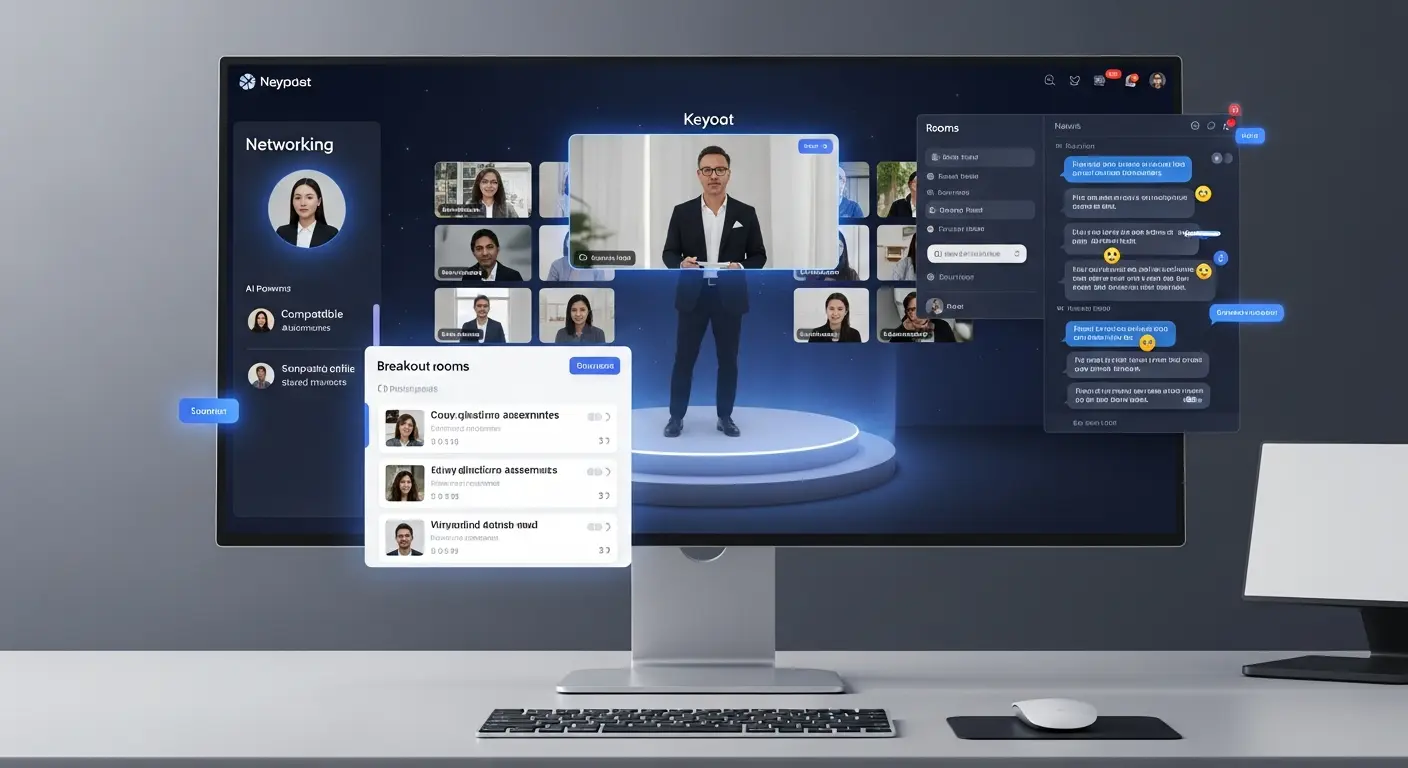
A virtual event platform is not valuable because it has more features; it is valuable when it helps a team create useful conversations before, during, and after an event. For B2B teams, that usually means registration quality, audience engagement, reliable production, and a clean handoff to sales or community teams.
This guide compares platforms by those outcomes rather than by feature-count alone.
The Data Science Behind Modern Virtual Events
As a data scientist, I find the backend of these new platforms fascinating. To understand why these tools are so effective at driving sales pipeline, you have to understand the algorithms powering them. Modern event platforms rely on three core pillars of Artificial Intelligence:
1. Natural Language Processing (NLP) & Real-Time Sentiment Analysis
In the past, the only way to know if your audience was engaged was to look at the drop-off rate. Today, NLP algorithms analyze the event's live chat, Q&A submissions, and even virtual reaction emojis in real-time. The AI categorizes audience sentiment (confused, excited, bored) and feeds a live "Engagement Score" to the speaker's dashboard. Furthermore, NLP enables instant, highly accurate live translation in over 50 languages, instantly globalizing your total addressable market.
2. Collaborative Filtering for Smart Networking
The biggest complaint about virtual events used to be the lack of networking. You couldn't just "bump into" a potential client at the coffee station. Today, event platforms use collaborative filtering — the exact same machine learning architecture that Netflix uses to recommend movies. By analyzing a user's LinkedIn profile, their registration questionnaire, and the sessions they attend, the AI actively suggests high-value 1-on-1 video networking matches, pushing people together who share mutual business interests.
3. Generative AI for Content Repurposing
An hour-long webinar generates thousands of words of spoken content. Historically, it took a video editor and a copywriter a week to turn that into usable marketing collateral. In 2026, Generative AI models instantly transcribe the audio, identify the highest-engagement moments of the speech, and autonomously generate bite-sized branded video clips for LinkedIn, alongside drafted blog posts and follow-up email sequences.
Quick Comparison: Top AI Event Platforms of 2026
| Platform | Best For | Standout AI Feature | Starting Price |
|---|---|---|---|
| Goldcast | B2B SaaS Marketers | Automated video clipping & CRM integration | Custom / Enterprise |
| RingCentral Events | Large Virtual Conferences | Collaborative filtering AI networking | $750/year |
| Bizzabo | Hybrid Events (Live/Digital) | AI attendee behavioral analytics | Custom |
| Zoom Events | Corporate Town Halls | AI Companion (real-time summaries) | $149/mo |
| HeyGen | Asynchronous Webinars | Multilingual generative AI avatar hosts | $29/mo |
| Cvent AI | Enterprise Event Teams | Predictive attendee forecasting | Custom |
| vFairs | Virtual Trade Shows | 3D environments with NLP chatbots | $1,500/event |
Deep Dive: The 7 Best AI Virtual Event Platforms
1. Goldcast (The Gold Standard for B2B Demand Gen)
- Target Audience: B2B SaaS companies, Demand Generation Marketers, RevOps teams
- The Tech: Goldcast was built specifically for marketers who want to turn events into revenue pipelines. It isn't just an event tool; it's an intent-data engine.
- How the AI Works: Goldcast's biggest superpower is its post-event generative AI engine. The moment your webinar ends, its algorithms scan the transcript to find the most highly engaged moments based on audience retention spikes. It autonomously generates TikTok/LinkedIn-ready video clips, drafts summary blog posts, and writes personalized follow-up email sequences. It also scores every attendee based on engagement and pushes that "AI Intent Score" directly into Salesforce or HubSpot.
- The ROI: Replaces the need for a dedicated post-event video editor and copywriter, saving an estimated $3,000+ per event.
2. RingCentral Events (Best for Massive Virtual Conferences)
- Target Audience: Associations, Media Companies, and Large-Scale Summits
- The Tech: Formerly known as Hopin, RingCentral Events has rebuilt its architecture around connection. It handles multi-day, multi-stage digital conferences seamlessly.
- How the AI Works: It solves the digital networking problem. Using collaborative filtering algorithms, the AI analyzes attendee data to suggest high-value 1-on-1 video networking matches. It also features AI-driven dynamic ticketing, which adjusts ticket prices based on predictive demand and historical purchasing patterns to maximize event revenue.
3. Bizzabo (Best for Hybrid Event Experiences)
- Target Audience: Global enterprises running simultaneous in-person and digital broadcasts
- The Tech: Bizzabo refers to its platform as the "Event Experience OS." It is uniquely positioned to bridge the physical and digital divide.
- How the AI Works: For hybrid events, Bizzabo combines digital interaction data with physical tracking via smart wearable badges for in-person attendees. The AI aggregates this data to give organizers a real-time "event health" score. If it detects that digital attendees are dropping off while in-person engagement is high, it alerts the digital moderator to launch an interactive poll to win back online attention.
4. Zoom Events with AI Companion (Best for Corporate Webinars)
- Target Audience: Internal corporate communications, standard product demos, HR town halls
- The Tech: This is a massive leap from a standard Zoom Meeting. Zoom Events is a dedicated platform heavily fortified by the "Zoom AI Companion."
- How the AI Works: The AI Companion acts as a silent, automated co-host. If an attendee joins 15 minutes late, they can privately ask the AI "What did I miss?" and receive a real-time summary of the speaker's points. The AI also auto-categorizes and prioritizes the public Q&A section, grouping similar questions so the speaker doesn't waste time repeating answers.
5. HeyGen (Best for Asynchronous & Evergreen Content)
- Target Audience: Global product marketers, customer success trainers
- The Tech: While not a traditional live webinar platform, HeyGen's generative AI video technology is completely changing how on-demand events are hosted.
- How the AI Works: You can train a highly realistic AI avatar of your company's CEO or Head of Product. For a global product launch, feed a single English script into HeyGen. The AI generates a hyper-realistic video of your host delivering that keynote in perfect Spanish, Mandarin, German, and French — complete with accurate, culturally appropriate lip-syncing and hand gestures.
6. Cvent AI (Best for Predictive Event Management)
- Target Audience: Dedicated event planning agencies and enterprise event managers
- The Tech: Cvent is the legacy giant of the event space, but their 2026 AI integrations focus heavily on logistics and predictive modeling.
- How the AI Works: Cvent uses AI for predictive attendance forecasting. By analyzing years of historical event data, seasonal trends, and current registration velocity, the AI can predict your final attendee count with stunning accuracy weeks in advance. It also features an AI writing assistant specifically trained to write high-converting event landing pages, speaker bios, and promotional emails.
7. vFairs (Best for Virtual Trade Shows & Career Fairs)
- Target Audience: Universities, job fairs, and industry trade shows
- The Tech: vFairs creates immersive, visually driven 3D digital environments rather than just standard video feeds.
- How the AI Works: In 2026, navigating a 3D digital trade show can be overwhelming. vFairs deploys highly intelligent NLP chatbots at the "entrance" of the virtual hall. An attendee can tell the bot, "I am looking for cybersecurity software vendors who specialize in healthcare," and the AI generates a custom 3D map routing them to the exact virtual booths that match their query.
The 3-Step Workflow for AI-Driven Event Marketing
Phase 1: Pre-Event AI Promotion
Stop guessing what email subject lines will drive registrations. Use generative AI tools combined with your CRM data to write hyper-personalized invites.
Actionable Tip: Segment your email list by industry. Have the AI generate 5 different versions of your event landing page copy, tailoring the value proposition specifically to Healthcare, Finance, Tech, etc. AI-driven personalization at the promotion stage can increase registration rates by up to 35%.
Phase 2: Live AI Moderation & Engagement
During the event, human moderators should not be busy approving chat messages or answering technical support questions.
Actionable Tip: Deploy an AI chatbot in your event lobby to handle all tier-1 support tickets (e.g., "I can't hear the audio," "Where are the slides?"). Use the platform's AI sentiment analysis to trigger dynamic polls. If the AI detects engagement dropping below 60%, immediately launch an interactive prompt to pull the audience back in.
Phase 3: Post-Event Pipeline Orchestration
This is where AI proves its ROI. The moment the event ends, human intervention should be minimal.
Actionable Tip: Ensure your event platform (like Goldcast) is tightly integrated with your CRM (Salesforce/HubSpot). Set up automation rules so that any attendee with an "AI Engagement Score" of 85 or higher is instantly routed to an SDR with an auto-drafted email referencing the specific poll they answered during the event.
Measuring ROI: Metrics That Matter in 2026
Historically, marketers measured event success by two vanity metrics: total registrants and live attendance rate. In the age of AI, those metrics are largely obsolete. Track these AI-enabled metrics instead:
- Active Engagement Minutes (AEM): How many minutes was the event tab actually the primary focus on the user's screen? AI platforms track tab visibility to give you real attention metrics.
- AI Content Yield: Track how many individual pieces of collateral (short-form videos, blog posts, social graphics) were generated by the AI from a single 60-minute session. Calculate the freelance cost of creating those manually to prove immediate software ROI.
- Pipeline Velocity: Because AI lead scoring allows SDRs to contact the hottest leads within minutes of the event ending (rather than waiting days for a manual list upload), measure how much faster event-sourced leads move from "Meeting Booked" to "Closed Won" compared to inbound web leads.
Frequently Asked Questions
Q: Are virtual events really as effective as in-person for B2B sales?
Yes, if tracked correctly. While physical, in-person events are exceptional for closing late-stage deals and building deep trust, AI virtual platforms are unparalleled for top-of-funnel lead generation and data collection. You get exact, granular data on how long someone watched, which questions they asked, and what files they downloaded — data points you simply cannot reliably capture from a crowded physical convention floor.
Q: How much do enterprise AI virtual event platforms actually cost?
Pricing models have shifted. Basic webinar platforms start around $100–$150/month. However, for true AI-driven platforms with CRM integration and generative content features (like Goldcast or Bizzabo), expect custom enterprise pricing ranging from $10,000 to $30,000+ annually, depending on your total registrant volume and CRM complexity.
Q: Will AI avatars replace human speakers?
For live, interactive Q&A and thought leadership, human speakers remain essential to build authentic trust. However, for evergreen content, product update tutorials, and asynchronous training videos, highly realistic AI avatars (like those from HeyGen) will absolutely become the industry standard by 2027 due to their cost efficiency and multilingual scaling capabilities.
Q: Do I need a technical background to set up these AI platforms?
No. The beauty of the 2026 SaaS landscape is that the AI operates invisibly in the background. Modern interfaces are drag-and-drop. If your marketing team can manage a HubSpot workflow or set up a Zoom meeting, they can learn to operate a high-end AI event platform within 1 to 2 weeks of onboarding.
Conclusion
The days of setting up a static streaming video link and hoping for the best are officially over. AI-powered virtual event platforms have transformed online gatherings from passive lectures into strategic, interactive data-gathering engines.
If you are a B2B SaaS company looking to rapidly drive sales pipeline and scale your content creation, platforms like Goldcast are currently the gold standard. If you are hosting a massive online summit and want to prioritize attendee connections and ticket sales, RingCentral Events will give your audience the best networking experience on the market.
Stop treating webinars as an administrative chore. Start treating them as the most data-rich, interactive assets in your marketing arsenal.
Tags
Written by

Sourabh Gupta
Founder & Data Scientist, AI Tools Specialist · 2+ years in AI/ML
Sourabh tests every AI tool he writes about — hands-on, with real use cases. His background in data science means he goes beyond marketing claims to benchmark actual performance, cost, and reliability for developers and creators.
Full bio & editorial process →