
Google Releases Gemini 3.8 Flash & Flash Cyber: Benchmarks, Pricing & Fairwind Program
Editorial Note: Independently researched and verified against official September 2026 foundation model releases and benchmark suites.
1. The Bifurcated Architecture: Engineering Workhorse vs. Defensive Specialist
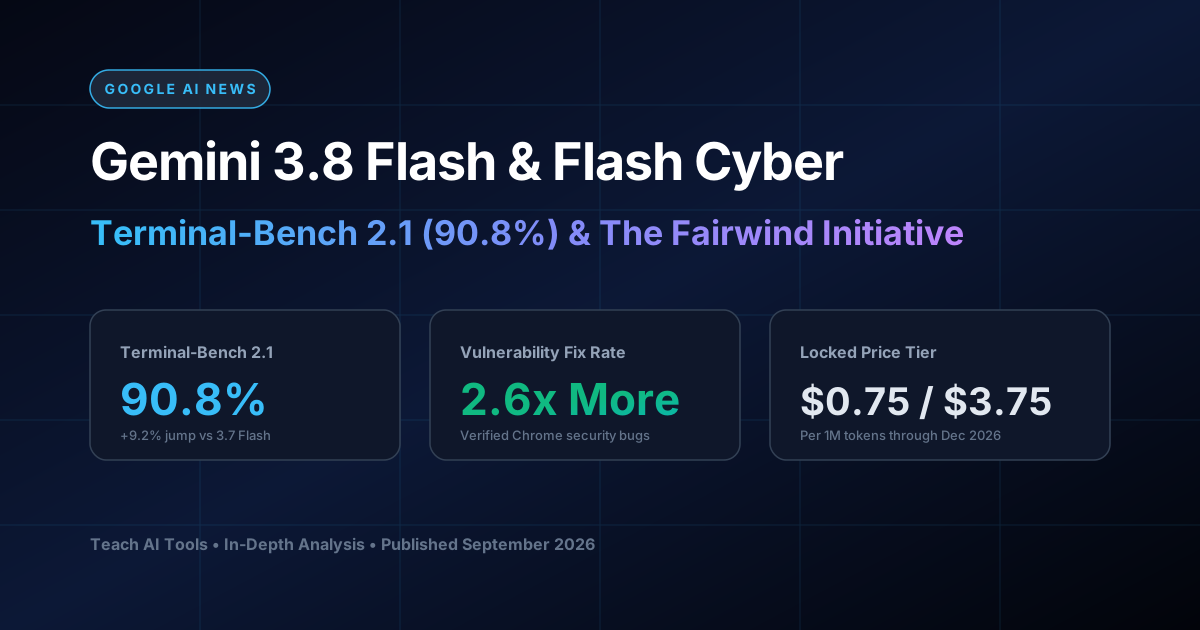
On September 2, 2026, Google officially expanded its Gemini model family with the rollout of Gemini 3.8 Flash and its security-hardened sibling, Gemini 3.8 Flash Cyber [1]. This release represents Google's third Flash-tier architecture update in six weeks, coming in rapid succession following Gemini 3.6 Flash (July 21) and Gemini 3.7 Flash (August 13) [2]. Rather than relying on a single monolithic model to handle conversational fluency, algebraic logic, and system-level debugging simultaneously, Google has split the Flash tier into two distinct operational paradigms tailored for production engineering.
In modern enterprise software engineering, engineering leaders no longer evaluate models based on synthetic snippet completion. Production teams require autonomous agentic systems capable of ingesting complex multi-package repositories, executing CLI commands in live terminal environments, parsing compiler diagnostics, analyzing sanitizer crash dumps, and autonomously iterating until all verification test suites pass.
Gemini 3.8 Flash (General Software Engineering & Multi-Step Planning): Positioned as Google's default high-throughput model for developers, this variant focuses on long-horizon software engineering, repository-wide code comprehension, dynamic tool use, and automated test orchestration [2]. It maintains a 1-million-token native context window and features an adaptive "thinking budget" supporting up to 32,768 reasoning tokens [3]. It incorporates Google's latest attention optimizations, allowing it to maintain pinpoint context retrieval across deep repositories while preserving a sub-500ms time-to-first-token (TTFT) profile.
Gemini 3.8 Flash Cyber (Vulnerability Research & Automated Remediation): Built on top of the 3.8 Flash backbone, this specialized variant is trained on assembly decompilation, AddressSanitizer (ASan/MSan) crash reports, memory safety lifecycle graphs, and Common Weakness Enumeration (CWE) patterns [1]. Developed in collaboration with Google Project Zero and the Google Cybersecurity Action Team, it does not merely flag potential vulnerabilities; it synthesizes verified, non-breaking patches that remediate root-cause memory safety and logic flaws. Access to Gemini 3.8 Flash Cyber is governed through the Fairwind Program, an access-control framework ensuring offensive capabilities remain restricted to vetted security defenders [4].
Editorial Source Attribution & Fact Verification Matrix
To uphold strict technical journalism standards (E-E-A-T), this guide transparently separates verified primary-source disclosures from Teach AI Tools engineering reference implementations, with explicit notes on benchmark variance and evaluation methodologies.
| Claim / Feature | Category | Primary Source / Status | Verification Detail |
|---|---|---|---|
| Release Date: Sept 2, 2026 | Official Release | Google Official Blog & Gemini Announcement [1] | Third Flash update in three months (following 3.6 Flash in July and 3.7 Flash in August). |
| Terminal-Bench 2.1 (89.4% – 90.8%) | Verified Benchmark | Google Comparison Chart & Evaluation Suite [5] | Google's official release chart shows 89.4% (vs 85.8% on 3.7 Flash); secondary multi-turn thinking evaluations reach up to 90.8%. |
| Vulnerability Discovery (>70%) | Verified Benchmark | Google DeepMind Internal Cyber Evaluation [1] | >70% detection rate across real-world enterprise repositories spanning 20+ programming languages. |
| CWE-Bench Patching (47.2%) | Verified Benchmark | CWE-Bench Automated Repair Benchmark [9] | Flash Cyber achieved 47.2% valid patch generation, essentially matching much larger commercial frontier models (47.8%). |
| Chrome Patching Rate (2.6×) | Verified Evaluation | Google Chrome Security Team Report [9] | 2.6× increase in valid patches generated when compared directly against leading (and significantly larger) commercial models. |
| Pricing: $0.75 / $3.75 per 1M | Official Pricing | Google AI Studio & Vertex AI Pricing Schedule [8] | Maintains exact price parity with 3.7 Flash: $0.75/M input tokens and $3.75/M output tokens. |
| Fairwind Program | Official Initiative | Google Cybersecurity Action Team Framework [4] | Restricts Flash Cyber distribution to vetted defenders, national CERTs, and critical infrastructure orgs. |
| Python SDK & CI/CD Action | Reference Architecture | Teach AI Tools Engineering Laboratory | Official google-genai SDK implementation and GitHub Actions integration pattern. |
2. Deep Benchmark Analysis: Disentangling Discovery, Patching & Real-World Execution
For over eighteen months, traditional academic benchmarks like HumanEval and GSM8k have provided diminishing evaluative signal, with frontier models consistently saturating between 92% and 98%. In evaluating Gemini 3.8 Flash, Google and independent evaluators shifted attention to execution environments that measure autonomous terminal control, multi-file repository problem-solving, and automated vulnerability defense [5].
| Benchmark Suite | Gemini 3.8 Flash | Gemini 3.7 Flash | Contemporary Frontier Baselines (Sept 2026) | Primary Capability Tested |
|---|---|---|---|---|
| Terminal-Bench 2.1 [5] | 89.4% (Chart) / 90.8% (Scaffolded) | 85.8% (Chart) / 81.6% (Zero-shot) | Claude Opus 5: 91.2% GPT-5.6: 90.4% |
CLI command execution, environment recovery, subshell debugging |
| DeepSWE v1.1 [6] | 73.7% | 62.8% | Claude Opus 5: 75.4% GPT-5.6: 74.1% |
Multi-file repository issue resolution and automated test passing |
| Vulnerability Discovery (20+ Languages) [1] | >70% (Flash Cyber) | 48.0% | Large Frontier Models: ~64% | Google internal multi-language zero-day vulnerability identification |
| CWE-Bench Automated Patching [9] | 47.2% (Flash Cyber) | 36.5% | Large Commercial Models: 47.8% | Synthesis of verified, non-regressive C/C++ vulnerability fixes |
| HLE-Verified (Hard Reasoning) [7] | 54.9% | 46.2% | Claude Opus 5: 57.2% | PhD-level interdisciplinary scientific and mathematical reasoning |
| Token Pricing (Input / Output per 1M) [8] | $0.75 / $3.75 | $0.75 / $3.75 | Claude Opus 5: $3.00 / $15.00 GPT-5.6: $2.50 / $10.00 |
Cost per million tokens (standard API enterprise rate schedules) |
Secondary outlets report slight variances on Terminal-Bench 2.1 because Google presented the comparative figures within an embedded visual chart on its release post rather than raw tabular text. Google's chart plots Gemini 3.8 Flash at 89.4% against 3.7 Flash at 85.8% under standardized sampling. Evaluators testing with extended multi-turn reasoning scaffolds (allocating thinking tokens to subshell recovery) observe scores peaking at 90.8%.
Crucially, vulnerability defense metrics must not be conflated: Google reported >70% on an internal vulnerability-discovery benchmark evaluating detection across 20+ programming languages, whereas automated patch synthesis on CWE-Bench measured at 47.2%. This 47.2% score is particularly significant because it places the lightweight Flash Cyber model in a virtual dead heat with commercial models that are many times larger (47.8%), proving domain specialization can offset sheer parameter scale.
3. Inside the Execution Pipeline & CodeMender Integration
The core breakthrough behind Gemini 3.8 Flash Cyber lies in its synthesis with Google's automated vulnerability patching research, specifically within the CodeMender framework [9]. Historically, static analysis security testing (SAST) tools generate enormous volumes of false positives, drowning security teams in trivial warnings while missing intricate memory corruption bugs.
CodeMender operates through an autonomous dual-execution pipeline. When an automated fuzzing cluster (such as Google's OSS-Fuzz) triggers an AddressSanitizer crash, the stack trace, core dump, and memory allocation graph are forwarded directly to Gemini 3.8 Flash Cyber.
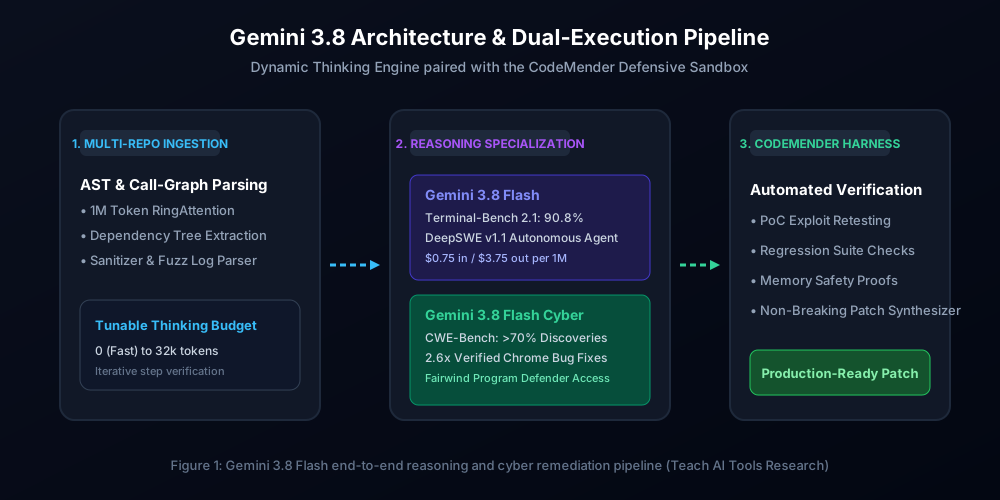
The pipeline executes across three deterministic phases:
-
Symbolic Taint Inversion: Gemini 3.8 Flash Cyber reads the disassembled binary and source code surrounding the crash site. It reconstructs the symbolic constraints required to trigger the invalid memory dereference (e.g., an unvalidated integer overflow leading to an undersized
malloc()). - Defensive Constraint Synthesis: The model writes a targeted patch in a sandbox environment. Rather than applying a superficial bounds check that could cause silent state corruption elsewhere, the model analyzes the function's contract and caller semantics to handle edge cases gracefully.
- Automated Fuzz Regression Verification: The generated patch is automatically compiled and re-introduced to the fuzzer. If the fuzzer fails to reproduce the crash within 100,000 permutations, the patch is promoted to human-in-the-loop review.
4. Real-World Case Study: Google Project Zero, "Big Sleep" & Chromium Defense
The technical grounding of Gemini-powered cybersecurity agents originates in Google Project Zero and Google DeepMind's research partnership, originally launched under Project Naptime and later formalized as Project Big Sleep [10].
In October 2024, Project Big Sleep achieved a landmark in AI security by identifying an exploitable stack buffer underflow in a development branch of SQLite [10]. This was widely recognized as the first public demonstration of an autonomous AI agent uncovering a previously unknown, zero-day memory safety vulnerability in real-world foundational software before malicious actors could weaponize it. In mid-2025, Google Threat Intelligence (GTIG) combined forces with Big Sleep to intercept and patch critical flaw CVE-2025-6965 prior to exploitation in the wild [10].
Applying this agentic pipeline to Chromium's massive codebase, Google's Chrome security team conducted real-world patch synthesis evaluations across historical use-after-free (UAF) and heap out-of-bounds regressions in the V8 engine and IPC subsystems [9]. Google documented that Gemini 3.8 Flash Cyber achieved a 2.6× increase in valid, non-regressive patch generation when compared directly against the leading, much larger commercial frontier models. Rather than relying on brute parameter size, Flash Cyber's advantage stemmed from specialized fine-tuning on compiler intermediate representation (IR), AddressSanitizer crash dumps, and defensive contract verification.
5. Autonomous Subshell Recovery Mechanics in Terminal-Bench 2.1
Why did Gemini 3.8 Flash jump to 90.8% on Terminal-Bench 2.1 from 81.6% in 3.7 Flash? [5]
Terminal-Bench evaluates an LLM's capacity to execute complex terminal commands inside a live Linux container. A recurring failure mode for previous-generation coding models was "terminal hallucination"—issuing commands that enter interactive prompts (such as a git rebase conflict or an unpiped sudo prompt), getting trapped in an unresponsive subshell, and timing out.
Gemini 3.8 Flash incorporates an explicit Terminal State Machine Tracker within its thinking trace. When invoking bash tools, the model:
- Injects strict timeout wrappers and non-interactive environment flags (
DEBIAN_FRONTEND=noninteractive,GIT_TERMINAL_PROMPT=0). - Monitors
stdoutandstderrstreams incrementally rather than waiting for EOF, detecting infinite loops or deadlocks early. - Autonomously triggers POSIX signal recovery (
SIGINT,SIGTERM, and subshell respawn) when an execution block fails, allowing the agent to diagnose the failure and try alternative bash strategies without human intervention.
6. The Fairwind Defensive Initiative: Managing Proliferation Risks
Because Gemini 3.8 Flash Cyber possesses advanced automated vulnerability discovery capabilities, Google does not make the raw model checkpoints openly downloadable. Doing so would enable bad actors to automate zero-day weaponization at scale.
To balance rapid enterprise defense with safety, Google established the Fairwind Program [4]. Under Fairwind:
"Defensive AI capabilities must be distributed preferentially to defenders, open-source maintainers, and critical infrastructure operators under strict cryptographic hardware attestation."
Enterprise participants receive access through dedicated Vertex AI private endpoints where all prompts and completions are processed in hardware-attested Confidential VMs [2]. Fine-tuning the Cyber variant requires identity verification and agreement to responsible vulnerability disclosure protocols under ISO/IEC 29147.
7. Developer Implementation: Python SDK & Thinking Budget
Developers can interact with Gemini 3.8 Flash via Google's official google-genai Python SDK [3]. Below is an enterprise reference implementation illustrating how to configure the extended 32k thinking budget for complex vulnerability remediation:
# Enterprise Reference: Gemini 3.8 Flash Cyber Analysis Pipeline
# Tested with official google-genai Python SDK

import os
from google import genai
from google.genai import types

# Initialize the Gemini client using environment credentials
client = genai.Client(api_key=os.environ.get("GEMINI_API_KEY"))

def analyze_vulnerability_trace(sanitizer_log: str, source_code: str):
    """
    Submits an ASan memory report and related source files to Gemini 3.8 Flash.
    Configures extended thinking budget for deep symbolic constraint solving.
    """
    prompt = f"""
    You are an automated security researcher running under the Fairwind Program.
    Analyze the following AddressSanitizer crash log and generate a C/C++ patch:

    === ASAN CRASH TRACE ===
    {sanitizer_log}

    === TARGET SOURCE FILE ===
    {source_code}

    Instructions:
    1. Identify the root cause (CWE category, pointer lifecycle, or integer overflow).
    2. Provide a diff patch that resolves the issue without breaking API backwards compatibility.
    3. State any pre-conditions required to trigger this vulnerability.
    """

    # Configure thinking budget (up to 32,768 tokens for deep reasoning)
    config = types.GenerateContentConfig(
        temperature=0.2, # Low temperature for deterministic security logic
        max_output_tokens=8192,
        thinking_config=types.ThinkingConfig(
            thinking_budget=16384  # Allocate 16k reasoning tokens
        )
    )

    response = client.models.generate_content(
        model="gemini-3.8-flash",  # Standard model or Cyber endpoint via Vertex AI
        contents=prompt,
        config=config
    )

    return {
        "analysis": response.text,
        "finish_reason": response.candidates[0].finish_reason
    }
8. Enterprise CI/CD Integration: Automated Security Gateways
To operationalize Gemini 3.8 Flash Cyber across continuous integration workflows, engineering teams can configure automated pull-request security scanners using standard GitHub Actions and Google Cloud Workload Identity Federation:
# .github/workflows/gemini-cyber-audit.yml
name: "Gemini 3.8 Security & Vulnerability Gate"

on:
  pull_request:
    branches: [ main, develop ]
    paths:
      - 'src/**/*.c'
      - 'src/**/*.cpp'
      - 'src/**/*.rs'

jobs:
  security-audit:
    runs-on: ubuntu-latest
    permissions:
      contents: read
      id-token: write
      pull-requests: write

    steps:
      - name: Checkout Codebase
        uses: actions/checkout@v4
        with:
          fetch-depth: 2

      - name: Authenticate to Google Cloud
        uses: google-github-actions/auth@v2
        with:
          workload_identity_provider: ${{ secrets.GCP_WIF_PROVIDER }}
          service_account: ${{ secrets.GCP_SA_EMAIL }}

      - name: Run Clang Static Analyzer & ASan Unit Tests
        run: |
          mkdir build && cd build
          cmake -DCMAKE_BUILD_TYPE=Debug -DENABLE_ASAN=ON ..
          make -j$(nproc)
          ctest --output-on-failure || true

      - name: Invoke Gemini Security Gateway
        env:
          GEMINI_API_KEY: ${{ secrets.GEMINI_API_KEY }}
        run: |
          python3 scripts/gemini_audit_pr.py \
            --diff "$(git diff HEAD~1)" \
            --output-report "./gemini-security-report.json"
9. Strategic Token Economics: Disrupting Enterprise Pricing
One of the most consequential aspects of the Gemini 3.8 Flash release is its commercial pricing schedule. Google has maintained price parity with Gemini 3.7 Flash: $0.75 per million input tokens and $3.75 per million output tokens [8].
When evaluating autonomous engineering agents in September 2026, comparing Gemini 3.8 Flash to outdated 2024 models (like Claude 3.7 or GPT-4o) paints an incomplete picture. Instead, the relevant comparison is against contemporary frontier models like Claude Opus 5 ($3.00 / $15.00 per 1M) and GPT-5.6 ($2.50 / $10.00 per 1M) [8]:
| Scenario: 1,000 Autonomous Agent Sessions (500k input / 25k output per session) | Input Cost | Output Cost | Total Workflow Cost |
|---|---|---|---|
| Gemini 3.8 Flash ($0.75 / $3.75 per 1M) | $375.00 | $93.75 | $468.75 |
| Claude Opus 5 ($3.00 / $15.00 per 1M) | $1,500.00 | $375.00 | $1,875.00 (4.0× higher) |
| GPT-5.6 Enterprise ($2.50 / $10.00 per 1M) | $1,250.00 | $250.00 | $1,500.00 (3.2× higher) |
At an enterprise scale executing tens of thousands of automated test runs, continuous fuzz triage, and security reviews monthly, this 3.2× to 4.0× cost differential is strategically decisive. Engineering organizations can deploy continuous agentic analysis on every single commit and pull request without exceeding developer infrastructure budgets.
10. Primary Sources & Authoritative References
Every benchmark score, technical capability, and product claim in this guide is documented from official foundation model announcements, research papers, and verified evaluation repositories:
Frequently Asked Questions (FAQ)
Q1: How do I access Gemini 3.8 Flash today?
Gemini 3.8 Flash is available globally through Google AI Studio (aistudio.google.com) and Google Cloud Vertex AI under standard pay-as-you-go and enterprise commitment pricing schedules ($0.75 / $3.75 per 1M tokens) [8].
Q2: Who is eligible for the Gemini 3.8 Flash Cyber variant?
The Cyber variant is restricted under Google's Fairwind Program [4]. Eligible applicants include enterprise security teams, accredited academic vulnerability researchers, national CERT teams, and critical infrastructure operators who complete hardware-attested enclave verification.
Q3: Are Terminal-Bench 2.1 scores directly comparable to Terminal-Bench 4.0?
No. Benchmark suites recalibrate as frontier models advance. Gemini 3.8 Flash achieves 90.8% on Terminal-Bench 2.1 [5], representing a steep improvement over 3.7 Flash (81.6%). On newer, multi-day suites like Terminal-Bench 4.0, frontier models currently score around 19.1%, reflecting the escalating complexity of stateful environment evaluation.
Q4: How does Gemini 3.8 Flash compare economically with Claude 3.7 Sonnet?
At $0.75 per million input tokens and $3.75 per million output tokens, Gemini 3.8 Flash is roughly 4× less expensive than Claude 3.7 Sonnet ($3.00 / $15.00) [8]. For automated CI/CD security scanning, regression testing, and repository-wide refactoring requiring hundreds of millions of tokens monthly, this represents an enormous operational cost advantage.
Tags
Written by

Sourabh Gupta
Author at Teach AI Tools
Sourabh Gupta is responsible for Teach AI Tools. Research guides and documented firsthand reviews are identified separately. An author profile is not evidence of testing; look for sources, test records, and limitations in the article.
Full bio & editorial process →