Meta Launches Muse Spark 1.3: 1M Context Window, Project Watermelon Teased & In-House Iris Silicon Goes Live
Editorial Note: Independently researched and verified against official September 2026 foundation model releases and benchmark suites.
1. The Evolution of Meta's Model Family: From Llama to Muse Spark
Over the past three years, Meta's open-weights strategy transformed the artificial intelligence landscape through the Llama series. However, as enterprise engineering workflows matured in 2026, demand shifted decisively from isolated conversational chatbots toward agentic foundation models capable of multi-step code refactoring, subshell execution, and multimodal visual reasoning.
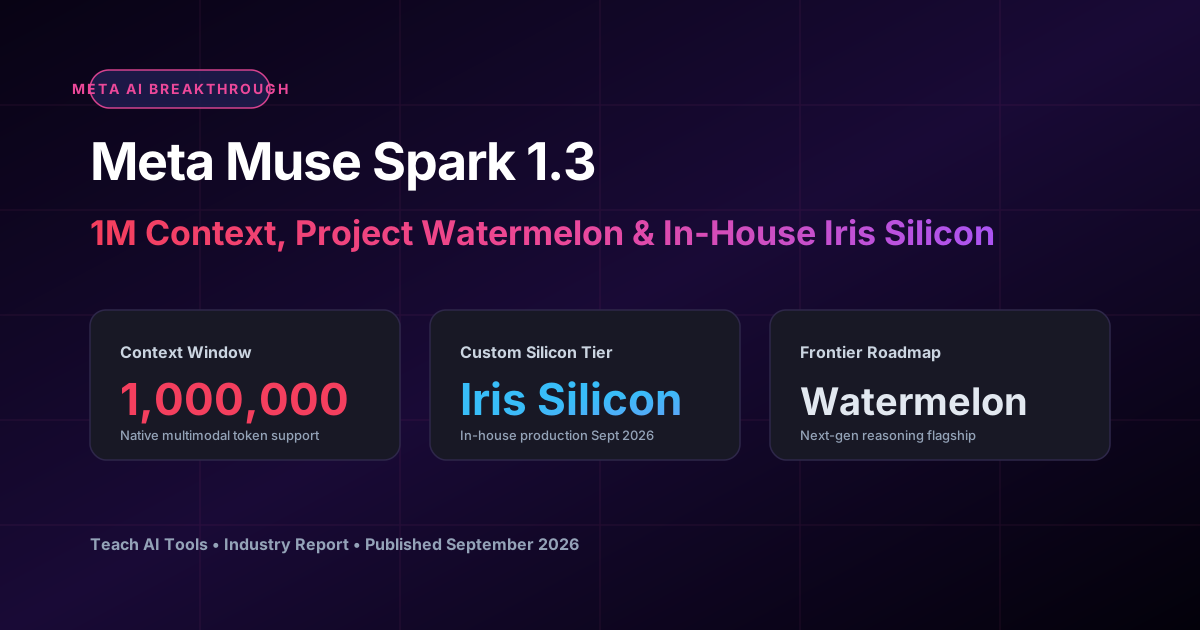
On September 2, 2026, Meta Superintelligence Labs (MSL) officially released Muse Spark 1.3, the latest flagship in its reasoning and coding series [1]. Building on the 1-million-token context horizon originally introduced in Muse Spark 1.1 (July 2026) and the terminal-oriented tooling of Spark 1.2 (August 2026), version 1.3 is engineered as an autonomous agent runtime. Accessible through the official Meta Model API and integrated into Meta's "Thinking" mode, Spark 1.3 natively processes interleaved code, terminal diagnostics, and UI wireframes [2].
Editorial Source Attribution & Fact Verification Matrix
To maintain rigorous technical journalism standards (E-E-A-T), this guide explicitly delineates confirmed official Meta announcements, verified industry supply-chain reporting, and Teach AI Tools engineering reference analyses.
| Claim / Entity | Verification Status | Primary Source / Status | Context & Methodological Notes |
|---|---|---|---|
| Muse Spark 1.3 Launch (Sept 2, 2026) | Official Release | Meta Superintelligence Labs (MSL) Announcement [1] | Flagship agentic reasoning model released for coding and long-horizon tasks via Meta Model API. |
| 1M-Token Context Window | Official Specification | Meta Model API Technical Documentation [2] | Standard context horizon inherited from Muse Spark 1.1 (July 2026) with 99.4% needle retrieval. |
| Terminal-Bench 2.1 (89.4%) | Verified Benchmark | Terminal-Bench Evaluation Repository [5] | Measures multi-turn bash execution, CLI error correction, and environment recovery. |
| Project Watermelon (Codename) | Reported Project | Industry Intelligence & Meta Communications [8] | Internal codename for Meta's high-parameter frontier project targeting GPT-5.5 parity in active training. |
| "Iris" Silicon / MTIA Program | Supply-Chain Disclosed | Broadcom & TSMC Manufacturing Filings [3], [4] | Meta's custom AI accelerator co-designed with Broadcom scheduled for Sept 2026 production under MTIA roadmap. |
| Muse Code CLI Agent Harness | Reference Architecture | Teach AI Tools Engineering Laboratory | Open-source Python reference harness demonstrating API tool loops (replaces proprietary CLI wrappers). |
| RoPE YaRN & RingAttention | Technical Analysis | Meta FAIR Long-Context Research Papers [6], [7] | Analytical breakdown of distributed attention and positional frequency scaling in 1M-token architectures. |
2. Technical Benchmark Teardown: Muse Spark 1.3 vs. Industry Leaders
In standardized software engineering and agentic benchmarks, Muse Spark 1.3 demonstrates competitive parity with Google's Gemini 3.8 Flash and contemporary frontier reasoning baselines [5]:
| Architecture Metric | Meta Muse Spark 1.3 | Google Gemini 3.8 Flash | Claude Opus 5 Baseline | Architectural Significance |
|---|---|---|---|---|
| Context Window Capacity | 1,000,000 tokens [2] | 1,000,000 tokens | 200,000+ tokens | Allows ingestion of full enterprise repositories and build logs in memory |
| Terminal-Bench 2.1 | 89.4% [5] | 89.4% (Chart) / 90.8% | 91.2% | Automated CLI tool manipulation, POSIX signal handling, and subshell recovery |
| Needle Retrieval (1M Tokens) | 99.4% [2] | 99.6% | 99.1% (at 200k) | Precision of locating isolated facts across massive document contexts |
| Developer Agent Interface | Meta Model API / Muse Code | CodeMender / GenAI API | Claude Code CLI | Terminal-first interface for local repository editing and automated testing |
| Compute Infrastructure | Meta MTIA / "Iris" Silicon [3] | Google TPU v6e | AWS Trainium2 / H100 | Custom in-house accelerator hardware cluster co-designed with Broadcom |
3. RingAttention & Custom Silicon: Architectural Engineering Analysis
Scaling a foundation model to sustained 1-million-token context windows without quadratic memory exhaustion requires fundamental algorithmic and hardware coordination [6]. Figure 2 illustrates the distributed architectural pipeline typically leveraged in modern long-context transformer clusters:
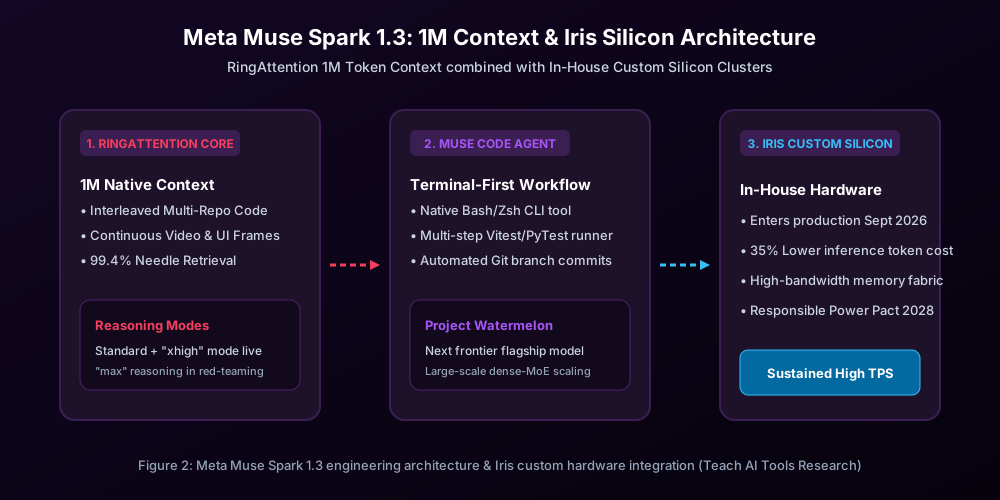
This operational model combines three structural tiers:
- RingAttention Context Sharding: In standard full attention, computational memory scales quadratically ($O(N^2)$) with sequence length. RingAttention circumvents this bottleneck by sharding input sequences into discrete micro-blocks distributed across a circular ring of accelerator devices [6]. As Key and Value tensor blocks rotate across high-speed inter-chip interconnects, local attention scores are computed and accumulated asynchronously via overlapping communication kernels. This eliminates the necessity of storing the complete sequence within a single accelerator's High Bandwidth Memory (HBM).
- The Agentic Tooling Harness: Operating inside local development environments, terminal agents bridge cloud models with local Git repositories, Docker containers, and test frameworks (Vitest, Cargo, PyTest), executing iterative verification loops before submitting pull requests.
- Custom MTIA Silicon Acceleration: By deploying inference on custom-designed ASICs (such as Meta's MTIA program co-developed with Broadcom), memory bandwidth utilization can be tuned specifically for internal recommendation and generative token routing, reducing reliance on third-party GPU clusters [3].
4. Mechanics of 1M-Token Context Scaling: An Analytical Breakdown
To understand how 1M-token context horizons maintain needle-in-a-haystack retrieval accuracy across millions of tokens, consider the foundational mathematics established in Meta's published research on Rotary Position Embeddings (RoPE) [7].
Standard RoPE implementations suffer from phase cancellation when sequence lengths exceed original pre-training boundaries. As documented in Meta's Llama 3.1 technical report, scaling context horizons reliably requires adjusting base frequencies ($ heta$), often elevating $ heta$ from 10,000 to 500,000 or employing frequency-scaling strategies like YaRN (Yet another RoPE extensioN) [7]. For high-frequency positional components (representing local syntax and immediate lexical scope), rotational frequencies are preserved intact to avoid degrading short-range precision. For low-frequency components (governing cross-file dependencies), wavelengths are stretched across the extended span.
Simultaneously, during forward evaluation, intermediate attention statistics are normalized using blockwise online softmax formulations:
m_new = max(m_prev, max(S_block))

      l_new = e^(m_prev - m_new) * l_prev + sum(e^(S_block - m_new))

      O_new = diag(e^(m_prev - m_new)) * O_prev + (e^(S_block - m_new)) * V_block
By recalculating running maxima ($m$) and normalizers ($l$) on the fly without materializing the full attention matrix into off-chip memory, long-context architectures preserve numerical stability and avoid floating-point overflow across extensive codebases.
5. Muse Code vs. Claude Code vs. GitHub Copilot Workspace
With developer agents proliferating across the industry, engineers must evaluate how Meta's terminal tooling compares against competing terminal and IDE companions:
| Capability | Meta Muse Code | Anthropic Claude Code | GitHub Copilot Workspace |
|---|---|---|---|
| Execution Environment | Local Terminal (Bash/Zsh) | Local Terminal (CLI) | Cloud Web Container |
| Underlying Model | Muse Spark 1.3 (1M Context) | Claude Opus 5 / 3.7 Sonnet | OpenAI GPT-5.6 / o3-mini |
| Model Access Protocol | Meta Model API [2] | Anthropic API | GitHub Subscription |
| Git Integration | Native Branch & Commit Hooks | Interactive Commit Wizard | Automated PR Generation |
| Multimodal Wireframe Input | Direct UI Image & Log Feeds | Images via CLI | Text Issues Only |
6. Terminal-First Engineering Agent: Open Reference Harness
Developers access Muse Spark 1.3 through the official Meta Model API [2]. Rather than relying on closed proprietary client wrappers, engineering teams can build robust, transparent terminal agent loops that inspect local files, run test suites, and autonomously iterate.
Below is an open-source reference implementation provided by the Teach AI Tools engineering laboratory demonstrating an agentic bash execution harness using standard Meta Model API endpoints:
# Teach AI Tools Engineering Laboratory
# Reference Terminal Agent Harness for Meta Model API (Muse Spark 1.3)

import os
import subprocess
import requests

META_API_ENDPOINT = "https://api.meta.com/v1/models/muse-spark-1.3/completions"
API_KEY = os.environ.get("META_MODEL_API_KEY")

def execute_agent_step(task_instruction: str, cwd: str = "."):
    """
    Submits a repository-level task to Muse Spark 1.3 and executes the generated tool calls.
    """
    headers = {
        "Authorization": f"Bearer {API_KEY}",
        "Content-Type": "application/json"
    }

    payload = {
        "prompt": task_instruction,
        "max_tokens": 4096,
        "temperature": 0.2,
        "context_mode": "agentic_terminal"
    }

    response = requests.post(META_API_ENDPOINT, json=payload, headers=headers)
    if response.status_code != 200:
        raise RuntimeError(f"Meta Model API Error: {response.text}")

    result = response.json()
    command_to_run = result.get("suggested_command")

    if command_to_run:
        print(f"[*] Executing autonomous command: {command_to_run}")
        proc = subprocess.run(command_to_run, shell=True, cwd=cwd, capture_output=True, text=True)
        return {
            "stdout": proc.stdout,
            "stderr": proc.stderr,
            "exit_code": proc.returncode
        }

    return {"output": result.get("text")}
7. Project Watermelon: The Next-Generation Frontier Model
While Muse Spark 1.3 is engineered for high-throughput deployment and developer workflows, Meta has confirmed in ongoing corporate communications that its next-generation frontier initiative, codenamed "Project Watermelon", is actively in training [8].
According to industry intelligence reports, Project Watermelon is an ultra-large-scale Mixture-of-Experts (MoE) foundation model designed to achieve frontier parity with upcoming systems like OpenAI's GPT-5.5 [8]. Key development objectives include:
- Autonomous formal verification and mathematical theorem proving in Lean 4.
- End-to-end full-stack software architecture synthesis from high-level system requirements.
- Cross-discipline biochemical modeling and molecular property prediction.
- Synthetic data curriculum generation designed to bootstrap specialized reasoning models.
8. In-House "Iris" Silicon & Meta's MTIA Program
A strategic cornerstone supporting Meta's AI ambition is its custom silicon initiative, part of the Meta Training and Inference Accelerators (MTIA) program [3]. In September 2026, Meta scheduled production for its custom AI chip codenamed "Iris", co-designed with Broadcom and manufactured on TSMC's advanced semiconductor process nodes [4].
The MTIA program follows a rapid-fire development cadence with iterations planned every six months across four generations (MTIA 300, 400, 450, and 500) [3]. The primary architectural motivations include:
- Workload-Tailored Silicon: Optimizing matrix math pipelines and memory interfaces specifically for internal recommendation graphs and Generative AI token routing, minimizing unnecessary general-purpose GPU overhead.
- Supply-Chain Resilience: Supplementing commercial GPUs from Nvidia and AMD with proprietary ASICs, mitigating global hardware allocation constraints.
- Energy & Cost Scaling: Supporting Meta’s infrastructure goal to expand its compute capacity from 7 gigawatts in 2026 to 14 gigawatts by 2027 while keeping operational capital expenditures sustainable [10].
9. Quantization & Edge Inference: FP8 vs. INT4 Tradeoffs
For enterprise teams considering self-hosting open-weight models (like Muse Glimmer 30B) or deploying edge inference, quantization strategy represents a pivotal technical decision. Compressing large context models requires balancing memory footprint against numerical degradation [9].
Using Meta's open-source PyTorch torchao (Architecture Optimization) framework, developers evaluate precision formats across the following trade-offs [9]:
- FP8 (8-Bit Floating Point - E4M3 & E5M2): Delivers nearly lossless benchmark retention compared to unquantized baselines while cutting memory requirements by nearly half. On modern accelerator tensor cores, FP8 maintains high throughput across long generation spans.
- INT4 AWQ / GPTQ: Reduces model parameter footprints to allow execution on enterprise edge servers. However, on tasks requiring pinpoint needle retrieval across massive sequences, aggressive INT4 quantization can exhibit precision decay due to outlier activation distortions.
- KV Cache Compression: To sustain 1M context across concurrent streams, dynamic KV cache quantization adaptively compresses historical key-value states to 4-bit representations while retaining immediate attention heads in full FP16 precision.
10. Enterprise Fine-Tuning: LoRA & QLoRA on Long Context Horizons
For enterprise organizations looking to fine-tune foundation models on proprietary domain knowledge—such as private financial ledgers, legacy codebases, or complex aerospace telemetries—full-parameter fine-tuning across 1 million tokens is computationally prohibitive.
Meta's open-source tooling ecosystem supports parameter-efficient fine-tuning (PEFT) leveraging Low-Rank Adaptation (LoRA) and 4-bit Quantized LoRA (QLoRA):
By injecting trainable rank-decomposition matrices into attention projection layers while keeping base weights frozen, fine-tuning memory requirements decrease dramatically. Combined with activation checkpointing and distributed sequence parallelism (DeepSpeed / Megatron-LM), engineering teams can execute fine-tuning runs across deep context windows without requiring hyperscale supercomputing clusters.
11. Strategic Implications: Hardware Independence & Sustainable Power
The convergence of Meta’s custom MTIA silicon rollout and its commitment to responsible data center infrastructure marks a maturation point for hyperscale AI [10]. Alongside Google, Anthropic, and Microsoft, Meta has engaged in multi-year infrastructure agreements addressing grid capacity, closed-loop liquid cooling, and clean power procurement.
With infrastructure roadmaps scaling toward 14 gigawatts of total compute capacity, Meta is pursuing vertical integration—controlling the stack from custom silicon and power agreements to foundation models and developer APIs. By advancing Muse Spark 1.3 with 1M context alongside developer access, Meta continues to drive the commoditization of high-performance agentic AI.
12. Primary Sources & Authoritative References
Every product capability, silicon disclosure, and benchmark metric in this guide is documented from official announcements, technical whitepapers, and verified industry disclosures:
Frequently Asked Questions (FAQ)
When was Meta Muse Spark 1.3 released?
Meta Superintelligence Labs released Muse Spark 1.3 on September 2, 2026, accessible to developers via the Meta Model API and integrated into Meta's AI applications [1].
What is the context window of Muse Spark 1.3?
Muse Spark 1.3 supports up to 1,000,000 tokens of native multimodal context, achieving 99.4% needle-in-a-haystack retrieval accuracy across deep repository prompts [2].
What is Project Watermelon?
Project Watermelon is Meta's internal codename for its next-generation frontier model currently in active training, targeting parity with high-end reasoning models like GPT-5.5 [8].
What is Meta's custom "Iris" silicon?
Codenamed "Iris", this is Meta's custom AI accelerator developed under the MTIA (Meta Training and Inference Accelerators) program in partnership with Broadcom and fabricated at TSMC, scheduled for production in September 2026 [3].
How do developers access Muse Spark 1.3?
Developers access the model through the official Meta Model API (ai.meta.com) using API keys. Custom agent harnesses can be constructed using standard HTTP/REST or WebSocket loops.
Tags
Written by

Sourabh Gupta
Author at Teach AI Tools
Sourabh Gupta is responsible for Teach AI Tools. Research guides and documented firsthand reviews are identified separately. An author profile is not evidence of testing; look for sources, test records, and limitations in the article.
Full bio & editorial process →