DeepSeek Harness Explained: Why the Layer Between Models and Agents Now Matters
Editorial note: Some links in this article are affiliate links — we may earn a commission if you sign up, at no extra cost to you. Research guides are distinguished from documented firsthand reviews in our editorial standards. Read our editorial standards →
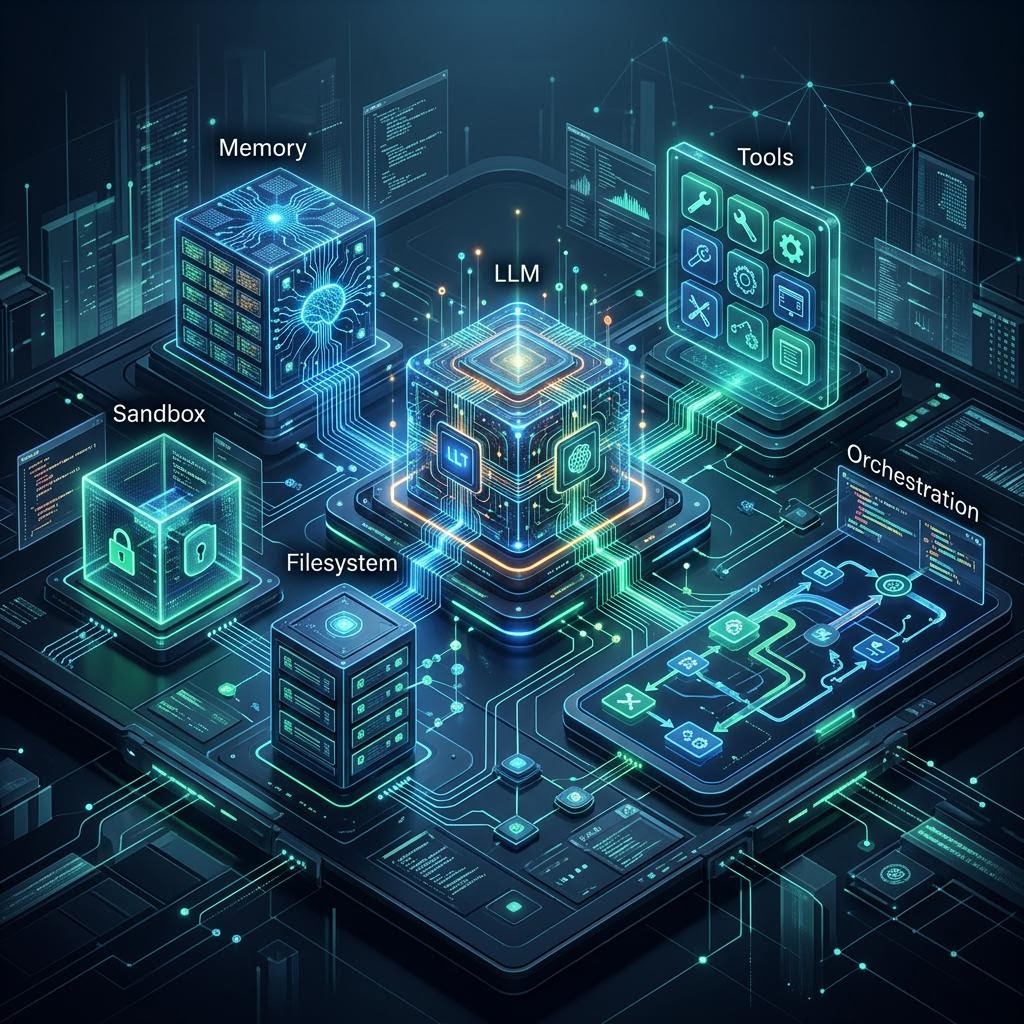
Original illustration created for Teach AI Tools.
DeepSeek’s recent open-source Harness preview is easy to misread as another model-adjacent developer utility. It is more interesting than that. The release is a signal that the competitive layer around large language models is changing. A strong model can reason, write code, or produce a plan. An agent has to do additional work: keep track of state, decide whether to use a tool, work with a file, recover from a failed call, obey a permission boundary, and leave enough evidence for a human to understand what happened. Harnesses are the software that makes those pieces behave like a system rather than a pile of demos.
The distinction matters because the visible part of AI has traditionally been the chat window. That interface encourages a simple mental model: ask a question, get an answer. Production work is rarely like that. A support investigation may involve a ticketing system, customer history, an order database, a policy document, an approval, and a final message. An engineering task may require a repository, a test runner, a package registry, a sandbox, and a pull request. The model is only one participant in that chain. The harness decides how the participants are connected.

Source photo: Pexels, used under the Pexels License.
What DeepSeek Actually Released
The useful description comes from DeepSeek’s own design language and the developer reporting around the preview: Harness is built around a plugin-oriented approach. Models, tools, skills, sessions, sandboxes, filesystems, loops, orchestration, and user interfaces can be treated as replaceable components. In other words, the framework is trying to make the “how an agent runs” layer modular instead of binding every application to one model provider, one tool runner, or one persistent-memory implementation.
That is a practical choice, not merely an architectural preference. A company may want to run a fast, inexpensive model for classifying incoming work, a stronger model for complex planning, and a locally hosted model for sensitive documents. It may need one sandbox for code execution and a different one for document extraction. It may want to replace its search system without rewriting the agent’s core loop. A tightly coupled agent implementation turns each of those changes into a rebuild. A plugin-oriented harness aims to make them configuration and integration work instead.
The developer-preview label should be taken seriously. A preview is not a promise of long-term support, security posture, or enterprise readiness. The important point is not that every team should deploy DeepSeek Harness immediately. The point is that an open framework is explicitly competing for the layer that sits between a model and the work it is meant to complete. That is a much broader ambition than shipping a better chatbot.
Why an Agent Needs More Than a Model
An autonomous workflow has at least five moving parts. First, it needs context: what the goal is, what has already happened, and which documents or records are relevant. Second, it needs tools: a reliable way to query a database, create a ticket, call an internal API, or run a test. Third, it needs an execution loop: a way to decide whether it is finished, whether a tool result changes the plan, and when to ask for help. Fourth, it needs memory and state so that a long task does not restart from zero after every interaction. Finally, it needs controls: budgets, sandboxing, permissions, logs, and escalation paths.
Chat products often hide these concerns because a human is supplying the next instruction. Agent systems cannot. If a model receives an ambiguous tool result, does it retry? If a database query returns more rows than expected, does it summarize, page, or stop? If a tool call fails, does it use a fallback or notify an owner? If the task requires access to a production system, what credential is used and how narrowly is it scoped? These are software-engineering questions, even when the model’s reasoning is impressive.
This is why the term agent harness has become useful. It gives a name to the runtime contract around the model. A good harness makes tool calls observable, constrains the environment, manages context growth, and prevents a useful prototype from becoming an unmaintainable production dependency. A weak harness can make an excellent model appear unreliable because the surrounding system loses state, swallows errors, or grants it access it should never have had.
The Plugin Idea Is a Bet on Change
The AI ecosystem is moving quickly enough that permanence is a risky assumption. Model quality changes. Pricing changes. Context windows change. New standards appear. A team that hard-codes an application around a single proprietary API can be productive in the short term and still create an expensive migration later. DeepSeek’s “everything is a plugin” framing is a response to that reality.
The right way to evaluate this claim is concrete. Can the model adapter be changed without rewriting task logic? Can a tool run locally in development and in a controlled remote environment in production? Can the memory store be replaced? Can the same task be replayed against a new model version? Can the UI show a trace that explains why the agent took a particular action? Those are more meaningful questions than whether a framework has the longest list of integrations.
Modularity also has a cost. Every plugin boundary is an interface to test, secure, document, and version. An organization does not become agile merely by installing a framework with many extension points. It becomes agile when it defines stable contracts and refuses to let convenience integrations become unreviewed production dependencies. The most successful use of a modular harness is usually boring: a small number of well-understood adapters, clear ownership, and a predictable release process.
How Harnesses Relate to MCP and A2A
It helps to separate three ideas that are often blended together. A harness is an application runtime: it coordinates the steps of an agent. The Model Context Protocol (MCP) is primarily a way for an AI application to connect to tools and data sources through a common interface. Agent2Agent (A2A) is intended for communication and delegation between independent agents. These concepts complement one another rather than compete directly.
An internal research agent, for example, might use its harness to plan a task and keep state. It could call an MCP server to search a document store or query a data warehouse. If it needs a specialist compliance review, it could use an A2A-style interaction to delegate that work to another agent with a different capability and governance boundary. The harness is the conductor inside one application; MCP and A2A help make its outside connections less bespoke.
That distinction is important for buyers. “We support MCP” does not explain how a product manages retries, approvals, or persistent task state. “We support multi-agent workflows” does not automatically mean agents can safely discover each other across vendors. Standards reduce integration friction. They do not eliminate the need for a thoughtful runtime.
The Open-Source Pressure on Agent Infrastructure
Open-source agent infrastructure can change the economics of this market. When the orchestration layer is inspectable, developers can study how context is assembled, where a tool boundary is enforced, and what happens when an execution loop fails. They can also adapt the stack to local hardware or regional requirements. For organizations that cannot send sensitive data to a closed hosted platform, that possibility matters.
There is a counterweight. Open source does not mean automatically secure, audited, or ready for a regulated environment. A public repository can expose design choices; it can also expose immature code and shift more operational responsibility to the adopter. Teams should assess release cadence, maintainer responsiveness, dependency hygiene, sandbox isolation, authentication patterns, and logging before treating an agent framework as foundational infrastructure.
The same caution applies to benchmark claims. DeepSeek’s V4 family has highlighted agentic capabilities in public materials, and third-party coverage has reported strong coding and terminal-task results. Those signals are useful for deciding what to test. They should not be mistaken for evidence that a particular harness will work safely with a company’s data, tools, or approval process. Production behavior is always a property of the full system.
Where to Start Without Overbuilding
The best first project is not a general-purpose digital employee. It is a narrow workflow with a known beginning and end. Consider an internal incident-summary assistant that reads an approved set of tickets, gathers a timeline from an observability system, drafts a summary, and routes it to an engineer for approval. The agent has a useful task, limited tools, a human checkpoint, and a record of its work.
Build the smallest harness that can make the workflow observable. Store the task goal, tool calls, tool results, final output, and approver decision. Put hard limits on runtime, token spend, file size, and destination systems. Start with read-only access where possible. Only after the system has earned trust should it receive an action such as creating a draft ticket or preparing a change request.
The bigger lesson from DeepSeek Harness is not that every company needs a new framework. It is that agentic AI is becoming an infrastructure problem. As models become more capable, the competitive advantage will increasingly come from the layer that gives them safe tools, durable context, sensible limits, and a path back to human judgment.
Sources and Further Reading
- DeepSeek: V4 Preview and agentic capabilities
- The Register: DeepSeek’s plugin-oriented Harness
- South China Morning Post: Harness developer preview
A Practical Response for Teams
The useful response to an agent harness becoming a core part of the AI stack is neither to declare a revolution on the strength of one launch nor to wait until the category is settled. The productive middle path is to treat the change as a design input. DeepSeek’s public preview makes the model-to-agent runtime layer a visible open-source battleground. That is enough information to make a small, controlled decision; it is not a license to make an irreversible one.
Start by choosing a workflow with a visible owner, a known baseline, and a consequence that can be contained. Pick one read-heavy internal workflow and implement an auditable loop before introducing autonomous writes. A pilot should have one accountable business sponsor and one technical owner who can stop it. It should also have an explicit definition of a successful handoff: what the system may do automatically, what it may prepare for review, and what must still be decided by a person. That clarity matters more than a fashionable agent framework or a perfect prompt.
Design the trial around boundaries, not just capability. Keep tool credentials scoped, sandbox code execution, and require an explicit approval boundary for consequential actions. Treat permissions, data exposure, budgets, and time limits as product requirements. A capable system with a small blast radius is far more informative than an impressive demo with unrestricted access. Keep a trace of the inputs, tool calls, outputs, approvals, and exceptions so the team can explain what happened later without reconstructing it from memory.
Measure the result as an operational change rather than a model score. Track task completion, escalation frequency, tool failures, repair effort, latency, and cost per completed workflow. A model can look exceptional in a benchmark and still make a workflow slower if people must repeatedly repair unclear handoffs. Conversely, a less glamorous model can create value when it is paired with reliable retrieval, constrained tools, and a review queue. The question is not “did the agent look intelligent?” It is “did the service level, error rate, cost, and accountability improve?”
There is also a people dimension. Give the people closest to the work a way to challenge the system, correct it, and see what it did. In a healthy deployment, the agent makes routine work more legible: it shows the evidence it used, declares uncertainty, and escalates exceptions. In an unhealthy deployment, it becomes a black box that quietly adds work to the people who are supposed to supervise it. The difference is architecture and operating discipline, not optimism.
Finally, revisit the pilot after a fixed interval. Review the incidents that did not become tickets: near misses, confusing recommendations, permissions that were too broad, and tasks that users quietly took back from the agent. Those are often more valuable than the headline productivity number. The teams that benefit from this wave will not be the teams that automate the most quickly. They will be the teams that learn how to delegate safely, observe clearly, and change course early.
Tags
Written by

Sourabh Gupta
Author at Teach AI Tools
Sourabh Gupta is responsible for Teach AI Tools. Research guides and documented firsthand reviews are identified separately. An author profile is not evidence of testing; look for sources, test records, and limitations in the article.
Full bio & editorial process →