Humanoid Robots Are Moving From Demos to Measured Factory Deployments
Editorial note: Some links in this article are affiliate links — we may earn a commission if you sign up, at no extra cost to you. Research guides are distinguished from documented firsthand reviews in our editorial standards. Read our editorial standards →
Humanoid Robots Are Moving From Demos to Measured Factory Deployments
Humanoid robots have spent years demonstrating that they can walk, pick up objects and converse. Those demonstrations are useful engineering milestones, but factories buy a different outcome: a task completed safely, repeatedly, at a known rate and cost, inside a production system that cannot stop for a viral video. The transition from spectacle to deployment is therefore less about a robot looking human than about measurement, workflow design and accountability.
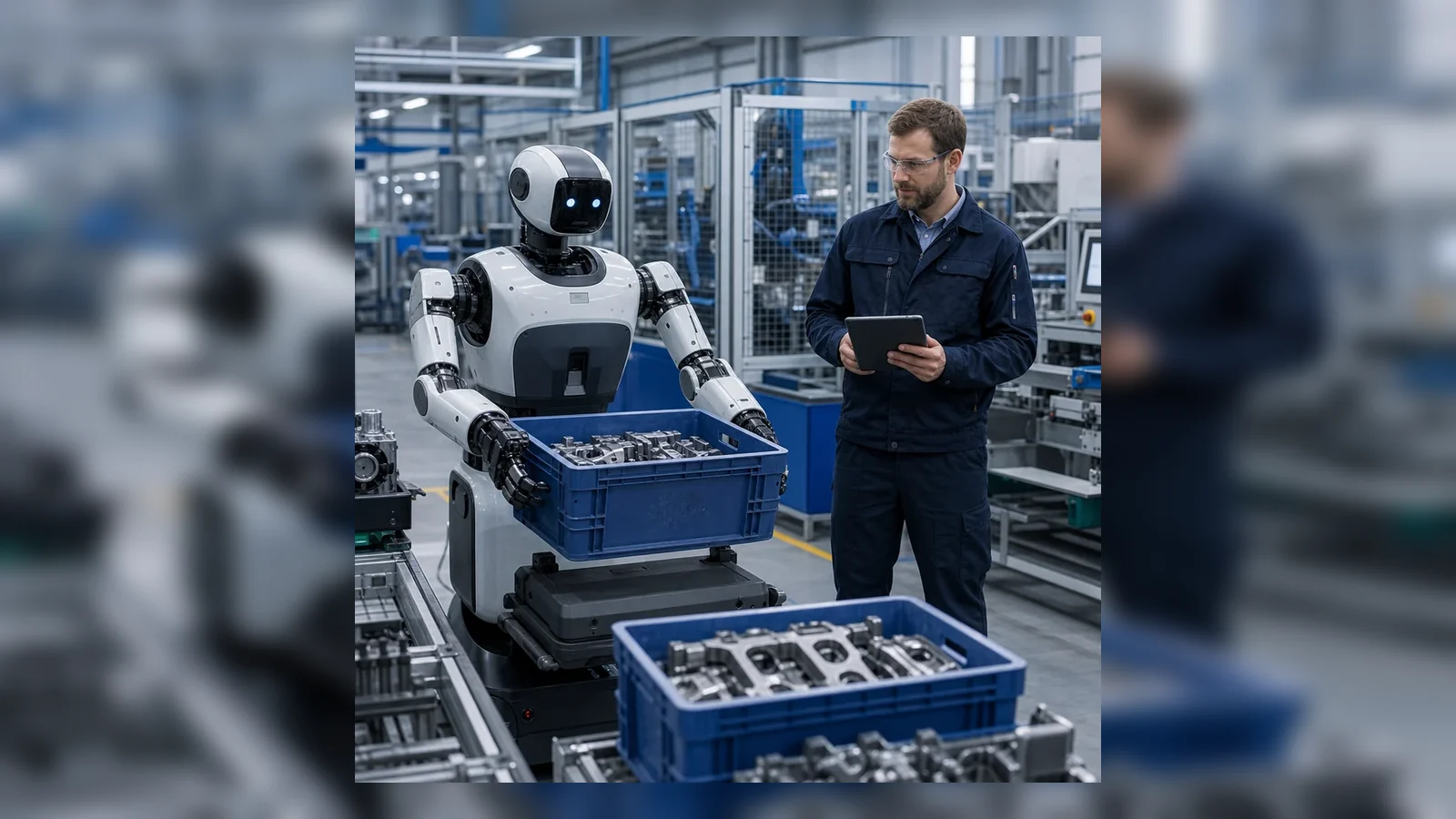
Reported fact: BMW Group announced that it would deploy humanoid robots in production in Germany for the first time, at Plant Leipzig. Its announcement identifies a Figure robot and describes a planned use in body-shop production. Inference: announcements such as this are significant because automakers are using a live production context to test a new form factor, not because they establish that humanoids are already a general replacement for industrial automation.
A factory is a hard test environment
Industrial robots have been successful by being specialized. A fixed arm can weld, paint or move a known part in a carefully designed cell with formidable speed and repeatability. Mobile robots can move materials along planned routes. Human workers remain valuable where work varies, parts are awkward, spaces were built for people, or judgment and recovery are needed.
Humanoids attempt to occupy some of that last category. Their body plan can potentially use human-oriented stairs, aisles, shelves, tools and workstations without rebuilding the entire plant. Their hands and arms could operate in spaces that were never designed for a robot cell. But the same generality creates problems: balancing, perception in clutter, safe interaction, battery duration, hand reliability and recovery from a mistake.
The question for a deployment is not whether a robot can execute a task once. It is whether it can do so through shift changes, variable lighting, component tolerance, dirty surfaces, occasional missing parts and the small disruptions that make up daily manufacturing.
“In production” needs a definition
The phrase can describe several very different stages. A robot may be physically located at a plant while running supervised trials. It may complete a limited task on a restricted line. It may be integrated with production controls but require human recovery. Or it may operate for full shifts under a defined safety case. Each is valuable, but they should not be collapsed into one claim.
BMW’s release is primary evidence of its deployment intention and location. It is not a public disclosure of robot uptime, cycle time, labor displacement or unit economics. Readers should resist filling those blanks with assumptions. Inference: the most useful early deployments will be narrow enough to measure and repeat, even if the long-term ambition is broader.
Why manufacturers are testing the form factor now
Factories face persistent pressure to improve throughput, ergonomics and resilience while handling product variation. Reconfiguring a conventional automation cell can take capital and engineering time. A robot designed to move through existing human spaces promises an alternative: software and end-of-arm tooling could adapt to changes without reconstructing every physical interface.
Labor context matters as well, but it should be stated carefully. Manufacturers may cite skills shortages, demographic change, injury prevention or demand variability. These are reasons to investigate automation; they do not prove a particular robot is economically justified. The cost of an operator is only one input. Integration, supervision, safety engineering, charging, spares and downtime are part of the comparison.
The body shop is a revealing starting point
Body-shop work can include repetitive material movement, part handling and tasks near established automation. That can make it a sensible place to define a bounded human-robot workflow. It also provides clear production metrics: parts handled, cycle time, defects, line stops and safety events.
Starting near existing automation does not mean the humanoid simply takes over a mature industrial robot job. Fixed automation may remain better where motions are stable and volumes are high. A humanoid’s possible value lies in interfaces and exceptions that would otherwise require a person or expensive bespoke equipment. The task selection tells more than the robot’s maximum walking speed.
The metrics that turn a pilot into evidence
Start with a task contract
A measured deployment needs a written task boundary: the object types, pickup and placement locations, allowable orientations, expected cycle time, environmental range, handoff to people and definition of success. Without this contract, a robot can appear productive by performing only easy cases while workers quietly handle exceptions.
Track the completion rate for all assigned attempts, not just successful cycles. Record recoveries, remote interventions, rework, quality escapes and time spent charging or recalibrating. Compare the result to the existing process, including the work needed to make that process safe.
Safety is an operating system, not a feature list
Humanoid robots bring mobile mass, articulated arms and perception systems into shared spaces. A safe deployment requires risk assessment, speed-and-separation rules, emergency stops, geofencing where appropriate, worker training and clear responsibility for changing the robot’s behavior. Standards and local requirements guide this work, but no generic claim of “AI safety” substitutes for a task-specific assessment.
Reported safety certification, where a vendor has it, should be read for scope. A certification or compliant component does not automatically approve every factory workflow. A robot with a new end effector, payload or route can require another review. The operational record—near misses, stops, response time and audits—is more informative than a marketing adjective.
Availability matters more than highlight-reel capability
Manufacturers should measure scheduled availability, productive availability and mean time to recovery. Productive availability excludes hours when a robot is technically powered on but waiting for an operator, a technician, a map update or a battery charge. Those distinctions reveal whether the limiting factor is mechanics, software, site infrastructure or the task design.
The economics should include supervision. Remote assistance can be a rational transition strategy, especially while software learns edge cases. But a “one robot, one remote human” operating model has different economics from a largely autonomous cell. Neither should be implied by the other.
Integration is the hidden work
The robot must fit material flow, production scheduling, quality systems, cybersecurity rules and maintenance procedures. It needs an unambiguous way to know which job it has, where parts are, and when it may enter a zone. It may need interfaces to manufacturing-execution systems, programmable controllers or vision infrastructure. Every integration point becomes an availability and security boundary.
This is why a realistic factory pilot can take longer than an on-stage demo. The difficult work is often mundane: labels on containers, fixture tolerances, network coverage, charging placement and escalation paths. Inference: vendors that make integrations repeatable may create more value than those that merely demonstrate more humanlike movement.
Generality has a cost curve
A humanoid can theoretically do many tasks, but each task may need data collection, end-effector configuration, safety validation and exception handling. A fixed cell has high up-front engineering cost but very low variation once proven. The right comparison is therefore not “general robot versus old robot.” It is the cost and time to automate a changing portfolio of tasks at a stated quality and safety level.
Plants with frequent model changes or existing human-centric workspaces may find the form factor attractive. Plants with stable, high-volume motions may continue to favor specialized machinery. Both outcomes can coexist in the same facility.
What has not been established
The BMW announcement does not show fleet-scale economics, unattended overnight operation, or a universal job category for humanoids. It also does not mean conventional industrial robots are being displaced. Existing automation remains the baseline for many tasks because it is fast, mature and purpose-built.
Equally, a cautious reading should not dismiss the deployment as “just a demo.” A factory placement forces vendors and customers to confront the real constraints: safety, uptime, handoffs and maintenance. That is more probative than a controlled showcase, provided results are measured and disclosed.
A practical procurement framework
Select one painful, bounded workflow
Choose a task with an ergonomic, staffing, quality or flexibility problem, but with measurable inputs and outputs. Establish the baseline process before introducing the robot. Define what happens when the robot cannot complete a cycle and who owns the recovery.
Require transparent operating data
Ask for task-success distribution, intervention rate, productive hours, charging and maintenance time, safety stops, quality outcome and integration assumptions. Require that metrics distinguish autonomous work from teleoperated or closely supervised work. A vendor can protect proprietary details while still providing decision-grade evidence.
Plan the off-ramp as well as the scale-up
Pilots should have safety and operational exit criteria. Specify how the robot is isolated, how work reverts to people or existing equipment, and who removes site data or credentials. A project that can stop safely is easier for a plant to start.
The signal to watch
The next meaningful headlines will be less cinematic: published operating hours, repeated installations, documented task boundaries and independent evidence of quality and availability. Those metrics reveal whether the robot’s software, hands, batteries and support model improve together.
Humanoids may become a useful layer of factory automation, especially where facilities are already built around people. That outcome is plausible, not settled. BMW’s Leipzig deployment is best read as a serious test of operational fit. The industry’s job now is to report what the machine did per shift—not merely what it could do on a stage.
An additional reporting practice would help: publish the baseline task definition when results are announced. A robot that handles a standardized container in a fenced zone is not equivalent to one that navigates an open line and resolves variation. Both may be commercially valuable. Separating them gives plant managers a realistic way to compare their own work and gives workers a clearer account of what is changing.
Workforce design is part of deployment design
The question is not only how many human minutes a robot removes from a task. A deployment changes roles: operators may load fixtures, technicians may maintain hands and sensors, safety staff may review incidents, and production engineers may manage task updates. These jobs need training and clear authority. If workers do not know when to stop the robot or how to report an unusual behavior, the technical capability will not translate into dependable production.
Manufacturers should involve the people who perform the baseline task in task selection and acceptance testing. They can identify edge cases that process diagrams omit: damaged containers, awkward reaches, shift-specific congestion and quality cues visible before an inspection station. This is operational evidence, not merely change-management etiquette. Incorporating it early can reduce intervention rates and improve the design of fixtures or material presentation.
Performance reporting should also separate throughput gains from ergonomic gains. A robot can be worthwhile if it removes a high-strain task even when it does not immediately lower headcount or beat a person’s best cycle time. Conversely, a claimed labor saving should include the new support work it creates. This fuller accounting helps a plant decide where a humanoid fits alongside people, fixed robots and mobile automation.
FAQ
Are humanoid robots replacing factory workers?
No general conclusion follows from early deployments. They may automate selected tasks, but staffing effects depend on the task, plant design, throughput and how the manufacturer redeploys people.
Why not use a conventional robot arm?
For stable, repeatable tasks a conventional arm is often preferable. A humanoid may be useful where human-oriented spaces, tools or task variation make bespoke automation costly.
What proves a pilot is successful?
Measured task completion, quality, productive availability, safety performance, intervention rate and total operating cost against a pre-defined baseline.
Does remote operation count as autonomy?
It is a valid operating mode, but it should be reported separately. Remote assistance changes both the reliability assessment and the economics.
Sources
Tags
Written by

Sourabh Gupta
Author at Teach AI Tools
Sourabh Gupta is responsible for Teach AI Tools. Research guides and documented firsthand reviews are identified separately. An author profile is not evidence of testing; look for sources, test records, and limitations in the article.
Full bio & editorial process →