LLM Observability & Distributed Tracing (2026): Langfuse vs. LangSmith vs. OpenInference Standards

Principal AI Systems Architect • 10+ yrs in High-Throughput Distributed AI & Enterprise Systems
1. The Blind Spot of Traditional APM in Generative AI Stacks
In standard microservice architectures, Application Performance Monitoring (APM) tools like Datadog, Dynatrace, and New Relic monitor database query times, garbage collection pauses, and HTTP 5xx error rates. When an endpoint returns HTTP 200 OK in 400ms, APM dashboards report healthy green status.
In agentic and generative AI architectures, an HTTP 200 response is completely insufficient as a health signal:
- The model may have experienced a silent hallucination, inventing fictitious financial figures or erroneous medical recommendations while returning syntactically valid JSON.
- The retrieval pipeline (RAG) may have returned irrelevant semantic chunks, diluting the context window and driving up token costs without resolving the user query.
- An autonomous agent may have entered an infinite tool-calling loop, executing repeated shell commands or browser actions before exhausting its recursion limit.
- A subtle prompt template change deployed in CI/CD may have degraded generation quality across a subset of enterprise queries without triggering a single compiler error.
LLM Observability addresses this by treating foundation models not as static HTTP endpoints, but as non-deterministic probabilistic state machines that require granular distributed tracing, token accounting, and continuous semantic evaluation.
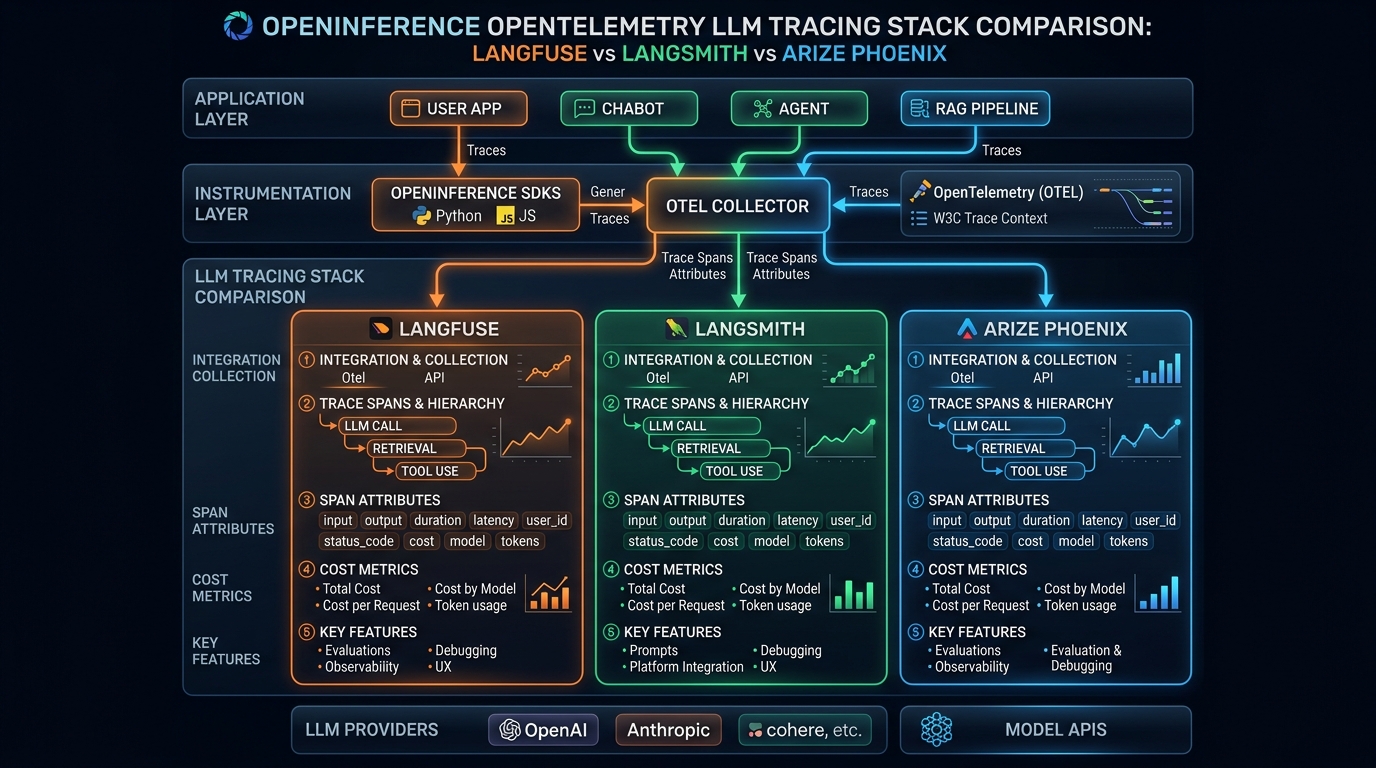
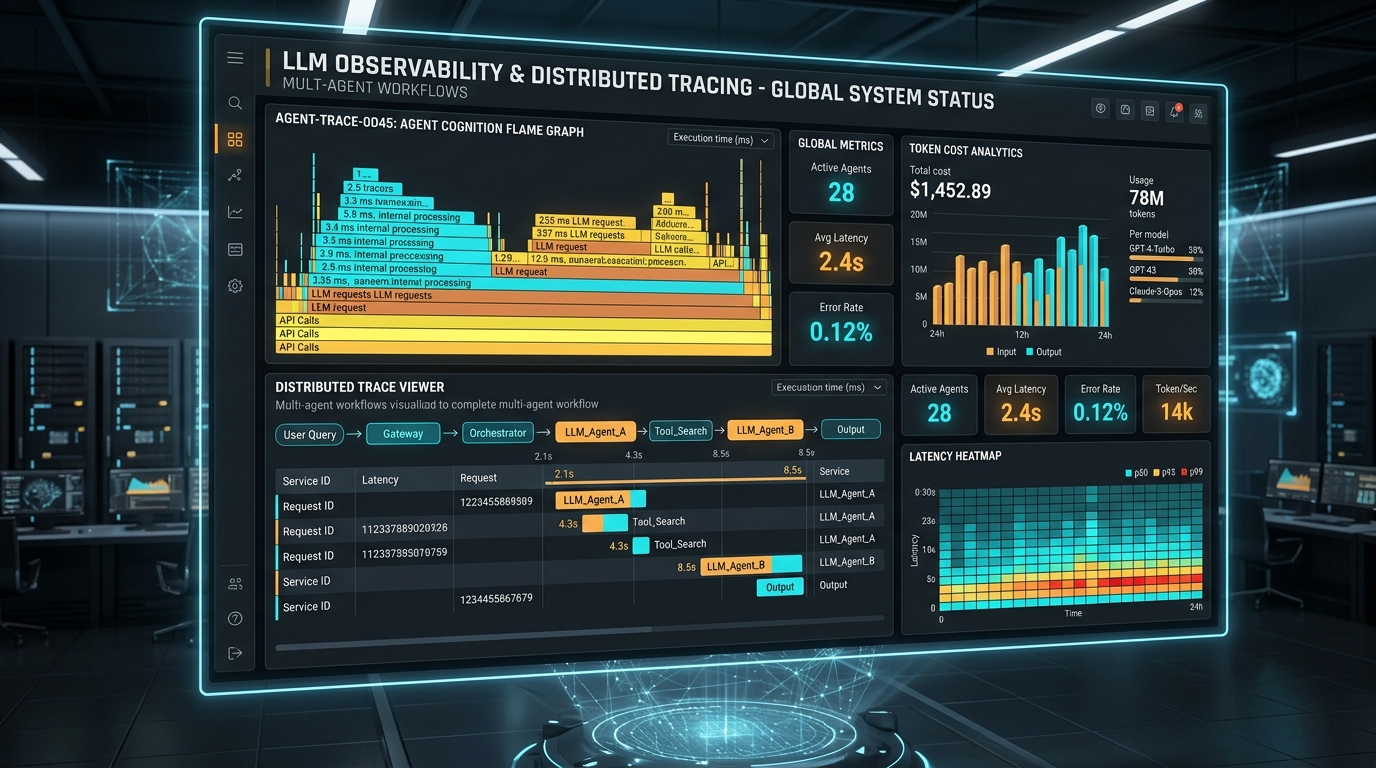
Figure 1: End-to-end LLM Observability pipeline showing OpenTelemetry auto-instrumentation, asynchronous span ingestion, ClickHouse OLAP indexing, and real-time LLM-as-a-judge scoring.
2. The OpenInference Standard: Extending OpenTelemetry for AI
A critical risk in adopting generative AI tooling is vendor lock-in. Developed by the open-source community in coordination with Arize AI, the OpenInference Semantic Conventions define a vendor-neutral OpenTelemetry extension for AI traces.
Under OpenInference, every generative operation is captured as a structured span conforming to standard namespaces. Furthermore, OpenTelemetry Collectors can be deployed as Kubernetes sidecars to buffer, filter, and route telemetry spans to multiple backends simultaneously (e.g. streaming cost metrics to Prometheus while persisting deep debug payloads to Langfuse).
Key standardized span attributes include:
| Span Attribute | Type | Example Value | Description |
|---|---|---|---|
| llm.model_name | String | gpt-4o-2024-11-20 |
Target inference model identifier |
| llm.token_count.prompt | Integer | 1,420 |
Input prompt token consumption |
| llm.token_count.completion | Integer | 285 |
Generated completion token count |
| tool.call_name | String | sql_executor_query |
Name of invoked agent tool |
| retrieval.documents | JSON Array | [{"id": "doc_42", "score": 0.89}] |
Retrieved semantic chunks and relevance scores |
3. Architectural Comparison: Langfuse vs. LangSmith
When selecting an LLM observability platform, enterprise engineering teams evaluate tradeoffs between open-source data sovereignty and managed developer platforms:
| Feature / Dimension | Langfuse (Open-Source Core) | LangSmith (LangChain Platform) |
|---|---|---|
| Licensing & Deployment | 100% Self-Hostable (MIT / Docker / Kubernetes) | Managed SaaS / Enterprise Hybrid VPC |
| Underlying Database | PostgreSQL (Metadata) + ClickHouse (OLAP Spans) | Proprietary High-Throughput Columnar Engine |
| Framework Agnostic Support | Native SDKs for Python, TypeScript, OpenAI, LiteLLM, OTel | Optimized for LangChain, LangGraph, and LangServe |
| Automated Evaluation Engine | Custom LLM Judges, Ragas integration, User feedback scores | Native evaluation suites, dataset versioning, online evaluators |
| Data Sovereignty & Privacy | Zero data leaves VPC (Air-gapped ready) | Encrypted in-transit to LangChain cloud |
4. Production Implementation: Tracing an Agent Stack with Langfuse
Below is an end-to-end production implementation demonstrating how to trace a multi-step agent workflow combining vector retrieval, inference generation, and asynchronous LLM-as-a-judge scoring:
import os
from langfuse import Langfuse
from langfuse.decorators import observe, langfuse_context
import openai

# 1. Initialize Langfuse client (Self-hosted or Cloud)
langfuse = Langfuse(
    public_key=os.getenv("LANGFUSE_PUBLIC_KEY"),
    secret_key=os.getenv("LANGFUSE_SECRET_KEY"),
    host=os.getenv("LANGFUSE_HOST", "http://localhost:3000")
)

client = openai.OpenAI()

@observe(as_type="generation")
def execute_llm_inference(prompt: str, context: str) -> str:
    # Attach custom metadata to generation span
    langfuse_context.update_current_observation(
        model="gpt-4o",
        input={"prompt": prompt, "context": context},
        metadata={"environment": "production", "feature": "financial_qa"}
    )

    response = client.chat.completions.create(
        model="gpt-4o",
        messages=[
            {"role": "system", "content": f"Answer based on context: {context}"},
            {"role": "user", "content": prompt}
        ],
        temperature=0.0
    )

    output = response.choices[0].message.content
    usage = response.usage

    # Report exact token consumption
    langfuse_context.update_current_observation(
        usage={"input": usage.prompt_tokens, "output": usage.completion_tokens},
        output=output
    )
    return output

@observe(name="financial_rag_pipeline")
def run_financial_agent(user_query: str):
    # Set trace-level attributes
    langfuse_context.update_current_trace(
        name="FinancialAnalysisPipeline",
        user_id="enterprise_user_984",
        tags=["quarterly_report", "q3_2026"]
    )

    # 2. Simulated vector retrieval span
    with langfuse_context.observe_span(name="hybrid_vector_retrieval") as span:
        retrieved_context = "Q3 Operating Income reached $4.2B, reflecting a 14% year-over-year expansion."
        span.update(output={"chunks_retrieved": 1, "relevance_score": 0.94})

    # 3. LLM generation span
    answer = execute_llm_inference(user_query, retrieved_context)

    # 4. Asynchronous LLM-as-a-Judge Evaluation Span
    with langfuse_context.observe_span(name="llm_as_a_judge_faithfulness") as eval_span:
        # Evaluate if answer strictly follows context without hallucination
        faithfulness_score = 1.0 if "4.2B" in answer and "14%" in answer else 0.0

        # Log evaluation score directly to root trace
        langfuse_context.score_current_trace(
            name="faithfulness",
            value=faithfulness_score,
            comment="Grounded directly in financial context chunk"
        )
        eval_span.update(output={"score": faithfulness_score})

    return answer

if __name__ == "__main__":
    result = run_financial_agent("What was the operating income growth in Q3?")
    print("[+] Pipeline Execution Result:", result)
    # Ensure all telemetry spans are flushed before exit
    langfuse.flush()
5. Real-Time Semantic Drift Detection & Evaluation Metrics
Beyond static token accounting, production LLM systems face semantic drift caused by user distribution shifts, model provider updates, and prompt template regressions.
Modern observability harnesses implement continuous statistical drift monitors:
- Embedding Distribution Tracking: By projecting high-dimensional input query embeddings onto a reduced 2D/3D UMAP space in real-time, the platform detects emerging semantic clusters (such as sudden shifts in customer intent or adversarial prompt injection patterns).
- Independent Ragas Quality Scoring: Automated evaluation routines compute key quality metrics—including Faithfulness (factual consistency against context), Answer Relevance (query-response semantic alignment), and Context Precision/Recall—as distinct independent scores (0.0 to 1.0) rather than a single combined composite. Engineering teams configure automated alerting when rolling averages dip below chosen operational targets (e.g., weekly Faithfulness dropping below 0.85).
- Negative Feedback Correlation: User thumbs-down reactions and session abandonment metrics are automatically correlated with trace spans, isolating the exact prompt versions and retrieval parameters responsible for user dissatisfaction.
6. CI/CD Integration: Automated Regression Testing with Synthetic Test Suites
Deploying prompt changes or model swaps directly to production without deterministic validation introduces operational risk. Observability platforms enable Offline Prompt CI/CD Gates:
# Example GitHub Actions Automated Prompt Regression Gate
import pytest
from langfuse import Langfuse
from deepeval.metrics import GEval, MetricCriteria
from deepeval.test_case import LLMTestCase

langfuse = Langfuse()

def test_prompt_release_candidate():
    # 1. Fetch Golden Benchmark Dataset from Langfuse Dataset Registry
    dataset = langfuse.get_dataset("enterprise_qna_golden_v3")

    for item in dataset.items:
        # 2. Run generation with Candidate Prompt
        prompt = langfuse.get_prompt("financial_assistant_prompt", version="release-candidate")
        formatted = prompt.compile(query=item.input["query"])

        # 3. Assert quality score meets threshold
        test_case = LLMTestCase(
            input=item.input["query"],
            actual_output=item.expected_output,
            context=item.input.get("context", [])
        )

        faithfulness_metric = GEval(name="Faithfulness", criteria=MetricCriteria.HIGH)
        faithfulness_metric.measure(test_case)

        assert faithfulness_metric.score >= 0.90, f"Prompt regression detected on item {item.id}"
7. Token Accounting, Cost Attribution & Budget Governance
In large engineering organizations with multiple autonomous agents, unmonitored LLM spend presents a substantial financial risk. Observability platforms provide real-time token telemetry and cost controls:
- Granular User & Tenant Attribution: By tagging traces with
user_idandtenant_id, finance teams accurately calculate unit economics per customer. - Prompt Caching Telemetry: Major LLM providers offer significant prompt caching discounts (e.g. Anthropic discounts cached input tokens by up to 90% at $0.30/M vs $3.00/M on Claude 3.5 Sonnet; OpenAI provides a 50% discount on cache hits). Observability dashboards track cache read/write ratios to optimize prompt construction.
- Automated Rate Limiting & Circuit Breakers: When a user session or script exceeds a configured spend cap (for example, a $50/hr safety threshold), the proxy triggers an automated circuit breaker to prevent runaway recursion.
- High-Cardinality Columnar Indexing: Using ClickHouse storage, teams execute low-latency queries across millions of historical traces by arbitrary metadata tags (e.g.,
experiment_id=rag_v4_reranker) without schema migration overhead. - In-Line PII Redaction & Data Masking: Sensitive entities (credit card tokens, national IDs, medical records) are sanitized before spans leave the execution environment using regex or Microsoft Presidio filters to maintain GDPR and HIPAA compliance.
8. Primary Technical Sources & Citations
- Langfuse Engineering Team. Open Source LLM Engineering Platform: Tracing, Prompt Management, Evaluations. GitHub Repository: github.com/langfuse/langfuse (2023–present).
- Arize AI & OpenInference Working Group. OpenInference Semantic Conventions: OpenTelemetry Standards for AI Systems. GitHub Repository: github.com/Arize-ai/openinference (2023–present).
- LangChain Architecture Team. LangSmith: Production Monitoring and Evaluation for LLM Applications. Official Documentation: langchain.com/langsmith (2023–present).
- Cloud Native Computing Foundation (CNCF). OpenTelemetry Semantic Conventions for Generative AI Operations. CNCF Standards Specification: opentelemetry.io (2024–present).
- Ragas Documentation Core. Ragas: Evaluation Framework for Retrieval Augmented Generation (RAG) Pipelines. Documentation: docs.ragas.io (2023–present).
Tags
Lead Systems Architect at Teach AI Tools • Specializing in Agentic Memory, Late-Interaction Retrieval (ColPali), & High-Throughput Distributed AI Serving.
Sourabh leads distributed AI research and production infrastructure at Teach AI Tools. His research focuses on solving the visual information bottleneck in multi-modal RAG systems and engineering scalable vector database late-interaction pipelines. View complete technical background, publications & editorial standards →