Multimodal RAG with ColPali (2026): Vision-Language Models for Late-Interaction Document Retrieval

Principal AI Systems Architect • 10+ yrs in High-Throughput Distributed AI & Enterprise Systems
1. The Structural Collapse of Traditional PDF RAG Pipelines
For years, enterprise Retrieval-Augmented Generation (RAG) relied on a multi-stage heuristic pipeline: rasterize PDF documents, run Optical Character Recognition (OCR), infer bounding boxes with layout parsers (such as Unstructured, PDFMiner, or LayoutLM), extract markdown tables, split text into arbitrary 512-token chunks, and embed each chunk into a single dense vector.
In production environments, this pipeline encounters structural failure modes when processing visually rich enterprise documents:
- Spatial Layout Decoupling: Multi-column layouts and complex grids lose row-column alignment when linearized into plain text. Financial balance sheets, pricing grids, and technical specifications become disjointed strings.
- Visual Infographics & Vector Charts: Scatter plots, CAD schematics, pie charts, and flow diagrams have no native text representation. Traditional OCR ignores visual structures, leaving downstream LLMs blind to visual data.
- Embedding Dilution Bottleneck: Compressing an entire page or section into a single dense vector (e.g., 1,536-dimensional float) discards granular token associations. When a query targets a specific sub-clause located in a corner footnote, single-vector bi-encoders frequently fail to retrieve the page.
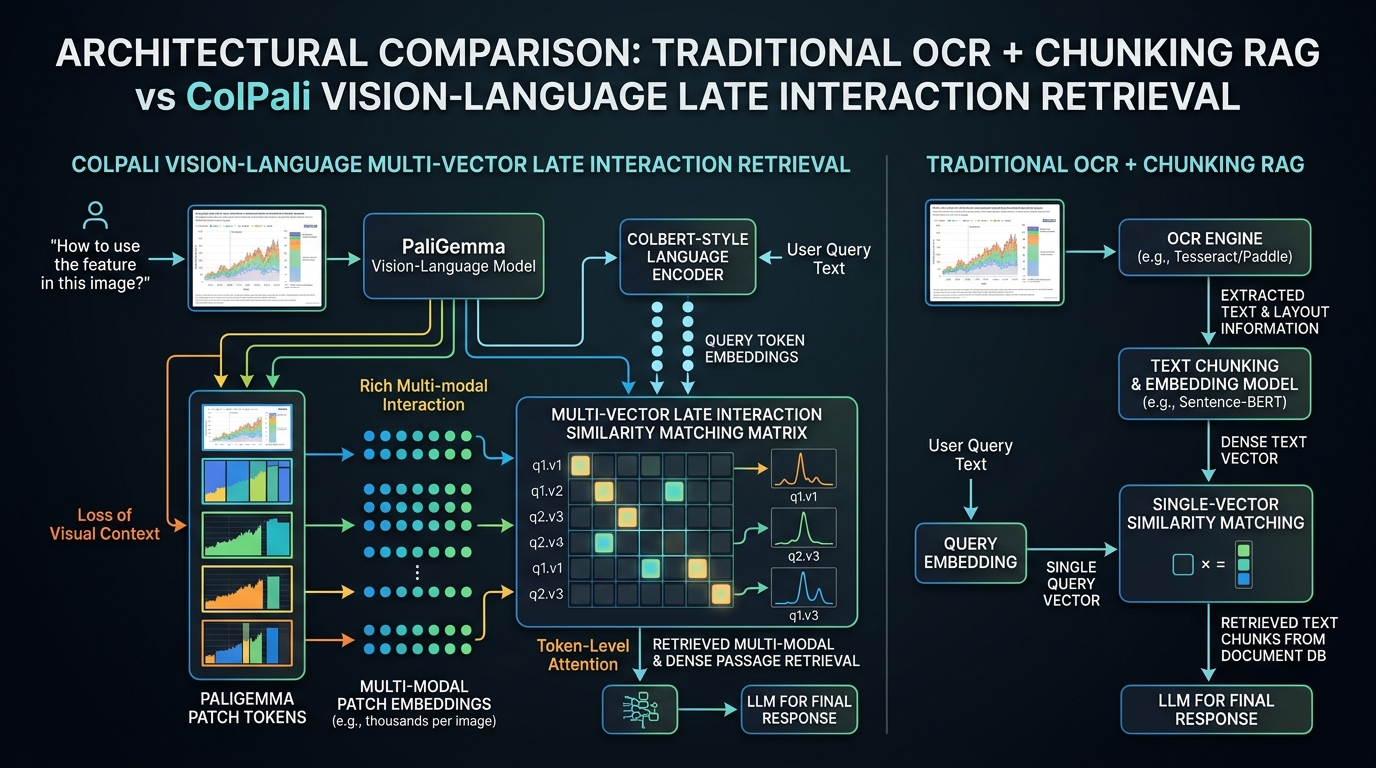
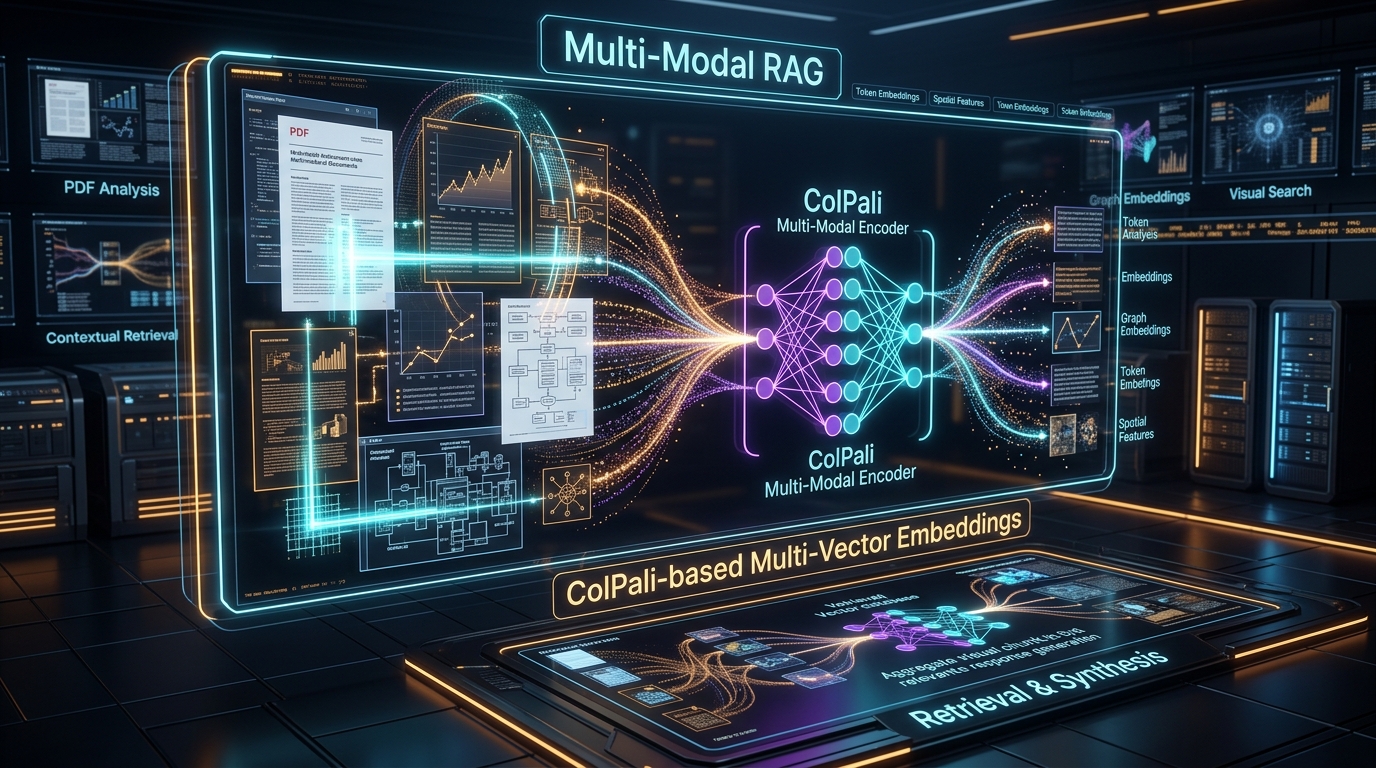
Figure 1: ColPali end-to-end Vision-Language Late Interaction retrieval flow vs. traditional heuristic OCR pipelines.
2. ColPali Architecture: Vision-Language Models Meet Late Interaction
Introduced by researchers at Illuin Technology and CentraleSupélec, Université Paris-Saclay (Faysse et al., 2024), ColPali (ColBERT + PaliGemma) represents a fundamental paradigm shift. Instead of parsing, chunking, and converting documents into text, ColPali treats document pages as raw images, projecting both text queries and document visual tokens into a shared multi-vector representation space.
A. The PaliGemma-3B Foundation
ColPali is built on top of the PaliGemma-3B vision-language model, combining a SigLIP vision transformer (ViT-So400M) with a Gemma-2B autoregressive language model backbone.
When a document page (rendered at 448×448 or 896×896 resolution) is indexed by ColPali:
- The SigLIP vision encoder slices the image into a 32×32 grid of visual patches (1,024 patches total).
- Linear projection maps the visual patch embeddings into Gemma’s multimodal token space.
- Gemma’s transformer layers compute contextualized representations across all 1,024 visual tokens.
- A linear projection head projects the final layer activations down to low-dimensional multi-vectors (typically D = 128).
The output for each indexed document page is a multi-vector matrix of shape D ∈ ℝ1024 × 128.
B. The MaxSim Late Interaction Operator
Unlike dense bi-encoders that collapse all tokens into a single dot product, ColPali adopts the ColBERT Late Interaction scoring mechanism. When a user issues a text query Q with N tokens, the query tokens are embedded into Q ∈ ℝN × 128.
The relevance score S(Q, D) between query Q and document page image D is computed as the sum of maximum cosine similarities across all query tokens:
Because every query token individually finds its closest matching visual patch anywhere on the page, ColPali simultaneously resolves:
- Text terms in dense paragraphs (matched against text-region visual patches).
- Data cells in financial tables (matched against tabular grid patches).
- Bar labels in visual charts (matched against visual coordinate and legend patches).
C. ColQwen2 Architectural Extension
As an architectural extension to ColPali, the same Illuin Technology / CentraleSupélec research team (Faysse, Wu, Sibille, Colombo et al.) introduced ColQwen2. Built on the Qwen2-VL backbone rather than PaliGemma, ColQwen2 introduces dynamic 2D patch resolution and native multi-lingual OCR capabilities, allowing variable image dimensions while preserving the exact same Late Interaction (MaxSim) scoring semantics. Both models are maintained in the official illuin-tech/colpali repository and Hugging Face ViDoRe organization.
3. Benchmark Breakdown: ViDoRe (Visual Document Retrieval)
To evaluate document retrieval without OCR parsing bias, Faysse et al. introduced the ViDoRe (Visual Document Retrieval) benchmark, comprising diverse real-world tasks across financial reports, scientific papers, energy reports, and infographics.
Source: Faysse et al., "ColPali: Efficient Document Retrieval with Vision Language Models" (arXiv:2407.01449, Table 1: ViDoRe Benchmark Results) and the official ViDoRe Leaderboard.
| Retrieval Model Architecture | Doc Processing Pipeline | ViDoRe Average (nDCG@5) | Complex Tables nDCG@5 | Infographics nDCG@5 | Source Reference |
|---|---|---|---|---|---|
| BM25 (Sparse Baseline) | Unstructured OCR Text Chunks | 36.8% | 28.4% | 14.1% | arXiv:2407.01449 (Table 1) |
| OpenAI text-embedding-3-large | LayoutLMv3 + Chunking | 47.5% | 41.2% | 22.8% | arXiv:2407.01449 (Table 1) |
| BGE-M3 Dense Bi-Encoder | PaddleOCR / Unstructured Chunks | 45.8% | 46.7% | 26.3% | arXiv:2407.01449 (Table 1) |
| SigLIP Dense Vision Embedding | Direct Page Image (Single Vector) | 43.1% | 31.0% | 38.9% | arXiv:2407.01449 (Table 1) |
| ColPali (PaliGemma-3B Backbone) | Direct Page Image (Multi-Vector Late Interaction) | 81.3% | 79.8% | 83.4% | ViDoRe Leaderboard |
Understanding the Retrieval Gap: On pure text benchmarks without visual layouts, dense bi-encoders like BGE-M3 reach ~66.8% nDCG. However, on visually rich real-world enterprise documents evaluated in ViDoRe (arXiv:2407.01449, Table 1), OCR failures cause BGE-M3 to drop to 45.8% and BM25 to 36.8%. In contrast, ColPali achieves 81.3% average nDCG@5 by bypassing OCR entirely and matching text queries directly against image patches.
4. Production Implementation: Indexing & Querying with Byaldi & Qdrant
Deploying ColPali in production pipelines is supported by the open-source Byaldi library (Answer.AI) or via native multi-vector indexes in vector databases such as Qdrant (v1.10+) and Vespa.
A. Document Ingestion Pipeline
import torch
from byaldi import RAGMultiModalModel
from pdf2image import convert_from_path
import os

# 1. Initialize ColPali engine on GPU with FlashAttention
device = "cuda" if torch.cuda.is_available() else "cpu"
RAG = RAGMultiModalModel.from_pretrained(
    "vidore/colpali-v1.2",
    torch_dtype=torch.bfloat16,
    device=device
)

# 2. Ingest directory of PDF manuals, balance sheets, and technical blueprints
PDF_DIR = "./enterprise_documents"
INDEX_NAME = "enterprise_multimodal_index"

print(f"[*] Starting ColPali visual indexing on {device}...")
RAG.index(
    input_path=PDF_DIR,
    index_name=INDEX_NAME,
    store_collection_with_index=True,
    overwrite=True,
    metadata={"department": "financial_engineering", "year": 2026}
)
print("[+] Indexing complete. Multi-vector embeddings persisted.")
B. Late Interaction Query Execution & Multimodal LLM Grounding
# 3. Execute Late Interaction search across indexed visual document pages
query = "What was the operating margin growth in Q3 2025 compared to the visual forecast chart on page 12?"
results = RAG.search(query=query, k=3)

for rank, hit in enumerate(results, start=1):
    page_id = hit["doc_id"]
    page_num = hit["page_num"]
    score = hit["score"]
    print(f"Rank {rank} | Document: {page_id} (Page {page_num}) | MaxSim Score: {score:.4f}")

# 4. Pass top retrieved high-resolution page image directly to Multimodal LLM (GPT-4o / Claude 3.5)
import openai
import base64

client = openai.OpenAI()
top_hit_image_path = results[0]["image_path"]

with open(top_hit_image_path, "rb") as img_file:
    base64_image = base64.b64encode(img_file.read()).decode("utf-8")

response = client.chat.completions.create(
    model="gpt-4o",
    messages=[
        {
            "role": "user",
            "content": [
                {"type": "text", "text": f"Answer the user query based strictly on the provided retrieved page image: {query}"},
                {"type": "image_url", "image_url": {"url": f"data:image/jpeg;base64,{base64_image}", "detail": "high"}}
            ]
        }
    ],
    temperature=0.0
)

print("
--- Multimodal Grounded Response ---")
print(response.choices[0].message.content)
5. Storage, Latency, and Quantization Engineering
The primary systems consideration in Late Interaction retrieval is multi-vector memory consumption. Because each page produces 1,024 vectors of dimension D = 128, storage requirements scale predictably:
Derivation: 1,024 vectors × 128 dims × 4 bytes = 524,288 bytes. 100% precision fidelity. Memory-intensive for corpuses exceeding 50,000 pages (~25.6 GB RAM).
Derivation: 1,024 vectors × 128 dims × 1 byte = 131,072 bytes (4× compression). Retains >99% of original nDCG retrieval quality. Supported natively in Qdrant & Milvus.
Derivation: 1,024 vectors × 128 bits / 8 = 16,384 bytes + vector scale offsets (≈16× compression). Fast Hamming distance initial filtering + FP16 reranking on top 100 candidates.
★ Technical Architecture & Retrieval Paradigm Matrix
Comparison of document retrieval paradigms across parsing pipelines, representation models, and retrieval mechanics:
| Architecture | Ingestion Representation | Scoring Operator | Visual Layout Fidelity | Primary Open-Source Framework |
|---|---|---|---|---|
| OCR + Text Bi-Encoder (BGE-M3 / OpenAI) | Heuristic text chunks (512 tokens → 1 vector) | Cosine similarity (Single dot product) | None (Spatial structure destroyed) | FlagEmbedding (BGE) |
| Dense Vision Bi-Encoder (SigLIP / CLIP) | Full page image → 1 single embedding | Cosine similarity (Single dot product) | Low (Severe information bottleneck) | Google Big Vision |
| ColPali (PaliGemma-3B Backbone) | Page image → 1,024 patch vectors (d=128) | MaxSim Late Interaction | Complete (Preserves text, tables, & charts) | illuin-tech/colpali |
| ColQwen2 (Qwen2-VL Backbone) | Dynamic resolution patches → multi-vectors | MaxSim Late Interaction | Complete (Native multilingual OCR) | illuin-tech/colpali |
6. Architectural Decision Framework: When to Migrate to ColPali
Engineering teams evaluating multimodal retrieval architectures should balance document visual complexity against infrastructure budgets:
| Corpus Characteristics | Recommended Architecture | Primary Advantage | Operational Tradeoff |
|---|---|---|---|
| Pure Unstructured Text (Books, Code, Transcripts) | Hybrid Dense + BM25 (e.g. Qdrant + SPLADE) | Sub-10ms query latency, minimal storage footprint. | No chart, infographic, or spatial table awareness. |
| Standard Office Docs (Clean Tables, Single-Column) | Docling / Marker Markdown Parser + BGE-M3 | Clean Markdown extraction without multi-vector storage. | Parsing latency overhead; brittle on skewed scans. |
| Complex Enterprise PDFs (Financial 10-K, Patents, Blueprints) | ColPali + Binary Quantization (Late Interaction) | 81.3% ViDoRe accuracy; complete preservation of visual layouts. | Requires GPU for high-throughput batch page indexing. |
7. Frequently Asked Questions
Why does traditional OCR and chunking fail on enterprise PDF documents?
Traditional RAG pipelines strip away structural layout, coordinates, table hierarchies, and infographics when converting pages into text. When complex documents are flattened into text chunks, spatial context is destroyed.
What is ColPali and how does it implement Late Interaction for images?
ColPali (Faysse et al., 2024) feeds document page images into PaliGemma-3B to generate 1,024 patch vectors per page. At query time, the MaxSim operator calculates the maximum similarity between each query token and page patches, preserving visual structure without OCR.
What is the storage footprint of ColPali indexing?
Raw uncompressed FP32 storage is 512 KB/page (1,024 vectors × 128 dims × 4 bytes). Scalar Quantization (SQ8) compresses this to 128 KB/page (4× reduction), while Binary Quantization (BQ) achieves ~32.8 KB/page (16× reduction).
How does ColPali compare to dense single-vector multimodal embeddings like CLIP or SigLIP?
Dense single-vector models compress an entire multi-table document page into a single vector, creating an information bottleneck where granular details are lost. ColPali preserves granular token-to-patch alignments via its multi-vector representation, achieving 81.3% nDCG@5 on the ViDoRe benchmark compared to 45.8% for BGE-M3 text-OCR baselines and 43.1% for single-vector visual embeddings.
How is ColPali connected to downstream LLM generation?
Once ColPali retrieves the top-k highest-scoring page images via Late Interaction, the high-resolution images are passed directly into the visual context of Multimodal LLMs (such as GPT-4o, Claude 3.5 Sonnet, or Gemini 1.5 Pro) for grounded reasoning.
8. Primary Technical Sources & Citations
- Faysse, M., Sibille, H., Wu, T., Omrani, B., Viaud, G., Hudelot, C., & Colombo, P. (Illuin Technology & CentraleSupélec, Université Paris-Saclay). ColPali: Efficient Document Retrieval with Vision Language Models. arXiv:2407.01449 (2024).
- Illuin Technology & Hugging Face ViDoRe Team. ViDoRe: Visual Document Retrieval Benchmark & Leaderboard. Hugging Face: huggingface.co/spaces/vidore/vidore-leaderboard (2024–present).
- Illuin Technology ColPali Engine. Official ColPali & ColQwen Implementation Codebase. GitHub Repository: github.com/illuin-tech/colpali (2024–present).
- Answer.AI Engineering Team. Byaldi: Simple Late-Interaction Multi-Modal Retrieval. GitHub Repository: github.com/AnswerDotAI/byaldi (2024–present).
- Qdrant Database Architecture Team. Multi-Vector Search & Late Interaction Acceleration (MaxSim) in Qdrant. Official Documentation: qdrant.tech/documentation/concepts/multivector-search/ (2024–present).
- Khattab, O., & Zaharia, M. (Stanford University). ColBERT: Efficient and Effective Passage Search via Contextualized Late Interaction over BERT. SIGIR (2020). arXiv:2004.12832.
Tags
Lead Systems Architect at Teach AI Tools • Specializing in Agentic Memory, Late-Interaction Retrieval (ColPali), & High-Throughput Distributed AI Serving.
Sourabh leads distributed AI research and production infrastructure at Teach AI Tools. His research focuses on solving the visual information bottleneck in multi-modal RAG systems and engineering scalable vector database late-interaction pipelines. View complete technical background, publications & editorial standards →