AI Agent Memory Architectures (2026): MemGPT (Letta) vs. Zep vs. Mem0 for Long-Term Context

Principal AI Systems Architect • 10+ yrs in High-Throughput Distributed AI & Enterprise Systems
1. The Stateless Agent Problem: Why Naive RAG Fails for Autonomous Systems
Large Language Models (LLMs) are fundamentally stateless inference functions. In an autonomous agent workflow—whether performing multi-step coding, ongoing user personalization, or executing multi-day business processes—retaining evolving context across interaction boundaries is a primary engineering challenge.
While frontier model context windows have expanded substantially (up to 1M–2M tokens), relying on raw context window accumulation introduces two structural failure modes:
- Attention Dilution & Intermediate Fact Degradation: Research on long-context retrieval (including the well-documented "Lost in the Middle" phenomenon) demonstrates that attention mechanisms exhibit retrieval variance when relevant facts are embedded in large, uncurated prompt payloads.
- Compute Overhead & Latency Inflation: Re-ingesting and re-encoding tens of thousands of historical conversation tokens on every turn significantly increases Time-to-First-Token (TTFT) and inflates infrastructure costs linearly with conversation depth.
Conversely, traditional Vector Similarity RAG fails as a complete agent memory backend because dense vector retrieval is fundamentally temporally blind and unaware of state mutations. If a user states in Session 1, "Our primary database is PostgreSQL", and in Session 12 states, "We migrated our database to ClickHouse", a standard cosine-similarity vector query on "What database do we use?" retrieves both chunks with high semantic similarity. Without a temporal layer or entity mutation model, the agent cannot deterministically know which statement supersedes the other.
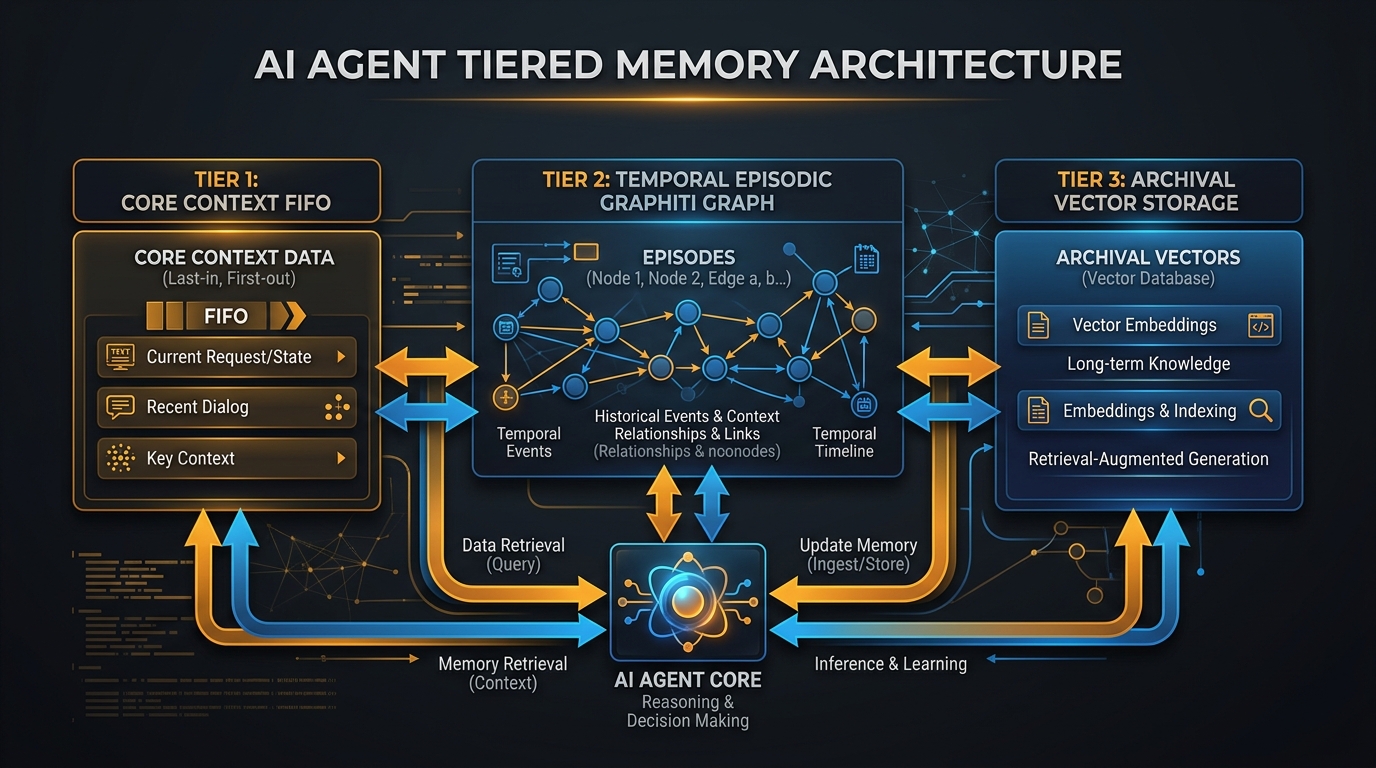
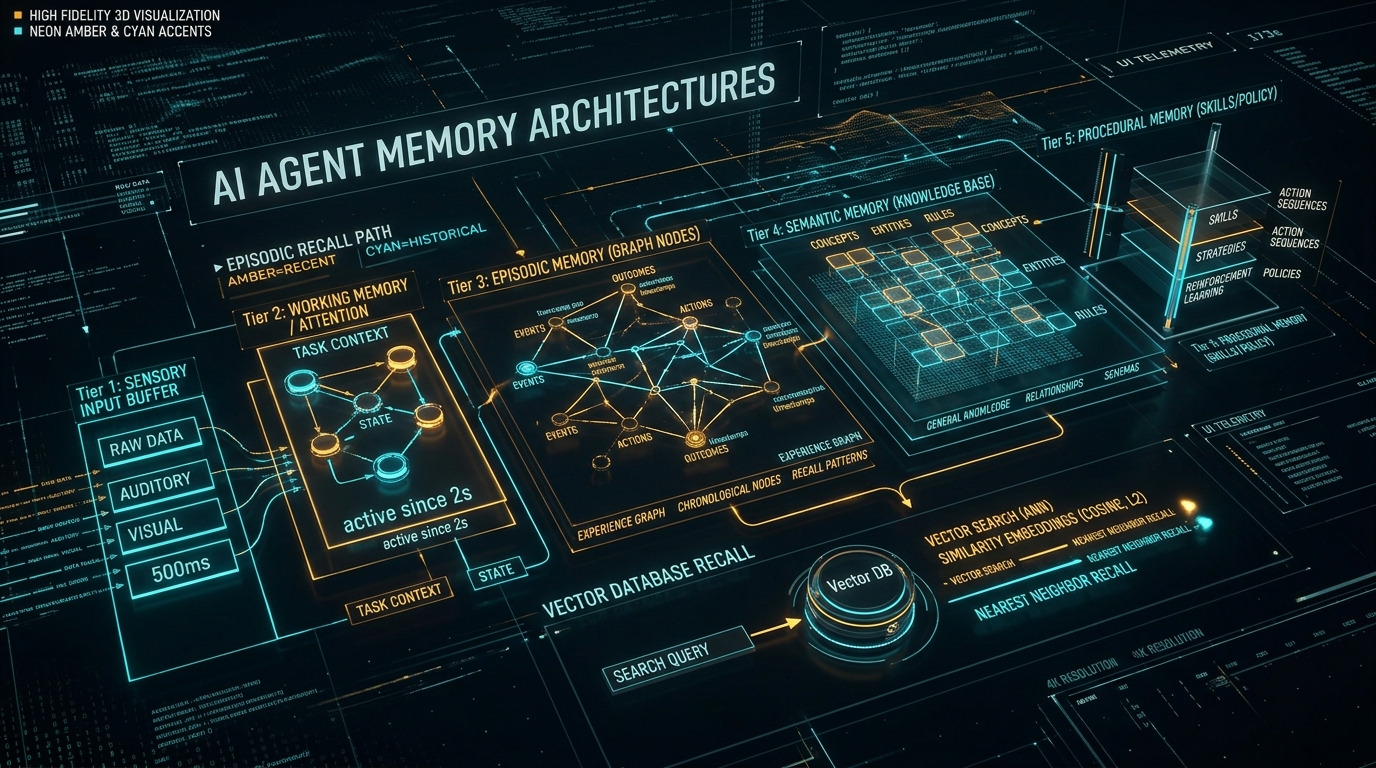
2. The Agent Memory Hierarchy: Cognitive Tiers in Production Systems
Modern agent frameworks organize state into a three-tiered hierarchy derived from cognitive psychology and operating system virtual memory paging:
1. Working Memory (Core Context)
The active prompt payload. Contains current system instructions, tool definitions, active scratchpads, and the immediate conversation turn buffer.
2. Episodic Memory (Temporal Logs)
Time-indexed interaction trajectories and event graphs. Captures multi-session dialogue history, past tool executions, and their observed outcomes.
3. Semantic Memory (Archival Graph)
Consolidated factual knowledge, entity ontologies, durable user preferences, and domain repositories decoupled from conversational timestamps.
3. Deep Dive: MemGPT (Letta) — Operating System-Style Context Virtualization
Developed by UC Berkeley researchers and evolved into the open-source Letta platform (Packer et al., 2023), MemGPT treats the LLM context window analogously to CPU cache and RAM, virtualizing memory management through autonomous tool calling.
Rather than relying on automated passive injection, MemGPT equips the agent with explicit memory-management functions:
core_memory_append(section, content): Appends critical facts to the prompt-resident Core Memory block.core_memory_replace(section, old_content, new_content): Mutates obsolete facts to prevent context contradictions.archival_memory_insert(content): Persists large unstructured data, code snippets, or document logs into secondary storage.archival_memory_search(query, page): Pages historical knowledge back into the working context on demand.
// Example: MemGPT Core Memory Schema and Mutation
class
AgentCoreMemory:human_profile: str = "User is a Senior Systems Engineer based in Austin, TX. Stack: Python, Rust."
persona_state: str = "Autonomous AI architecture assistant. Concise, verified outputs."
scratchpad: str = "Investigating gRPC serialization overhead in distributed worker fleet."
# Autonomous self-directed mutation when state updates
agent.execute_tool("core_memory_replace", {
section: "human_profile",
target: "Stack: Python, Rust.",
replacement: "Stack: Go, Zig, ClickHouse."
})
4. Deep Dive: Zep and the Graphiti Temporal Knowledge Graph
While MemGPT relies on the LLM to actively manage its own memory via tool calls, Zep approaches state retention through automated, asynchronous graph synthesis via its open-source Graphiti engine.
Graphiti converts continuous interaction streams into dynamic bi-temporal knowledge graphs:
- Asynchronous Entity & Edge Extraction: Background workers extract subject-predicate-object triples (e.g.,
[Engineering Lead] -[USES_INFRA]-> [Kubernetes]) from raw dialogue without blocking user response streaming. - Bi-Temporal Edge Versioning: Every edge maintains both valid time (when the fact was true in reality:
valid_from/valid_until) and transaction time (when the system recorded it:created_at/invalidated_at). - Automated Edge Invalidation: When contradictory information is observed, Graphiti marks the existing relationship edge as invalidated rather than performing hard deletes, preserving full historical auditability.
- Hybrid Graph-Vector Retrieval: Query execution combines dense vector similarity over entity nodes with BM25 keyword matching and 1–2 hop breadth-first edge expansion.
5. Deep Dive: Mem0 and Multi-Tier Context Partitioning
Mem0 focuses on multi-tenant, partitioned memory abstraction designed for enterprise agent swarms and multi-agent coordination frameworks (such as CrewAI, LangGraph, and AutoGen):
- User-Level Memory: Persistent profile information and cross-session entity attributes tied to a specific user identity.
- Session-Level Memory: Scoped transactional context that automatically expires or flushes upon workflow completion.
- Agent-Level Memory: Shared heuristics, tool invocation strategies, and domain ontologies accessible across a fleet of specialized worker agents.
Mem0 evaluates incoming conversational turns against existing memory representations, detecting semantic divergence to execute automated CRUD (Create, Read, Update, Delete) operations across configured vector and graph datastores (e.g., Qdrant, Chroma, Neo4j, or pgvector).
6. Architectural Scorecard: MemGPT vs. Zep vs. Mem0
| Evaluation Dimension | MemGPT (Letta) | Zep (Graphiti) | Mem0 |
|---|---|---|---|
| Memory Abstraction | Virtual OS-style Paging (Core, Recall, Archival) | Dynamic Bi-Temporal Knowledge Graphs | Multi-Tier Partitioned Entity Store |
| State Mutation Model | LLM-initiated explicit tool calls (in-band) | Asynchronous extraction pipeline with edge invalidation | Semantic divergence checking & automated CRUD |
| Temporal Reasoning | Sequential message log search | Native bi-temporal edge attributes (valid/invalidated time) | Timestamped session clusters & metadata filtering |
| Storage Layer Dependencies | PostgreSQL + pgvector / SQLite | Neo4j / FalkorDB + Qdrant / pgvector | Qdrant / Chroma / Neo4j / pgvector |
| Operational Latency Profile | Multi-turn tool execution loop per retrieval event | Fast hybrid graph lookup; extraction decoupled to background | Low-latency direct vector + KV retrieval |
| Context Optimization | Fixed-size prompt block + selective archival search | Subgraphs injected on demand (200–500 tokens) | Targeted profile summaries injected per scope |
| Primary Production Fit | Autonomous conversational agents & personal companions | Enterprise CRM, support workflows, long-horizon temporal tasks | Multi-agent swarms (CrewAI, LangGraph, AutoGen) |
★ Comparative Architecture & Specifications Matrix
The table below summarizes the core mechanisms, underlying storage subsystems, open-source repositories, and foundational documentation across agent memory implementations.
| System | Primary Abstraction | Storage Backend | Open-Source Codebase | Primary Reference |
|---|---|---|---|---|
| MemGPT (Letta) | Hierarchical virtual paging via explicit tool calls | PostgreSQL + pgvector / SQLite | letta-ai/letta | Packer et al. (arXiv:2310.08560) |
| Zep Graphiti | Bi-temporal knowledge graphs with edge invalidation | Neo4j / FalkorDB + Qdrant | getzep/graphiti | Zep Documentation |
| Mem0 | Multi-tier context partitioning (User/Session/Agent) | Qdrant / Chroma / Neo4j / pgvector | mem0ai/mem0 | Mem0 Documentation |
| Microsoft GraphRAG | Hierarchical community detection & summaries | Parquet / LanceDB / Graph Store | microsoft/graphrag | Edge et al. (arXiv:2402.04616) |
7. Production Implementation: Building a Resilient Memory Pipeline
When integrating persistent memory into production agent architectures, consider the following engineering practices:
- Decouple Memory Extraction from the User Critical Path: Never run graph triple extraction synchronously during user response generation. Stream the model's response immediately, then push the conversation turn payload to an asynchronous background message queue (e.g., Redis Streams, RabbitMQ, or Celery) for entity extraction, edge invalidation, and graph synchronization.
- Enforce Strict Injected Token Budgets: Limit dynamically retrieved memory payloads to a hard token budget (e.g., 200–500 tokens max) to prevent memory contexts from dominating prompt reasoning space.
- Implement Cold-Storage Compaction: Move inactive episodic nodes older than 60–90 days into compacted summary embeddings to preserve low graph traversal latencies and prevent graph clutter.
- Guard Against Memory Poisoning: Sanitize and validate external user inputs before allowing agents to commit permanent updates to Core Memory or semantic graph nodes, preventing indirect prompt injection attacks against persistent state.
8. Frequently Asked Questions
Why do naive vector search RAG systems fail for AI agent long-term memory?
Vector databases retrieve text chunks purely based on semantic cosine similarity without awareness of timestamp ordering or state mutation. When facts evolve over time, vector search returns contradictory chunks rather than updated state.
How does MemGPT (Letta) implement OS-style memory management?
It partitions memory into Core Context (working prompt RAM) and Archival/Recall Memory (secondary storage), allowing the agent to autonomously page data in and out via explicit tool functions.
What is the difference between Zep Graphiti and Mem0?
Zep uses Graphiti for bi-temporal knowledge graph versioning with edge invalidation timestamps. Mem0 provides multi-layer memory partitioning across users, sessions, and multi-agent fleets.
How do memory systems optimize LLM context utilization and costs?
By extracting and dynamically injecting only relevant subgraphs or core profile blocks (200–500 tokens) rather than raw historical transcripts (10,000+ tokens), memory engines eliminate the overhead of repetitive token processing.
9. Primary Technical Sources & Citations
- Packer, C., Wooders, S., Lin, K., Fang, V., Patil, S. G., Stoica, I., & Gonzalez, J. E. (UC Berkeley). MemGPT: Towards LLMs as Operating Systems. arXiv:2310.08560 (2023).
- Letta AI (formerly MemGPT). Letta: The Framework for Building Stateful LLM Applications & AI Agents. GitHub Repository: github.com/letta-ai/letta (2024–present).
- Zep AI Engineering. Graphiti: Dynamic Bi-Temporal Knowledge Graph Framework for AI Agents. GitHub Repository: github.com/getzep/graphiti (2024–present).
- Mem0 AI Team. Mem0: The Memory Layer for Personalized AI Applications and Agent Swarms. GitHub Repository: github.com/mem0ai/mem0 (2024–present).
- Edge, D., Trinh, H., Cheng, N., Bradley, J., Chao, A., Mody, A., Truitt, S., & Larson, J. (Microsoft Research). From Local to Global: A Graph RAG Approach to Query-Focused Summarization. arXiv:2402.04616 (2024).
- Liu, N. F., Lin, K., Hewitt, J., Paranjape, A., Bevilacqua, M., Petroni, F., & Liang, P. (Stanford University). Lost in the Middle: How Language Models Use Long Contexts. Transactions of the Association for Computational Linguistics (2024).
Tags
Lead Systems Architect at Teach AI Tools • Specializing in Agentic Memory, Late-Interaction Retrieval (ColPali), & High-Throughput Distributed AI Serving.
Sourabh leads distributed AI research and production infrastructure at Teach AI Tools. His research focuses on solving the visual information bottleneck in multi-modal RAG systems and engineering scalable vector database late-interaction pipelines. View complete technical background, publications & editorial standards →