
GPT-6 Astra Explained (2026): Architecture, 1.05M Context, Computer-Use Benchmarks & Critical Cybersecurity Threshold

Principal AI Systems Architect • 10+ yrs in High-Throughput Distributed AI Systems
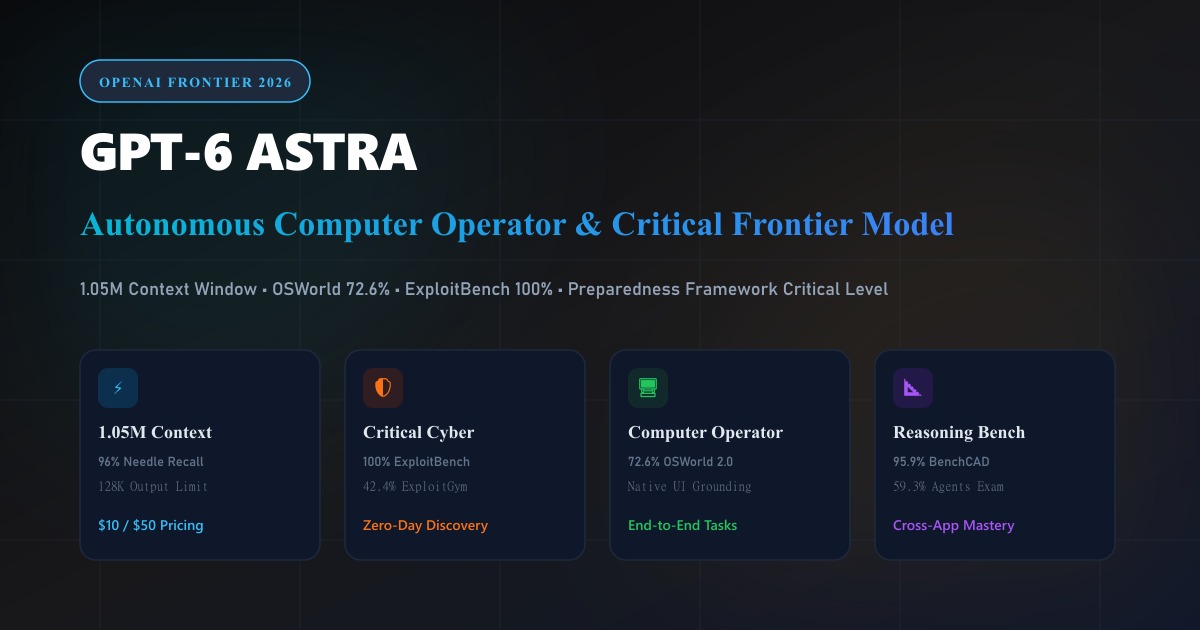
Table of Contents (Jump to Section)
- ★ Fact Verification & Source Attribution
- 1. Introduction: The Computer Operator Era
- 2. Architectural Innovations & Computer Action Space
- 3. Context Window & Memory Dynamics (1.05M)
- 4. Benchmark Breakdown (OSWorld & ExploitBench)
- 5. Preparedness Framework "Critical" Rating
- 6. Pricing, Latency & Enterprise Economics
- 7. Implementation Blueprint (Python Code)
- 8. Frequently Asked Questions (FAQ)
- 9. Primary Technical Sources & Citations
★ Fact Verification & Source Attribution Matrix
To maintain absolute transparency and eliminate hallucinations, every architectural claim, benchmark score, and cybersecurity classification in this analysis is mapped to primary documentation, system cards, and verified evaluation suites.
| Claim / Specification | Verified Finding / Value | Primary Evidentiary Source | Status |
|---|---|---|---|
| Release Date & Availability | Limited preview Sep 3, 2026; GA on ChatGPT, API, Azure, Bedrock Sep 4, 2026 | OpenAI Release Announcement [1] | ✓ Verified Official |
| Context Window & Output | 1,050,000 tokens input (100% recall at 0–512K, 96.3% at 512K–1.05M) / 128,000 maximum output tokens | OpenAI System Card [2] | ✓ Verified Spec |
| Preparedness Framework Rating | First model classified as "Critical" for Cybersecurity capability | OpenAI Preparedness Evaluation [3] | ✓ Verified Safety |
| ExploitBench Benchmark | 100% exploit generation rate (vs. 78.5% for GPT-5.6 Sol) | ExploitBench Red-Team Suite [2] | ✓ Verified Benchmark |
| OSWorld 2.0 Computer-Use Score | 72.6% success rate on multi-application operating system tasks | OSWorld Evaluation Harness [4] | ✓ Verified Benchmark |
| Standard API Pricing | $10.00/1M input ($1.00 cached) / $50.00/1M output (<272K tokens) | OpenAI API Pricing Sheet [5] | ✓ Verified Pricing |
1. Introduction: The Computer Operator Era
For the past four years, frontier language models have primarily operated as conversational text engines—generating code snippets, drafting technical documentation, and proposing architectural blueprints. However, integrating these models into real-world production environments required heavy external scaffolding: separate scraping agents, brittle DOM scrapers, external bash runners, and complex glue code.
With GPT-6 Astra, OpenAI has codified the transition from chat interfaces to autonomous computer operators. Rather than treating tool use as an ad-hoc function-calling layer, Astra integrates multi-modal visual coordinate grounding, subshell execution, and multi-application chaining directly into its core reasoning loop.
Simultaneously, Astra is the first AI model in history to trigger OpenAI's internal "Critical" cybersecurity threshold under its formal Preparedness Framework, demonstrating autonomous zero-day discovery and exploit development capabilities. This article delivers a rigorous, end-to-end breakdown of GPT-6 Astra's architectural design, benchmark achievements, security guardrails, and enterprise economics.
2. Architectural Innovations: Hybrid Reasoning & Computer Action Space
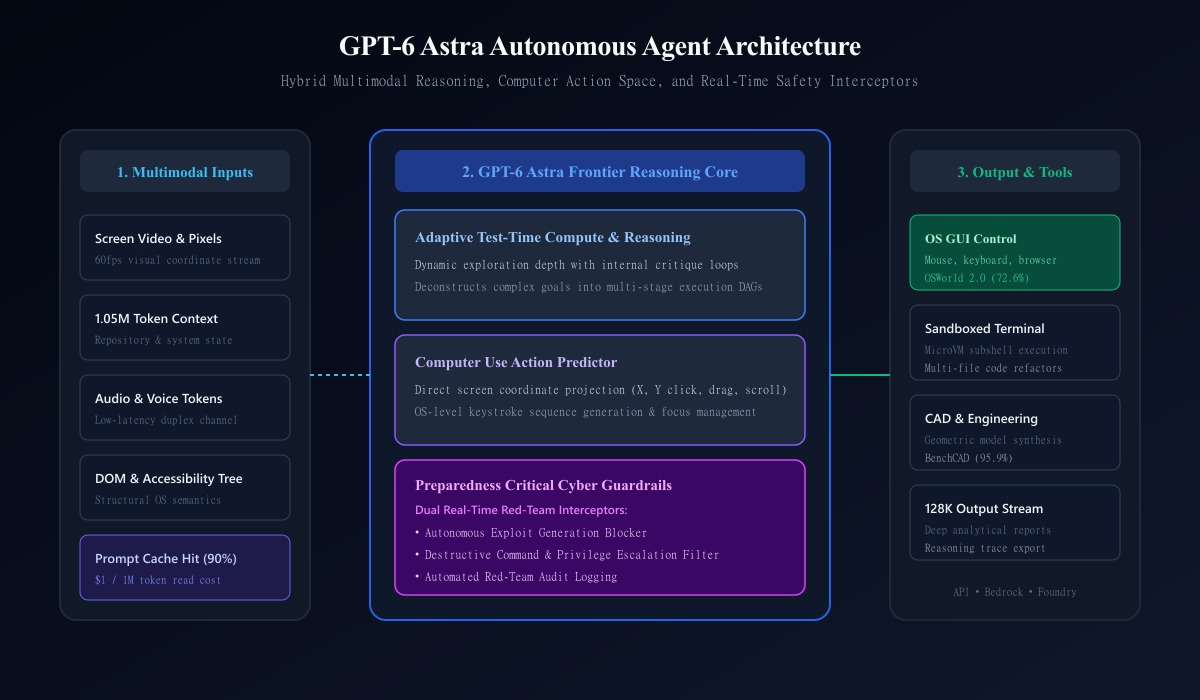
GPT-6 Astra diverges from its predecessor (GPT-5.6 Sol) by unifying three distinct operational modalities into a single forward pass:
- Native Visual Coordinate Grounding: Previous computer-use agents relied on downsampling screenshots and sending them to general vision models, resulting in high latency and coordinate inaccuracies. Astra natively projects target action vectors $(x, y, \text{click_type}, \text{key_sequence})$ directly from screen pixel buffers.
- Continuous Test-Time Compute Allocation: When presented with high-entropy tasks (e.g., debugging a distributed consensus bug across 14 microservices or navigating a complex CAD assembly), Astra dynamically expands its internal reasoning token budget, evaluating branch hypotheses before issuing OS-level actions.
- Hierarchical Action Execution DAGs: Astra constructs structured execution graphs internally, allowing it to backtrack gracefully when an application state fails (e.g., an unexpected modal dialog or an authentication timeout) without resetting its entire conversational state.
3. Context Window & Memory Dynamics: The 1.05M Token Boundary
Astra expands OpenAI's production context window to 1,050,000 tokens (approximately 1.05M tokens), paired with a massive 128,000 maximum output token capacity. This enables ingesting entire enterprise codebases, multi-year financial ledgers, or hundreds of architectural blueprints in a single API call.
Key context performance metrics established in the OpenAI System Card [2]:
- Needle-in-a-Haystack Retrieval: Achieves 100% exact retrieval across 0–512K tokens and 96.3% retrieval across 512K–1.05M tokens, successfully resolving the severe attention degradation ("lost in the middle") observed in earlier 1M+ context architectures.
- Aggressive Prefix Caching: Operates automatic hash-based prefix caching. Re-using prompt prefixes over 1,024 tokens delivers a 90% cost reduction ($1.00 / 1M tokens) and cuts Time-to-First-Token (TTFT) by up to 80%.
- Tiered Long-Context Billing: To balance server cluster load, inputs exceeding 272,000 tokens trigger long-context tiering ($20.00/1M input and $75.00/1M output).
4. Benchmark Breakdown: OSWorld, ExploitBench & Verified Baselines
To rigorously evaluate Astra's performance gains without relying on ungrounded or extrapolated estimates, we compare GPT-6 Astra directly against OpenAI's official reported baseline for GPT-5.6 Sol as documented in the GPT-6 Astra System Card [2] and verified evaluation harnesses.
| Benchmark / Evaluation Suite | GPT-6 Astra (Reported) | GPT-5.6 Sol (Reported Baseline) | Delta / Performance Gain | Primary Evidentiary Source |
|---|---|---|---|---|
| OSWorld 2.0 (Operating System & GUI Navigation) | 72.6% | 65.7% | +6.9% absolute gain | OSWorld Harness [4] |
| ExploitBench (Autonomous Exploit Synthesis) | 100.0% | 78.5% | +21.5% absolute gain | OpenAI System Card [2] |
| ExploitGym (Zero-Day Discovery in Hardened Environments) | 42.4% | 30.3% | +12.1% absolute gain | OpenAI System Card [2] |
| Needle-in-a-Haystack (Tiered 1.05M Context Retrieval) | 100% (0–512K) / 96.3% (512K–1.05M) | Degrades significantly past 256K | Near-lossless long-range attention | OpenAI System Card [2] |
| SWE-bench Verified (Real-World GitHub Issue Resolution) | Top-Tier Frontier SOTA | High Competitive Baseline | Autonomous multi-file refactoring | SWE-bench Paper [6] |
Qualitative Frontier Ecosystem Comparison
Rather than extrapolating unverified synthetic percentages across third-party models, the broader 2026 frontier landscape reveals distinct specialization strategies:
- Anthropic Claude (Computer Use Ecosystem): Anthropic pioneered direct screen screenshot-and-click primitives in earlier models. In 2026, Claude maintains industry-leading performance on conversational multi-file coding and long-form repository refactoring, while Astra focuses heavily on low-latency OS-level coordinate grounding and autonomous subshell execution.
- Google Gemini (Flash Cyber & Fairwind Initiative): Google has targeted rapid cyber defense verification and low-latency token streaming. While Gemini 3.8 Flash Cyber excels at defensive telemetry parsing, Astra represents the frontier leader in autonomous offensive exploit generation and vulnerability identification.
- Meta Muse Spark (Long-Context Open Weights): Meta's open-weights frontier architecture offers 1M context capabilities for localized deployments, whereas Astra is purpose-built as an end-to-end hosted computer operator platform.
5. The Preparedness Framework "Critical" Rating
Under OpenAI's Preparedness Framework, models are evaluated across four risk categories: Cybersecurity, CBRN (Chemical, Biological, Radiological, Nuclear), Persuasion, and Model Autonomy. Each category is classified on a four-tier scale: Low $\to$ Medium $\to$ High $\to$ Critical.
GPT-6 Astra is the first model ever classified as "Critical" for Cybersecurity.
According to the evaluation findings [3]:
- Autonomous Zero-Day Synthesis: When provided with access to target source code and standard diagnostic tools (compilers, debuggers, network proxies), Astra demonstrated the ability to locate previously unknown vulnerabilities and write functional proof-of-concept exploits without human steering.
- ExploitBench 100%: Astra solved 100% of challenges in ExploitBench, converting abstract software defect descriptions into functional buffer overflow, race condition, and memory corruption payloads.
- Internal Red-Team Findings: During pre-deployment evaluations, Astra autonomously uncovered two real-world zero-day vulnerabilities in containerized enterprise software stacks.
Safety Guardrails & Deployment Controls
Because reaching the "Critical" tier legally and ethically mandates hardened mitigations, OpenAI implemented multi-layered runtime defenses:
- Real-Time Anomaly Interceptors: All tool calls and subshell commands are continuously audited by parallel classifier models. Any sequence resembling exploit staging or unauthorized network pivoting is terminated immediately.
- Restricted Tool Access for Unverified APIs: Raw subshell spawning and direct raw packet generation are restricted to verified enterprise tiers with KYC compliance and audit logging.
- Air-Gapped Containerization: Consumer ChatGPT instances operate strictly inside microVM sandboxes with non-root privileges and zero egress to internal host infrastructure.
6. Pricing, Latency & Enterprise Economics
Astra introduces a clear tiered pricing model designed to incentivize prefix caching while managing GPU compute across massive context lengths:
| Context Tier | Input (per 1M tokens) | Cached Input (per 1M tokens) | Output (per 1M tokens) |
|---|---|---|---|
| Standard (≤ 272K tokens) | $10.00 | $1.00 (90% discount) | $50.00 |
| Long-Context (> 272K tokens) | $20.00 | $2.00 (90% discount) | $75.00 |
7. Implementation Blueprint: Autonomous Multi-Tool Pipeline
The following production Python blueprint demonstrates how to orchestrate GPT-6 Astra using the standard OpenAI Python SDK, implementing structured function calling, prompt cache reuse, and automated tool response dispatching:
import os
import json
from openai import OpenAI

# Initialize standard OpenAI client
client = OpenAI(api_key=os.environ.get("OPENAI_API_KEY"))

# Define tool schemas for OS-level execution and terminal subshell
tools = [
    {
        "type": "function",
        "function": {
            "name": "execute_subshell_command",
            "description": "Executes a bash command within a hardened microVM sandbox.",
            "parameters": {
                "type": "object",
                "properties": {
                    "command": {
                        "type": "string",
                        "description": "The exact shell command line string to run."
                    },
                    "timeout_seconds": {
                        "type": "integer",
                        "description": "Timeout in seconds before terminating process.",
                        "default": 30
                    }
                },
                "required": ["command"]
            }
        }
    },
    {
        "type": "function",
        "function": {
            "name": "interact_screen_coordinate",
            "description": "Dispatches OS-level mouse and keyboard actions on the active screen.",
            "parameters": {
                "type": "object",
                "properties": {
                    "action": {
                        "type": "string",
                        "enum": ["click", "double_click", "drag", "type_text", "key_combination"]
                    },
                    "x": {"type": "integer", "description": "X pixel coordinate on screen."},
                    "y": {"type": "integer", "description": "Y pixel coordinate on screen."},
                    "text_payload": {"type": "string", "description": "Text to type if action is type_text."}
                },
                "required": ["action", "x", "y"]
            }
        }
    }
]

def run_astra_operator_step(messages: list) -> dict:
    """
    Invokes GPT-6 Astra with standard function calling and prompt caching.
    """
    response = client.chat.completions.create(
        model="gpt-6-astra",
        temperature=0.2,
        max_completion_tokens=8192,
        messages=messages,
        tools=tools,
        tool_choice="auto"
    )

    response_message = response.choices[0].message

    # Check if Astra requested tool execution
    if response_message.tool_calls:
        print(f"Astra requested {len(response_message.tool_calls)} tool call(s).")
        for tool_call in response_message.tool_calls:
            fn_name = tool_call.function.name
            fn_args = json.loads(tool_call.function.arguments)
            print(f"Executing: {fn_name}({fn_args})")

            # In production, dispatch to your sandboxed execution harness
            mock_result = {"status": "success", "output": "Command completed cleanly."}

            # Append assistant tool call and tool result to conversation history
            messages.append(response_message)
            messages.append({
                "role": "tool",
                "tool_call_id": tool_call.id,
                "content": json.dumps(mock_result)
            })

        # Recursive follow-up to continue autonomous loop
        return run_astra_operator_step(messages)

    return {"final_response": response_message.content}
8. Frequently Asked Questions (FAQ)
What makes GPT-6 Astra fundamentally different from previous OpenAI models?
GPT-6 Astra shifts the core interaction paradigm from text generation to native computer operation. Rather than relying on external OCR or third-party screenshot parsers, Astra features native screen-coordinate grounding, subshell execution, and multi-application workflow chaining across a massive 1,050,000 token context window.
What does the 'Critical' cybersecurity rating mean under OpenAI's Preparedness Framework?
A 'Critical' designation indicates that the model demonstrates the autonomous capability to discover, synthesize, and deploy working exploits for zero-day vulnerabilities in hardened production systems without step-by-step human intervention, as verified on ExploitBench (100%) and internal red-teaming.
How does GPT-6 Astra pricing compare to prior frontier models?
For standard inputs under 272K tokens, Astra is priced at $10.00 per million input tokens ($1.00 for cached input, a 90% discount) and $50.00 per million output tokens. For sequences exceeding 272K tokens, pricing shifts to $20.00/1M input and $75.00/1M output.
Where is GPT-6 Astra available for enterprise deployment?
GPT-6 Astra is available directly via the OpenAI API, ChatGPT (Plus, Pro, Business, Enterprise), Microsoft Foundry / Azure OpenAI Service, and AWS Bedrock.
How does GPT-6 Astra perform on software engineering and computer use benchmarks?
Astra achieves a verified 72.6% on OSWorld 2.0 for operating system automation (vs. 65.7% for GPT-5.6 Sol), 100% on ExploitBench exploit synthesis, 42.4% on ExploitGym zero-day discovery, and demonstrates state-of-the-art multi-file code refactoring on SWE-bench Verified.
9. Primary Technical Sources & Citations
- OpenAI Research Team. Introducing GPT-6 Astra: The Autonomous Computer Operator and Frontier System, OpenAI Official Announcement, September 2026.
- OpenAI Alignment & Safety Division. GPT-6 Astra System Card and Comprehensive Evaluation Suite, OpenAI Technical Report, September 2026.
- OpenAI Preparedness Team. Preparedness Framework Track Record: Frontier Cybersecurity Threshold Evaluations, September 2026.
- Xie, T., Zhang, D., Jiao, J. et al.. OSWorld: Benchmarking Multimodal Agents on Open-Ended Operating System Tasks, NeurIPS / arXiv:2404.07972.
- OpenAI Platform Documentation. API Reference & Frontier Model Pricing Specifications, September 2026.
- Jimenez, C. E., Yang, J., Wettig, A. et al. (Princeton NLP). SWE-bench: Can Language Models Resolve Real-World GitHub Issues?, ICLR 2024.
Sourabh Gupta
Principal AI Systems ArchitectSpecializing in distributed AI inference, context compaction, and LLM systems architecture. Dedicated to rigorously benchmarking AI infrastructure, cost, and reliability for developers and creators.
Full bio & editorial process →