GPT-6 Migration Guide: Astra vs Sol vs Luna and Which Model to Use

Data Scientist & AI Practitioner • 2+ Years in AI/ML & LLM Benchmark Tracking
1. What Is GPT-6?
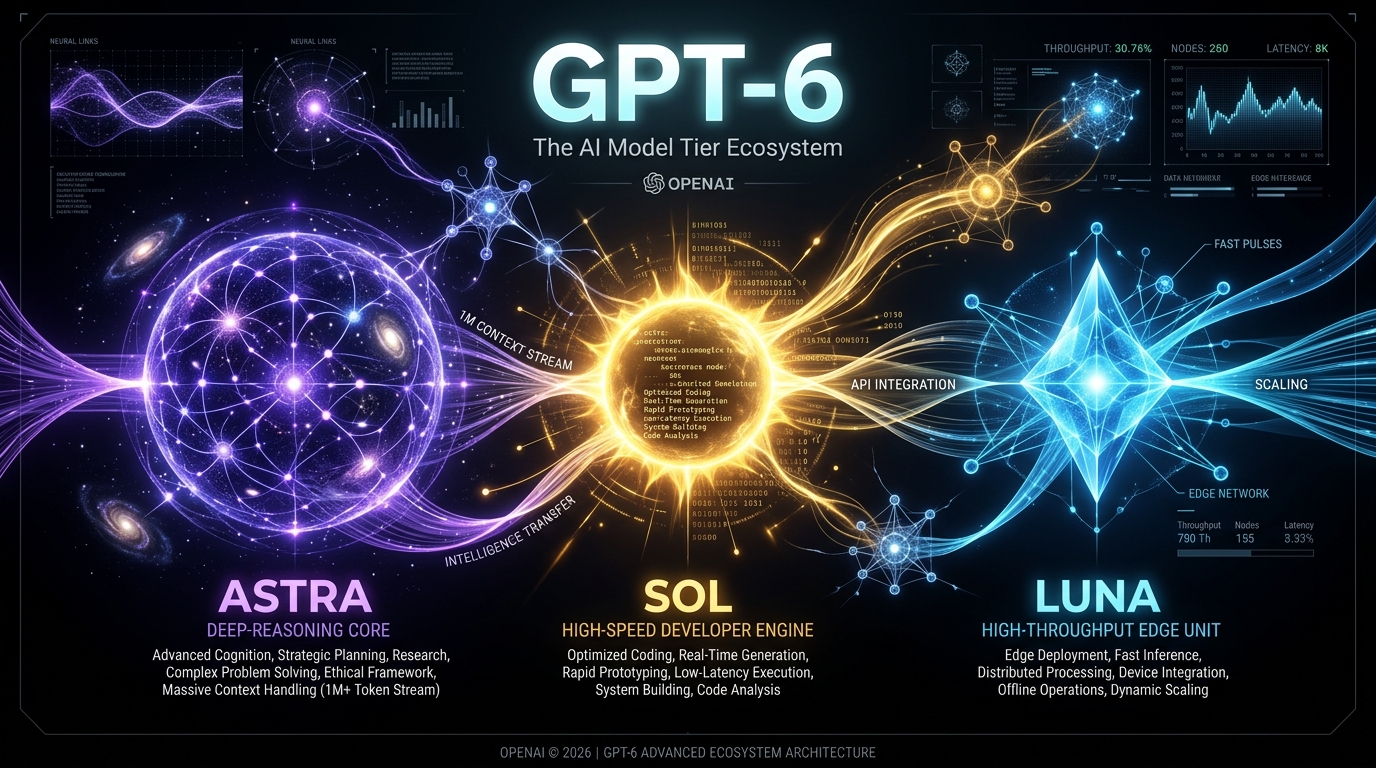
GPT-6 is OpenAI's foundation model family introduced in late September 2026. The release structures frontier intelligence into three operational tiers: GPT-6 Astra, GPT-6 Sol, and GPT-6 Luna.
A central design characteristic of the GPT-6 family is the direct integration of configurable reasoning controls into the model endpoints. Rather than maintaining completely separate product lines for general chat and reasoning, developers can adjust test-time reasoning compute using the reasoning_effort parameter on supported tiers.
1.05M Tokens
1.05M-token context window across GPT-6 Astra, Sol, and Luna with up to 128K max output tokens.
Tiered by Workload
Priced from $0.10/1M input (Luna) up to $10.00/1M input (Astra) for standard short-context requests.
Recommended
OpenAI designates the Responses API endpoint for GPT-6 tool calling and structured workflows.
2. GPT-6 Astra vs Sol vs Luna
OpenAI defines the three GPT-6 tiers around specific workload requirements:
- GPT-6 Astra: Highest capability for complex reasoning, mathematical synthesis, and deep multi-step coding problems.
- GPT-6 Sol: Designed for demanding tasks where you want a balance of capability and cost, such as full-stack software development and agent workflows.
- GPT-6 Luna: Designed for efficient, repeatable, high-volume workloads where latency and cost matter.
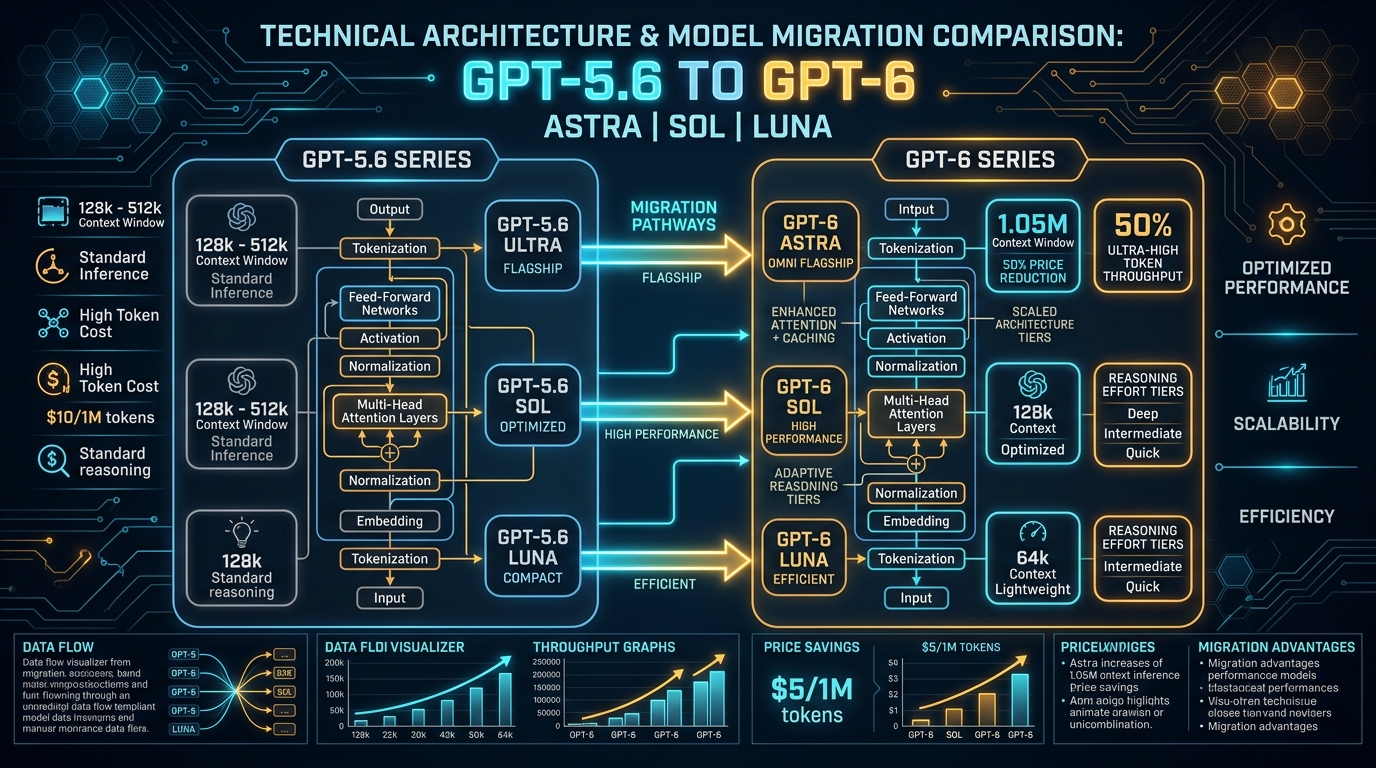
| Model | Model Identifier | Target Positioning | Context Window | Max Output | Supported Reasoning Levels |
|---|---|---|---|---|---|
| GPT-6 Astra | gpt-6-astra |
Highest capability for complex reasoning & coding | 1,050,000 | 128,000 | low, medium, high, xhigh, max |
| GPT-6 Sol | gpt-6-sol |
Balanced capability & cost for demanding tasks | 1,050,000 | 128,000 | none, low, medium, high, xhigh, max |
| GPT-6 Luna | gpt-6-luna |
Efficient, repeatable, high-volume workloads | 1,050,000 | 128,000 | none, low, medium, high, xhigh, max |
3. GPT-6 Pricing & Cost Structure
Standard short-context pricing (prompts ≤272,000 tokens) matches the current OpenAI API documentation:
| Model | Input Price / 1M | Output Price / 1M | Cached Input Price / 1M | Prompts >272k Tokens |
|---|---|---|---|---|
| GPT-6 Astra | $10.00 | $50.00 | $1.00 | $15.00 / 1M input |
| GPT-6 Sol | $2.00 | $10.00 | $0.20 | $3.00 / 1M input |
| GPT-6 Luna | $0.10 | $0.50 | $0.01 | $0.15 / 1M input |
4. GPT-6 vs GPT-5.6: Architectural Changes
Transitioning from GPT-5.6 to GPT-6 introduces key operational differences:
- Standardized Context Limits: GPT-6 standardizes the published 1.05M-token context window across Astra, Sol, and Luna.
- Expanded Output Capacity: Output token limits have increased to 128,000 tokens across all three models, facilitating large single-turn code generation and document extraction tasks.
- Unified Reasoning Parameter: Rather than toggling between distinct reasoning-only and base model endpoints, developers configure
reasoning_efforton the same model ID.
5. Which GPT-6 Model Should You Use?
OpenAI's guidance frames model selection around the complexity of the task, latency tolerance, and cost constraints:
GPT-6 Astra
Use when output correctness and rigorous multi-step deduction are paramount, and compute cost is secondary.
gpt-6-astraGPT-6 Sol
Use for interactive coding, agentic harness loops, full repository refactoring, and multi-tool orchestration.
gpt-6-solGPT-6 Luna
Use for high-frequency classification, batch summarization, RAG query parsing, and interactive chat where latency matters.
gpt-6-luna6. Which GPT-6 Model Should You Migrate To?
OpenAI does not suggest that every older model maps one-to-one to a single GPT-6 model. Instead, migration depends on your specific performance requirements:
| Typical workload / legacy model examples | Recommended GPT-6 Target | Decision Criteria |
|---|---|---|
| Complex reasoning, deep research, advanced coding, computer-use workflows (e.g., GPT-5.6 Sol workloads) | GPT-6 Astra | Choose Astra when maximum capability is the priority. |
| General software engineering, agent workflows, everyday professional work (e.g., GPT-5.6 Terra workloads) | GPT-6 Sol | Choose Sol when you need a balance of capability, reasoning, and cost. |
| High-volume classification, extraction, summarization, and routine automation (e.g., GPT-5.6 Luna workloads) | GPT-6 Luna | Choose Luna when efficiency, throughput, and lower cost are the priority. |
7. GPT-6 Astra Use Cases
GPT-6 Astra is suited for workloads where reasoning accuracy outweighs latency:
- Supervisory Planning in Multi-Agent Systems: Serving as the top-level orchestrator in hierarchical agent swarms (e.g. LangGraph, CrewAI) to synthesize requirements and decompose tasks. See our technical guide on AI Agent Memory Architectures.
- Scientific & Bio-Computational Research: Validating complex chemical equations, theorem proving, and analyzing multi-document academic literature.
- High-Stakes Legal & Regulatory Audits: Comparing complex enterprise compliance policies against regulatory frameworks on the AI Governance Dashboard.
8. GPT-6 Sol Use Cases
GPT-6 Sol serves as the primary engine for engineering and developer workflows:
- Terminal-First Coding Loops: Powering autonomous programming tools that parse AST errors, execute test suites, and refactor multi-file codebases. For implementation details, see Building Autonomous CLI Coding Loops.
- Multi-Step Tool Orchestration: Reliable invocation of external APIs, SQL queries, and microservices via the Responses API.
- Full-Stack Application Prototyping: Generating frontend and backend modules with full type definitions and test harnesses.
9. GPT-6 Luna Use Cases
GPT-6 Luna has substantially lower published per-token pricing than GPT-6 Sol and Astra for high-volume AI workloads:
- RAG Pipeline Preprocessing & Chunking: Parsing documents, generating metadata, and scoring candidate chunks before forwarding to deeper models. Learn more in our comparison of GraphRAG vs Hybrid Vector Search.
- Customer Support & Conversational Interfaces: Designed for efficient, repeatable workloads where latency and cost matter.
- Batch Data Extraction & Classification: Processing large datasets of unstructured logs, user feedback, and transaction records.
10. GPT-6 API Migration & Responses API Implementation
OpenAI's GPT-6 migration guidance emphasizes the Responses API as the primary integration path. In particular, GPT-6 Astra tool calling requires the Responses API, while Sol and Luna have limitations around function calling in legacy Chat Completions.
Important API Rule: When reasoning_effort is enabled (any setting other than none), sampling parameters such as temperature, top_p, and presence_penalty should be omitted.
Python Example: Responses API with Tool Calling and Reasoning Control
# Upgrade SDK: pip install --upgrade openai
from openai import OpenAI
client = OpenAI()
# Using the recommended Responses API for GPT-6
response = client.responses.create(
model="gpt-6-sol",
input=[
{"role": "user", "content": "Diagnose this cache invalidation race condition."}
],
reasoning_effort="medium", # Sol supports: none, low, medium, high, xhigh, max
tools=[{
"type": "function",
"name": "inspect_redis_keys",
"description": "Fetch TTL and memory state for active keys.",
"parameters": {
"type": "object",
"properties": {"pattern": {"type": "string"}},
"required": ["pattern"]
}
}]
# Note: temperature is omitted when reasoning_effort is active
)
print(response.output_text)
TypeScript / Node.js Responses API Example
// npm install openai@latest
import OpenAI from "openai";
const openai = new OpenAI();
async function runWorkflow() {
const response = await openai.responses.create({
model: "gpt-6-luna",
input: [{ role: "user", content: "Extract customer sentiment and topic tags." }],
reasoning_effort: "low",
});
console.log(response.output_text);
}
11. GPT-6 Reasoning Effort Parameters
Reasoning effort support differs across the GPT-6 model family:
| Model | none |
low |
medium |
high |
xhigh / max |
Primary Use Case |
|---|---|---|---|---|---|---|
| GPT-6 Astra | ✗ Not Supported | ✓ Supported | ✓ Supported | ✓ Supported | ✓ Supported | Complex logic, scientific synthesis, formal verification |
| GPT-6 Sol | ✓ Supported | ✓ Supported | ✓ Supported | ✓ Supported | ✓ Supported | Interactive coding (low/medium) to deep refactoring (high) |
| GPT-6 Luna | ✓ Supported | ✓ Supported | ✓ Supported | ✓ Supported | ✓ Supported | Fast chat (none) to structured classification (low) |
Illustrative Multi-Tier Routing Cost Model
Instead of routing all queries to a single model, production applications often route requests based on task difficulty. For example, in an assumed 1,000,000-request monthly workload:
- 800,000 triage/classification requests on Luna (avg. 500 input tokens = 400M tokens @ $0.10/1M = $40)
- 180,000 standard developer/tool tasks on Sol (avg. 1,000 input tokens = 180M tokens @ $2.00/1M = $360)
- 20,000 complex reasoning tasks on Astra (avg. 2,000 input tokens = 40M tokens @ $10.00/1M = $400)
Illustrative cost calculation: Under these assumed token volumes and routing percentages, the input-token spend would be approximately $800/month, compared with $2,000/month if the same input volume were processed entirely by Sol.
12. Frequently Asked Questions (FAQ)
What is OpenAI GPT-6 and when was it released?
GPT-6 is OpenAI's foundation model family released on September 22, 2026. It features three models—GPT-6 Astra, GPT-6 Sol, and GPT-6 Luna—each with a published 1.05M-token context window and up to 128,000 maximum output tokens with adjustable reasoning_effort levels.
Which reasoning_effort levels are supported across GPT-6 models?
GPT-6 Sol and GPT-6 Luna support reasoning_effort values from 'none' up to 'max' (none, low, medium, high, xhigh, max). GPT-6 Astra is a dedicated reasoning model and does not support 'none'; its reasoning levels range from 'low' to 'max'.
Why does OpenAI recommend the Responses API for GPT-6 migration?
OpenAI's migration guidance designates the Responses API (client.responses.create) as the primary endpoint for GPT-6 workloads. In particular, GPT-6 Astra tool calling requires the Responses API, and sampling parameters like temperature are omitted when reasoning_effort is active.
What is the standard API pricing for GPT-6 models?
Standard short-context pricing is: GPT-6 Astra at $10.00 / 1M input ($1.00 cached) and $50.00 / 1M output; GPT-6 Sol at $2.00 / 1M input ($0.20 cached) and $10.00 / 1M output; GPT-6 Luna at $0.10 / 1M input ($0.01 cached) and $0.50 / 1M output. Prompts exceeding 272,000 tokens incur long-context pricing.
How should developers choose which GPT-6 model to migrate to?
Model selection is determined by task demands: choose Astra for the most complex reasoning, deep research, and theorem validation; choose Sol for demanding coding and agent workflows where you want a balance of capability and cost; and choose Luna for high-volume, cost-sensitive, repeatable tasks.
13. Official Documentation & Sources
- OpenAI Product Announcement. Introducing GPT-6, Sol, and Luna. OpenAI Official Blog (September 22, 2026).
- OpenAI Platform Documentation. GPT-6 Model Guide, Responses API, and Reasoning Effort Parameters. OpenAI Docs (2026).
- OpenAI API Pricing Page. Standard and Long-Context Token Pricing Rate Card. OpenAI (2026).
- Teach AI Tools LLM Pulse. Live Model Comparison & Specification Directory. Teach AI Tools (2026).
Tags
Founder of Teach AI Tools • 2+ Years of hands-on Data Science & AI/ML Engineering experience, tracking 844+ live AI models on LLM Pulse.
Sourabh is an active AI practitioner and builder of Teach AI Tools' 6 specialized AI platforms. He focuses on foundation model evaluation, practical developer workflows, and agent architectures. Learn more on the About Us page →