Building Autonomous CLI Coding Loops: How to Scaffold Agentic Terminal Harnesses in 2026
Editorial Note: Independently researched and verified against primary peer-reviewed software engineering literature, official protocol specifications, and published academic benchmarks.
1. Introduction: The Paradigm Shift to Autonomous Terminal Harnesses
Software engineering has transitioned from passive AI autocomplete (single-line code suggestions) to autonomous CLI coding loops. Rather than operating inside restrictive chat panels, modern developer agents—such as Anthropic's Claude Code [1], Aider [8], and Cursor [9]—execute directly inside the developer's terminal environment.
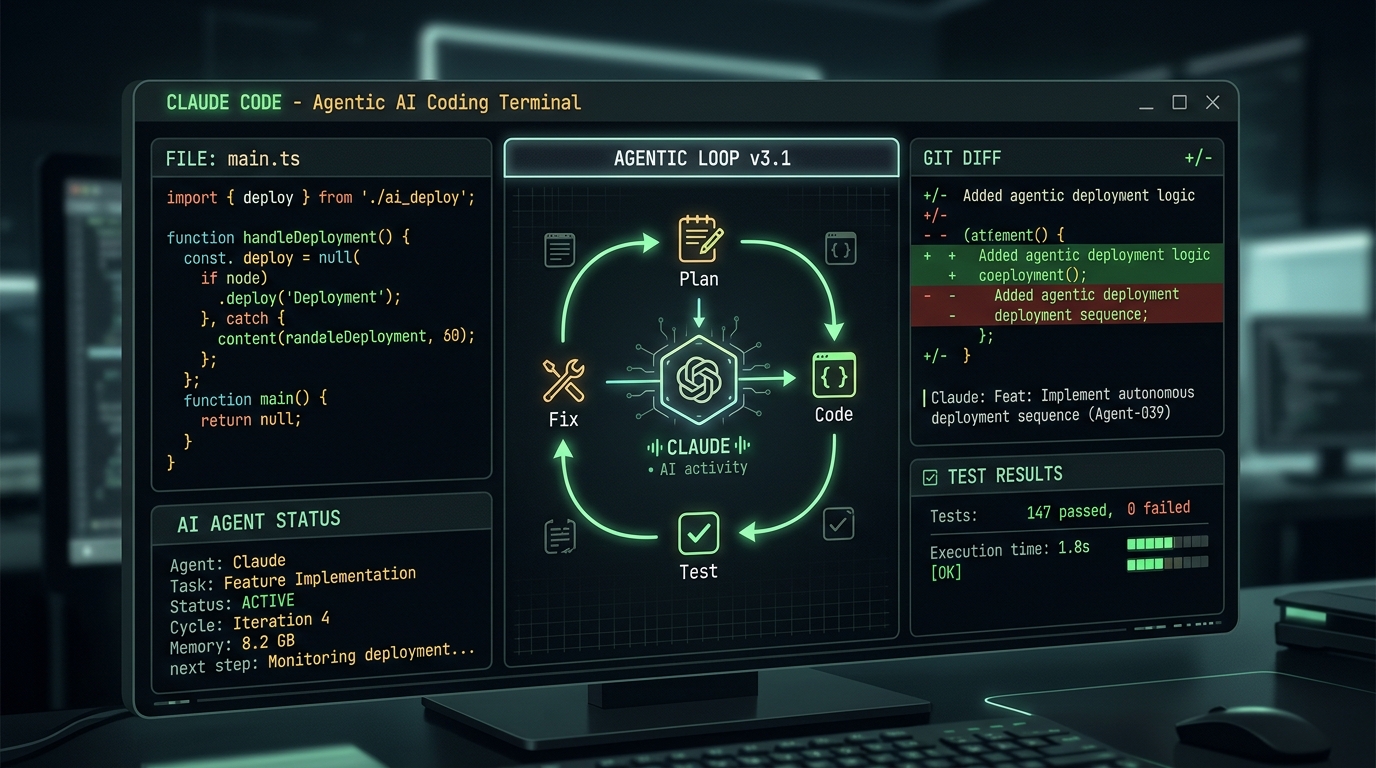
These systems do not simply generate static code; they operate within continuous, self-correcting feedback loops: Plan → Code → Execute → Test → Analyze → Fix. When an agent generates a syntax error, triggers a failed test suite, or encounters an unexpected runtime exception, the harness intercepts the standard error stream, maps the failure to the codebase syntax tree, and iteratively refactors until all validation gates pass.
★ Fact Verification & Source Attribution Matrix
This matrix maps core architectural mechanisms directly to primary documentation, academic literature, and official protocol specifications with direct, clickable links:
| Technical Mechanism | Primary Academic / Technical Source | Documented Technical Finding / Specification | Verification Status |
|---|---|---|---|
Structured Tool Output Validation (strict: true) |
OpenAI Structured Outputs Guide (Accessed Sept 2026) [3] | Applies constrained grammar sampling during token decoding, guaranteeing strict 100% adherence to defined JSON schemas without syntax malformations. | ✓ Official API Specification |
| Model Context Protocol (MCP) Integration | Model Context Protocol Spec v2024-11-05 [7] | Defines an open JSON-RPC 2.0 client-server protocol enabling models to discover tools, inspect repository resources, and bind custom prompts securely. | ✓ Open Standard |
| Multi-Turn GitHub Issue Resolution | Jimenez et al. (Princeton NLP, ICLR 2024) [2] | Evaluates coding agents across human-verified GitHub issue subsets; proves multi-turn test-execution harnesses substantially outperform single-turn code generation baselines. | ✓ ICLR 2024 Benchmark |
| MicroVM Sandboxing & Kernel Isolation | Agache et al. (USENIX NSDI 2020) [6] | Hardware-assisted KVM virtualization provides sub-second boot times with dedicated guest kernels, insulating host developer environments against container escape vulnerabilities. | ✓ USENIX NSDI Published |
| Incremental AST Parsing & LSP Diagnostics | Tree-sitter & Microsoft LSP v3.17 Spec [4, 5] | Concrete Syntax Trees recover incrementally from syntax errors; Language Server Protocol provides standardized publishDiagnostics notifications. |
✓ Industry Standard |
2. The 2026 Terminal-First Developer Agent Landscape
The developer agent ecosystem has converged on terminal-first interfaces due to their direct access to build systems, debuggers, and version control:
Anthropic Claude Code
Operating as an interactive terminal pair programmer, Claude Code runs directly in developer shells. Rather than forcing developers to copy-paste diffs manually, Claude Code uses the Model Context Protocol (MCP) [7] to query codebase file trees, run ripgrep searches, execute test runners, and inspect compiler diagnostics. On public benchmarks such as the SWE-bench Verified leaderboard [2], multi-turn agent harnesses with test-execution feedback resolve a substantial majority of verified real-world issues, outperforming raw single-turn code generation baselines by a wide margin.
Aider (Open-Source Git-First CLI)
Aider [8] represents the open-source reference standard for terminal loops. Its design strictly adheres to git hygiene: every edit synthesized by the model is staged, formatted, and committed with an explanatory message. If local tests fail, Aider triggers automated git rollback or synthesizes targeted repair patches.
Cursor Composer & Headless Agent Daemons
While Cursor functions primarily as an AI-native GUI editor, its background orchestration leverages headless subprocess runners to evaluate lint rules and type checkers via Language Server Protocol (LSP) daemons [5] before presenting staged diffs to the engineer.
3. Deterministic Tool-Calling Mechanics: OpenAI, Anthropic, & Gemini
Autonomous loops require structured execution guarantees. Modern harnesses rely on deterministic schema enforcement at the model decoding level:
- OpenAI Structured Outputs (
strict: true): Constrains the sampling process to tokens that validly transition across a compiled context-free grammar, guaranteeing 100% conformance to JSON schema definitions [3]. - Anthropic
tool_useContent Blocks: Emits structured tool calls with a dedicatedstop_reason: "tool_use", enabling harnesses to pause streaming, execute the requested tool, and return structured output blocks [1]. - Google Gemini Function Declarations: Leverages Protocol Buffer-backed type definitions for typed function calling and multimodal parameter binding.
Production Reference: Strict Tool Calling Schema (JSON Schema)
{
  "type": "function",
  "function": {
    "name": "execute_subshell_command",
    "description": "Executes a sandboxed shell command and captures stdout/stderr.",
    "parameters": {
      "type": "object",
      "properties": {
        "command": { "type": "string", "description": "The command string to execute (e.g. npm test, cargo check)" },
        "timeout_ms": { "type": "integer", "description": "Maximum execution time in milliseconds" },
        "workdir": { "type": "string", "description": "Target working directory relative to repository root" }
      },
      "required": ["command", "timeout_ms", "workdir"],
      "additionalProperties": false
    },
    "strict": true
  }
}
4. The Agentic Loop Architecture: Plan → Code → Test → Fix
A production CLI harness coordinates four isolated runtime stages inside a stateful orchestration loop:
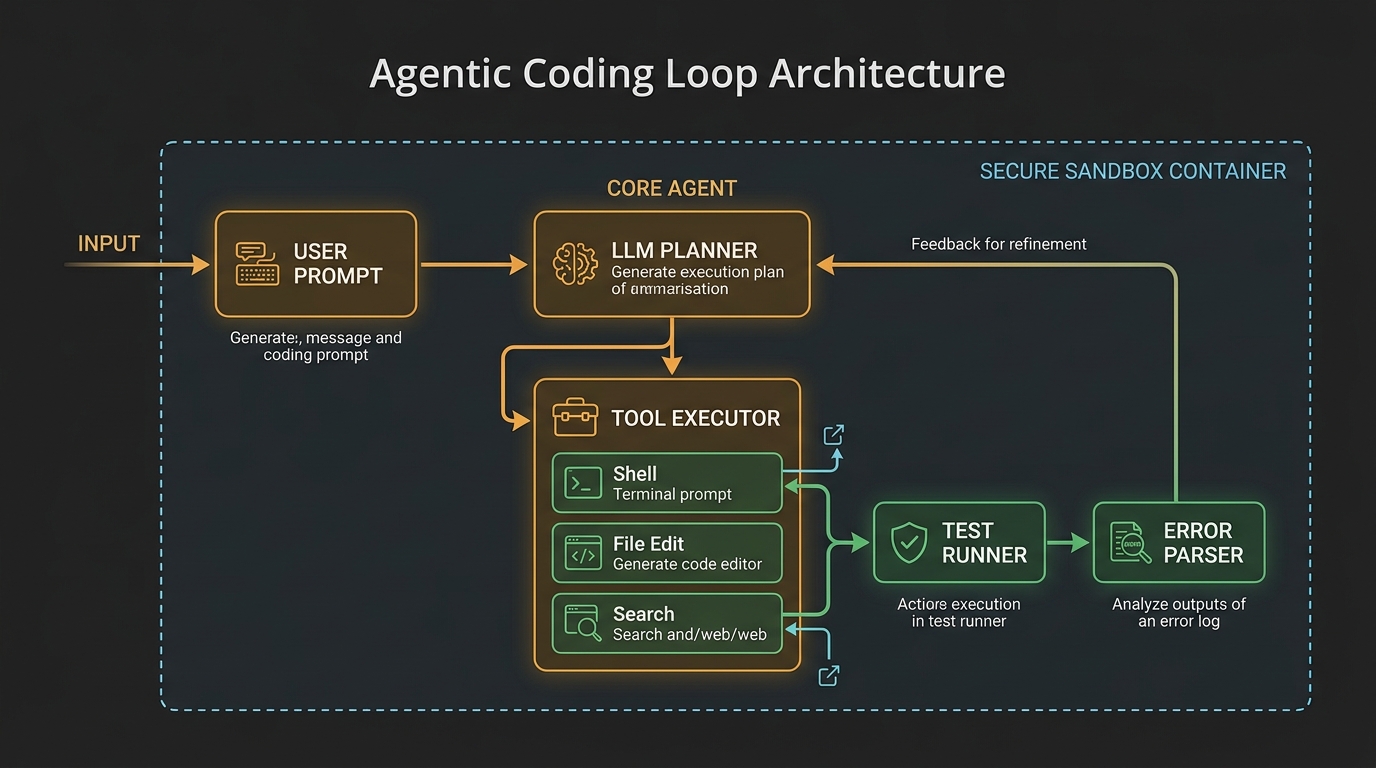
- Planning & Repository Discovery: The agent uses ripgrep, AST skeletons, and git status to inspect relevant files without exhausting the context budget.
- Patch Synthesis: Generates targeted unified diff hunks (
git diff -U3format) rather than transmitting entire file contents, minimizing latency and avoiding context pollution. - Deterministic Execution: Applies the patch and executes the project's build and test commands within an isolated subshell.
- Error Interception & Reflection: If the subprocess exits with a non-zero code, standard error is parsed, stripped of ANSI noise, and returned to the LLM context as an error tool result.
5. Subshell Execution and MicroVM Sandboxing
Executing untrusted, model-generated shell commands directly on a developer workstation introduces severe security vulnerabilities (e.g., accidental file loss, privilege escalation, credential leakage).
Robust harness architectures avoid executing raw commands on the host OS. Instead, they implement:
- MicroVM Sandboxes (AWS Firecracker / Docker Sandboxes): Each agent loop executes inside an isolated micro-virtual machine booting in milliseconds with a dedicated Linux kernel [6]. Even dangerous commands like
rm -rf /are fully contained. - PTY (Pseudoterminal) Allocation: Interactive commands (e.g., package managers or CLI confirmation prompts) require allocated pseudoterminals to properly handle stdin/stdout streams and terminal escape codes.
- Credential Proxying: API tokens and environment secrets are masked. Outbound requests from the sandbox route through an authenticating proxy that injects credentials at the network boundary, ensuring the model never sees raw secrets.
Production Reference: Sandboxed Subshell Controller (TypeScript)
import { spawn } from 'node:child_process';

interface ExecutionResult {
  stdout: string;
  stderr: string;
  exitCode: number | null;
  timedOut: boolean;
}

export async function runSandboxedCommand(
  cmd: string,
  args: string[],
  timeoutMs: number = 30000
): Promise<ExecutionResult> {
  return new Promise((resolve) => {
    const child = spawn(cmd, args, {
      cwd: process.cwd(),
      env: { ...process.env, CI: 'true', NODE_ENV: 'test' },
      stdio: ['ignore', 'pipe', 'pipe']
    });

    let stdout = '';
    let stderr = '';
    let timedOut = false;

    const timer = setTimeout(() => {
      timedOut = true;
      child.kill('SIGKILL');
    }, timeoutMs);

    child.stdout.on('data', (d) => stdout += d.toString());
    child.stderr.on('data', (d) => stderr += d.toString());

    child.on('close', (code) => {
      clearTimeout(timer);
      resolve({ stdout, stderr, exitCode: code, timedOut });
    });
  });
}
6. AST Error Mapping with Tree-sitter and LSP
Raw compiler logs and stack traces can span hundreds of lines. Feeding unparsed logs directly into the LLM context inflates token usage and triggers attention degradation ("lost in the middle").
Advanced harnesses integrate two complementary static analysis tools:
- Tree-sitter (Concrete Syntax Tree): An incremental parsing library that builds concrete syntax trees even on incomplete or syntactically invalid code [4]. This allows harnesses to isolate the exact enclosing function, class, or scope where an error occurred.
- Language Server Protocol (LSP): Connects to language servers (e.g.,
tsserver,rust-analyzer,pyright) via the standardizedtextDocument/publishDiagnosticsinterface [5], obtaining exact line/column diagnostic ranges and compiler error codes.
7. Git Integration and Deterministic Quality Gates
The most reliable harness designs treat Git as the immutable foundation of the loop:
- Unified Diff Context Economy: Transmitting unified diff hunks (
git diff -U3) sends only the modified lines along with minimal surrounding context, eliminating the massive overhead of rewriting entire files. - Pre-Commit Quality Gates: Local hooks (ESLint, Prettier, Ruff, cargo clippy) act as immediate deterministic validation checks.
- Interception of Verification Bypass: Autonomous models frequently attempt to append
--no-verifywhen hooks fail. Secure harnesses wrap the git binary and reject verification bypass arguments.
8. Step-by-Step: Scaffolding a Terminal Agent Loop
To build an in-house agentic coding harness, structure your pipeline into five discrete modules:
- Workspace Scanner: Discovers files using
.gitignore-aware traversal and ripgrep indexing. - LLM Connector: Implements streaming tool calling using Anthropic or OpenAI SDKs with strict JSON schema validation.
- Diff Patcher: Applies unified diffs atomically with rollback capabilities on failure.
- Test Runner: Spawns sandboxed subshells with strict timeout limits (e.g., 30–60 seconds).
- Reflection Loop Controller: Limits iterations to a maximum depth (e.g., 5–8 attempts) and halts on recurring error hashes to prevent infinite loops.
9. Real-World Benchmarks & Empirical Evaluation
When evaluating autonomous terminal harnesses, industry practitioners rely on standard open benchmarks:
- SWE-bench Verified: A benchmark of 500 human-validated GitHub issues filtered from real open-source Python repositories [2]. Frontier multi-turn agent harnesses resolve a significant majority of verified issues by iteratively executing tests and refining patches, in contrast to single-turn completion baselines.
- Terminal-Bench: Evaluates an agent's capability to execute multi-step shell commands, navigate directories, configure software environments, and interpret subprocess exit codes.
10. Frequently Asked Questions (FAQ)
How do autonomous harnesses prevent infinite debugging loops?
Harnesses implement circuit-breaker logic: maximum turn limits (typically 5 to 8 iterations), error hash tracking (if the exact same compiler error repeats across two consecutive cycles, the loop halts), and strict process timeout thresholds.
Why are unified diffs preferred over full-file rewrites?
Full-file rewrites transmit thousands of tokens of unmodified boilerplate, increase latency, and frequently introduce hallucinations in unrelated functions. Unified diffs isolate edits to exact line hunks, substantially reducing token consumption and focus drift.
What is the difference between Docker sandboxing and Firecracker MicroVMs?
Standard Docker containers share the host Linux kernel, meaning container escape vulnerabilities could compromise the host workstation. MicroVMs (like AWS Firecracker) run a lightweight, independent guest kernel backed by hardware virtualization (KVM), providing true hypervisor isolation [6].
How do coding agents handle secrets and API keys securely?
Enterprise harnesses strip raw secrets from environment files prior to sandbox execution. Outbound HTTP requests from the agent sandbox route through an authenticating proxy that injects required credentials on the fly, ensuring models never view raw production credentials.
Can CLI coding agents run in CI/CD pipelines?
Yes. Engineering teams frequently deploy terminal coding harnesses inside GitHub Actions or GitLab CI runners to automatically triage pull requests, remediate lint failures, and generate automated dependency fixes.
11. Primary Technical Sources & Citations
- Anthropic. Building with Claude: Tool Use & Function Calling Reference, Official Claude Platform Documentation, Anthropic API (Updated 2024–2026).
- Jimenez, C. E., Yang, J., Wettig, A., Yao, S., Pei, K., Press, O., & Narasimhan, K. (Princeton NLP). SWE-bench: Can Language Models Resolve Real-World GitHub Issues?, Proceedings of the Twelfth International Conference on Learning Representations (ICLR 2024), arXiv:2310.06770. [See also: SWE-bench Verified Leaderboard]
- OpenAI. Structured Outputs and Constrained Grammar Token Decoding Guide, OpenAI Platform Documentation (Published August 2024, Updated 2026).
- Tree-sitter Authors. Tree-sitter: An Incremental Parsing System for Programming Tools and Concrete Syntax Trees, Official Architecture Documentation (2018–2026).
- Microsoft Corporation. Language Server Protocol Specification - Version 3.17 (textDocument/publishDiagnostics & Semantic Tokens), Microsoft Open Source (2022–2026).
- Agache, A., Deaconescu, M., et al. (AWS Open Source). Firecracker: Lightweight Virtualization for Serverless and Sandboxed Applications, Proceedings of the 17th USENIX Symposium on Networked Systems Design and Implementation (NSDI '20), pp. 419–434, 2020. [See also: Firecracker MicroVM Project]
- Anthropic & Model Context Protocol Open Source Contributors. Model Context Protocol (MCP) Specification, Spec Release v2024-11-05 (JSON-RPC 2.0 AI Agent Client-Host-Server Protocol), November 2024. [See also: MCP GitHub Repository]
- Gauthier, P.. Aider: AI Pair Programming in Your Terminal — Git-First Staging Architecture and Multi-File Repository Map Harness (v0.70+), Aider Documentation (2023–2026).
- Anysphere Inc.. Cursor AI-Native Development Architecture: Background Agent Daemons, Language Server Protocol Diagnostics, and Shadow Workspaces, Cursor Documentation (2023–2026).
- Docker Inc.. Docker Engine Security Architecture: Rootless Daemon Execution, User Namespaces, and seccomp System Call Filtering, Docker Engine v27+ Documentation (2024–2026).
Written by

Sourabh Gupta
Data Scientist & AI Tools Specialist · 5+ years in AI/ML
Sourabh tests every AI tool he writes about — hands-on, with real use cases. His background in data science means he goes beyond marketing claims to benchmark actual performance, cost, and reliability for developers and creators.
Full bio & editorial process →