Photonic Computing and the Optical AI Inference Race
Editorial note: Some links in this article are affiliate links — we may earn a commission if you sign up, at no extra cost to you. Research guides are distinguished from documented firsthand reviews in our editorial standards. Read our editorial standards →
Photonic Computing and the Optical AI Inference Race
Photonic computing is having a familiar hardware moment: laboratory results are becoming concrete enough to invite product-roadmap claims, while the work needed to turn a fast optical operation into a dependable AI system remains substantial. The opportunity is real. Light can carry information with high bandwidth, and optical devices can implement useful linear transformations with little or no energy spent on repeated digital multiply-accumulate operations inside the optical core.
Reported fact: recent peer-reviewed work in Nature Communications describes deep-neural-network inference using an integrated, reconfigurable photonic tensor processor. Inference: photonics is most likely to enter AI inference as a specialized accelerator around selected high-throughput operations, not as an immediate replacement for every digital processor in a serving stack. The difference between those statements is the difference between a demonstration and a deployment thesis.
Why inference puts optics on the agenda
Modern neural networks spend much of their time on linear algebra: matrix-vector or matrix-matrix multiplications in attention, projections and feed-forward layers. These operations involve moving very large arrays between memory and compute. The energy and latency of that movement can dominate the arithmetic itself in electronic hardware.
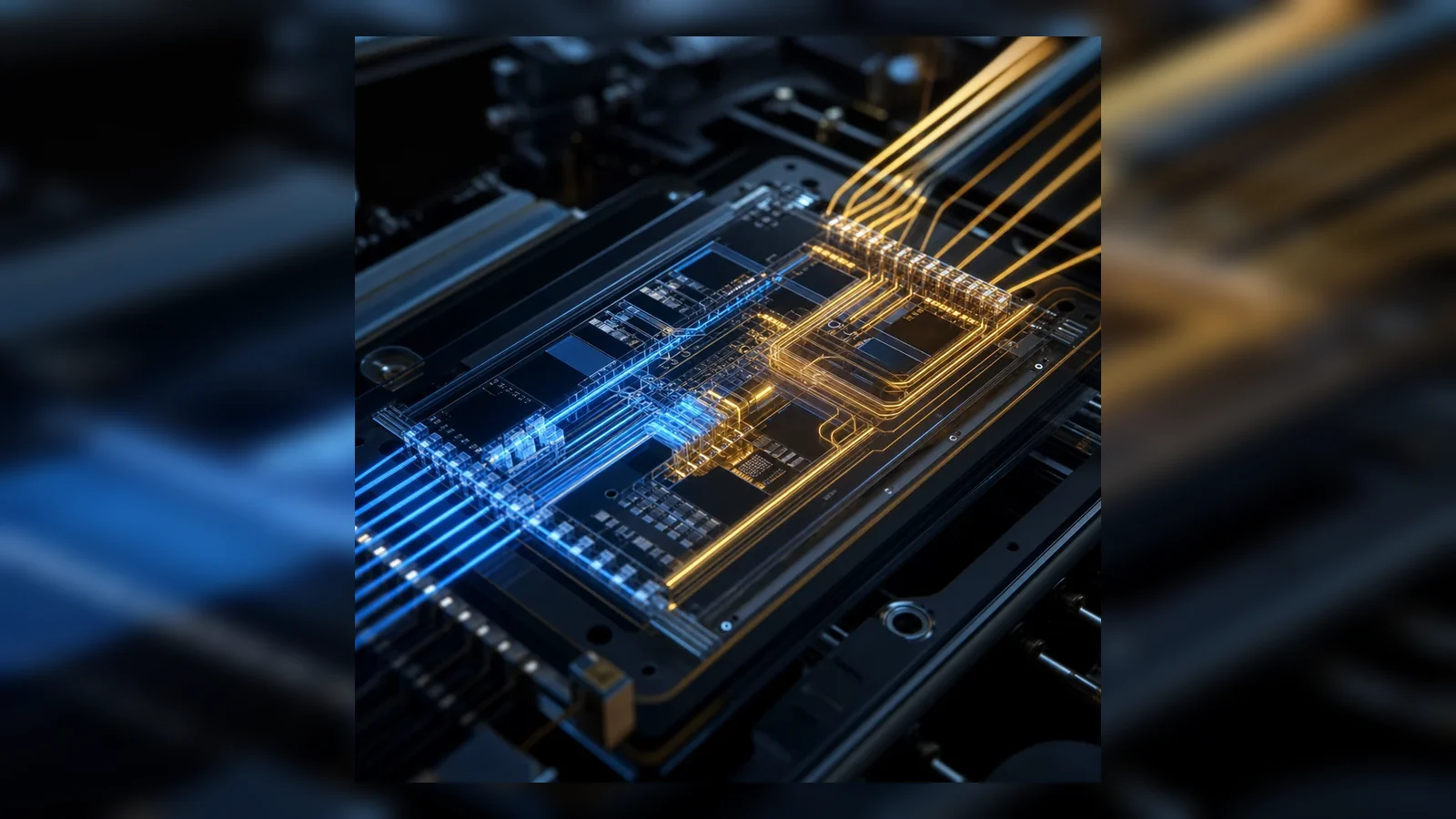
An optical circuit can encode values in properties of light such as amplitude, phase, wavelength or polarization. Interference and modulation then implement transformations in parallel. In a simplified picture, a mesh of interferometers or another optical structure applies a programmed matrix to an input signal. This is why research papers often emphasize throughput, latency or energy per operation.
That picture is useful but incomplete. Models need non-linear functions, state, control flow, memory access, quantization, scheduling and communication. Inputs generally must be converted from electrical to optical form; results must be detected and converted back. The converters, lasers, calibration circuits and electronic control plane can decide the system’s energy and accuracy. A headline for an optical multiply is not a measurement for an end-to-end inference request.
Analog speed comes with analog responsibilities
Most photonic neural processing is analog in its optical portion. Analog computation can exploit physics efficiently, but it is sensitive to noise, device variation, temperature drift, nonlinearity and finite detector resolution. A practical system must calibrate its transfer function and maintain it over time. It must also decide how much precision the model actually needs and whether retraining, quantization-aware training or compensation is required.
This is not a fatal flaw; conventional accelerators also use reduced precision and error-management techniques. It is a reason to ask different questions. Digital operations are repeatable within a defined numerical format. An optical result may depend on calibration state and environmental conditions. A credible comparison reports accuracy on a named workload, stability over time, power at the stated boundary and the overhead of keeping the processor calibrated.
What the research has demonstrated
The integrated reconfigurable photonic tensor-processor paper reports neural-network inference and describes an architecture intended for tensor operations. The result matters because integration and reconfigurability address two historic objections to optical computing: a one-off bench experiment is not a programmable processor, and discrete optical setups do not readily scale into packaged systems.
Other recent research has explored high-density nanophotonic media and optical computers for AI inference. Together these papers make a narrow, defensible point: optical hardware can perform useful inference-relevant computations, and researchers are improving density, programmability and demonstrations on recognizable model tasks. They do not establish that a photonic processor has beaten GPUs on a production model-serving total-cost basis.
Inference: the scientific race is moving from “can light do neural math?” to “can a packaged optical subsystem retain a system advantage after conversion, calibration, memory and software are counted?” That is a harder and more commercially meaningful test.
Throughput is not utilization
Optical devices can quote extraordinary operation rates because wavelengths or spatial paths operate concurrently. Buyers should distinguish peak physical throughput from sustained, useful model throughput. The latter requires specified batch size, input/output precision, model shape, data-transfer path, host overhead and accuracy target.
The right comparison may not be tokens per second alone. For a vision pipeline or a fixed recommendation model, batch latency, joules per inference and rack integration can matter more. For autoregressive language models, small-batch latency, KV-cache traffic and irregular control flow can reduce the fraction of time spent in the linear layer that an optical engine accelerates. Workload shape determines the addressable opportunity.
Where electronics are still essential
Photonic chips do not remove electronic computing. Digital logic configures optical elements, moves model parameters, performs nonlinear activations where needed, stores state and interfaces with networks and memory. Electrical-to-optical and optical-to-electrical conversion is a physical boundary with bandwidth, noise and power costs. Laser sources also require power and thermal management.
This hybrid nature is not a retreat from the promise. It tells system architects where to look for the first wins: repeated, high-utilization linear operations with data that can stay near the optical path long enough to amortize conversion and setup. An accelerator attached to an electronic host may be valuable even if only a portion of the graph runs optically.
Packaging may be the decisive technology
An optical die needs efficient light sources, couplers, detectors, electronic drivers and heat control. Connecting those pieces at scale without losing optical power or yield is a packaging challenge. Co-packaged optics in networking shows why the industry cares about short electrical paths and high bandwidth, but a compute package has its own calibration and precision demands.
Reported research devices should therefore be read with their experimental boundary in view. Was laser power included? Were control electronics integrated? What was the chip yield? Was performance measured in a temperature-controlled laboratory? These are not gotcha questions. They identify the engineering work remaining between a paper and a fleet.
The software question is as large as the optics question
Inference platforms win when developers can compile models, inspect accuracy, profile performance and fall back safely. A photonic backend needs graph partitioning: decide which layers run optically, lay out weights, schedule conversions, manage calibration and reconcile numerical formats. It also needs monitoring that can tell an operator whether a quality change came from data drift, the model or hardware drift.
For fixed models, a specialized mapping may be acceptable. For rapidly changing generative models, reconfigurability and toolchain maturity are more valuable. A system that performs brilliantly only after weeks of manual tuning can still fit a narrow appliance market, but it is not yet a general inference platform.
How to assess a vendor claim
Establish the measurement boundary
Ask whether energy includes lasers, thermal control, drivers, analog-to-digital and digital-to-analog conversion, host interface and idle consumption. Ask whether latency includes input formatting and output readout. An optical-core number can be informative engineering data, but it should not be presented as data-center energy per request.
Demand task-level accuracy and duration
Request results on a named model and dataset, with precision, calibration interval and environmental conditions disclosed. Accuracy should be measured after the complete hybrid pipeline. A short best-case run is not enough: drift and recalibration interrupt useful work, so a sustained test is materially more informative.
Compare an achievable deployment
Use a reference GPU or other accelerator under the same workload, service-level objective and power boundary. Include networking, memory, host CPUs, model conversion and operations. The decision is not whether photons can multiply faster; it is whether a buyer can serve more useful requests within a chosen power, latency and reliability envelope.
What to watch in the next phase
The strongest signals will be independently repeatable systems results: packaged devices, disclosed power boundaries, long-duration accuracy data, a usable compiler and customer workloads that fit the architecture. Research will continue to improve optical tensor engines, but the commercialization bottleneck may lie in calibration automation and manufacturing rather than the optical operation itself.
The balanced conclusion is neither “photonic AI is here” nor “it is just a lab curiosity.” The literature establishes a credible technical path for optical acceleration of parts of inference. It does not erase electronic memory, conversion or software. Buyers who keep those boundaries visible can identify genuine specialization without mistaking a component metric for a deployed AI service.
A sensible adoption sequence
Organizations considering optical acceleration should begin with profiling, not a platform bet. Identify a stable inference path with a large fraction of repeatable linear algebra, clear latency and power limits, and enough volume to justify integration. Establish an electronic baseline using the same precision and service-level objective. Only then can a photonic candidate be evaluated fairly.
Run a sustained proof of concept that includes startup, calibration, workload changes and recovery from a deliberately introduced fault. Preserve the actual accuracy distribution, not only an average. Define a fallback route through existing hardware so a promising experiment cannot become a service dependency before its operations model is proven. This approach neither assumes that optics will fail nor requires a buyer to treat an early component result as a fleet commitment.
For research teams, an additional useful discipline is to publish the “uninteresting” overheads. Laser wall-plug power, control traffic, calibration duration, conversion precision and packaging assumptions are often the facts another engineer needs to reproduce a claimed advantage. Transparency in these terms will make the optical inference race easier to assess and faster to mature.
This also protects customers from benchmark theater. A deployment review should retain raw telemetry, model versions and the exact compiler configuration used in each comparison. If a performance gain disappears after a routine model update, that is a valuable result, not an embarrassment. Repeatability is the product requirement that turns a compelling optical experiment into dependable inference infrastructure.
Precision and memory set the practical boundary
Model accuracy is not governed by compute alone. Weights must be represented, refreshed and delivered to the engine; activations must be encoded and read back; and the accumulated numerical error must remain within a task’s tolerance. Some inference tasks can tolerate low precision after training and calibration. Others, including workloads with sensitive ranking thresholds or long chains of autoregressive decoding, can amplify small deviations. A photonic design should therefore identify the numerical format used at every boundary rather than describe precision with one broad label.
Memory is equally decisive. If a model’s weights or attention state continually travel to and from a separate electronic memory, data movement can dominate the benefit of a fast optical transform. Research prototypes may use compact models or preloaded weights for good reasons, but that setup should be disclosed when drawing production conclusions. The relevant question is whether the architecture retains locality for the actual model and request pattern.
This suggests a useful division of labor. Optical engines may first succeed where a fixed or slowly changing model repeatedly evaluates many inputs and where quality can be measured against a stable reference. Electronics can continue to handle control-heavy, memory-bound and rapidly evolving portions of the graph. That is an inference about likely adoption, not a limitation imposed by physics; it gives evaluators a concrete workload hypothesis to test.
FAQ
Is photonic computing faster than GPUs?
It can be very fast for selected optical linear operations. Whether a complete inference workload is faster depends on conversion, memory, software, model shape and the performance metric used.
Does an optical processor use no energy?
No. Optical propagation may be efficient, but lasers, modulators, detectors, converters, control electronics and thermal systems all consume energy.
Can photonic chips run large language models?
Research points to possible acceleration of relevant linear layers. A full LLM service also needs memory, nonlinear operations, decoding logic and software orchestration, so the result is typically a hybrid system.
What evidence should a buyer request?
End-to-end accuracy, sustained throughput, energy at a disclosed system boundary, calibration behavior, model tooling and a comparison on the buyer’s actual workload.
Sources
Tags
Written by

Sourabh Gupta
Author at Teach AI Tools
Sourabh Gupta is responsible for Teach AI Tools. Research guides and documented firsthand reviews are identified separately. An author profile is not evidence of testing; look for sources, test records, and limitations in the article.
Full bio & editorial process →