AI Agents in 2026: How Autonomous AI Is Replacing Manual Workflows
Editorial note: Some links in this article are affiliate links — we may earn a commission if you sign up, at no extra cost to you. Every tool is independently tested by our team before being recommended. Read our editorial standards →

There is a difference between an AI that answers a question and an AI that finishes a task. In 2025 and 2026, that difference collapsed.
AI Agents in 2026: How Autonomous AI Is Replacing Manual Workflows
AI agents — systems that plan, act, use tools, and iterate without a human steering every step — moved from research labs into everyday workflows. This guide explains exactly what AI agents are, which tools lead the field, and how to start deploying them without a background in machine learning.
What Makes Something an "AI Agent"?
A basic chatbot waits for your message, replies, and stops. An AI agent receives a goal, breaks it into steps, executes each step using tools (search, code execution, file read/write, API calls), checks its own output, and continues until the goal is done.
The four pillars of an agent are:
- Perception — it can read inputs: your message, a file, a web page, a database row
- Planning — it reasons about what steps are needed, in what order
- Action — it can actually do things: write code, call an API, send an email, fill a form
- Memory — it maintains context across steps, and sometimes across sessions
Most chat AI tools in 2024 had perception and planning but weak action and almost no memory. 2026 tools have all four.
Why Agents Matter Right Now
The shift is economic. When an AI can complete a multi-step task — research a topic, draft a report, format it for your CMS, and publish it — the productivity leverage stops being a multiplier on your time and becomes a replacement for entire task categories.
Early adopters are already reporting that agents handle:
- Daily competitor research and summarization (no human reads 30 tabs anymore)
- Drafting and scheduling social media content queues
- Responding to tier-1 customer support tickets
- Monitoring dashboards and sending alerts with context, not just numbers
- Running regression tests on new code and filing GitHub issues when they fail
None of this required custom software. It required the right tool, a clear goal, and the right permissions.
The Best AI Agent Platforms in 2026
ChatGPT with Operator Mode (OpenAI)
OpenAI's Operator is the most widely used agentic interface in 2026. It runs inside a sandboxed browser, meaning it can navigate websites, fill forms, click buttons, and extract information as if it were a human user. The Agent SDK underneath lets developers wire ChatGPT to external tools through function calling.
Best for: Consumer automation, web research, form-filling workflows
Pricing: Included in ChatGPT Pro ($20/mo), deeper access at the API level
Limitation: Operator's web browsing is intentionally sandboxed, which limits access to authenticated internal tools
Claude with Projects + Tool Use (Anthropic)
Claude's Projects feature gives each workspace a persistent memory context — documents, instructions, and conversation history that survive session restarts. Combined with Claude's native tool use (web search, code execution, file analysis), it behaves as a long-running research and writing agent.
Claude also has a 200,000-token context window, which means it can hold entire codebases, legal contracts, or research libraries in a single working session. For document-heavy agent workflows, this is decisive.
Best for: Research, legal document analysis, multi-document summarization, long coding sessions
Pricing: Claude Pro at $20/mo, API access from $3/M tokens
Limitation: No native browser automation (unlike Operator)
n8n with AI Nodes
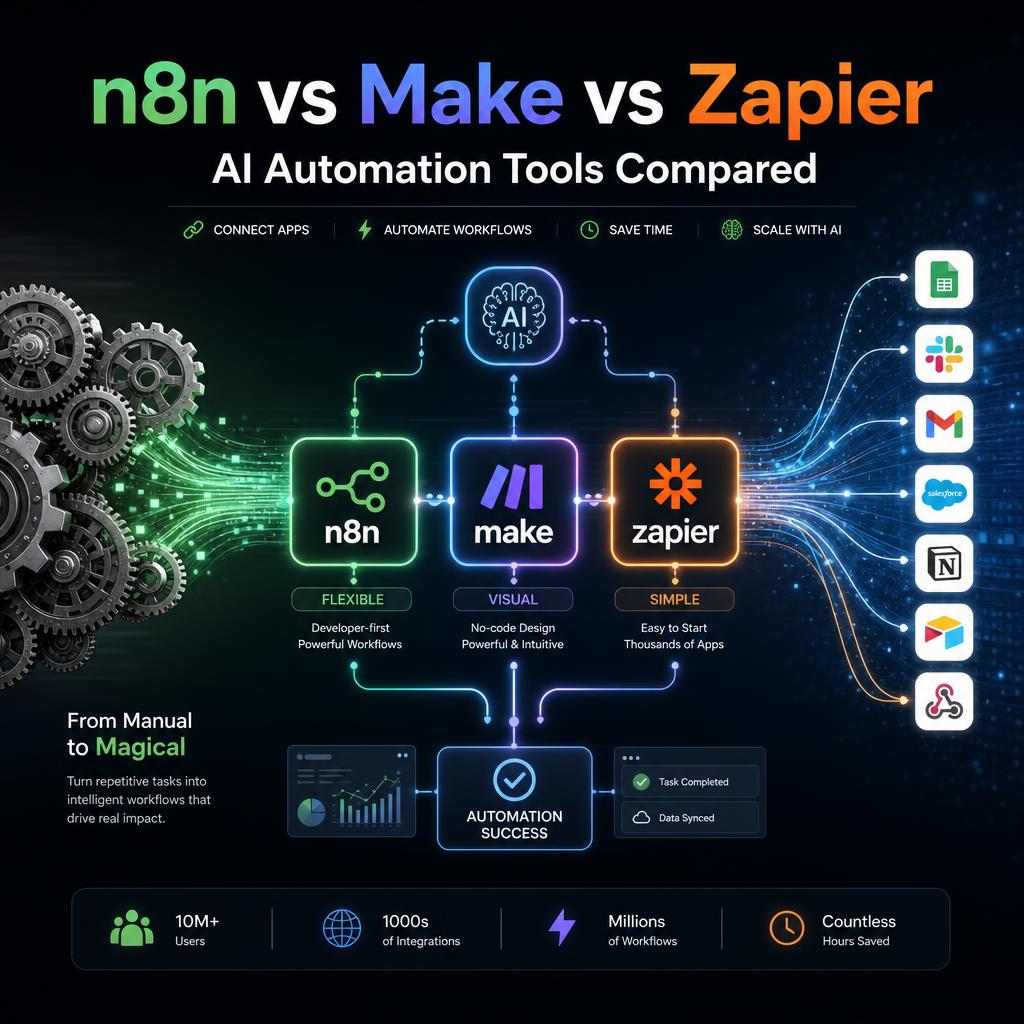
n8n is an open-source workflow automation platform that became one of the most powerful agentic tools in 2026 by connecting AI calls to literally any API. You can build a workflow that: monitors a Gmail inbox → classifies emails with GPT-4o → drafts replies with Claude → logs them to Notion → flags edge cases in Slack.
The AI Agent node in n8n gives your workflow a reasoning loop — the AI decides which tools to call next, rather than following a fixed sequence. This is closer to true agency than most "no-code AI" tools.
Best for: Business process automation, connecting AI to existing SaaS stacks
Pricing: Free self-hosted, Cloud plan from $20/mo
Limitation: Requires some understanding of API authentication and data mapping
CrewAI
CrewAI is a Python framework for building multi-agent systems where specialized agents collaborate. You define roles (Researcher, Writer, Editor, Publisher), assign each agent a goal and set of tools, and CrewAI orchestrates the conversation between them.
The key insight: complex tasks are better done by a team of focused agents than one generalist agent. A Researcher agent that only searches and summarizes will outperform a single agent trying to do everything.
Best for: Content pipelines, research workflows, software development teams
Pricing: Open source (free)
Limitation: Requires Python knowledge to set up; no GUI
Relevance AI
Relevance AI offers a no-code agent builder where you create agents with custom tools, memory, and escalation logic. It sits between n8n (pure workflow) and CrewAI (pure code) in terms of technical requirement. Their Agent OS lets you hire and manage AI "employees" with defined skills.
Best for: Sales, support, and marketing teams who want agents without engineering help
Pricing: Free tier available, paid from $19/mo
AutoGPT
AutoGPT was one of the first autonomous agent frameworks to gain mainstream attention. It has matured significantly and now runs as a web application at agpt.co. You describe a goal, give it access to search and file tools, and watch it plan and execute.
Best for: Experimenting with autonomous agents, research tasks
Pricing: Free tier available
How to Build Your First AI Agent Workflow (No Code)
Here is a practical starting point using n8n and ChatGPT:
Goal: Every morning, monitor three competitor blogs and email you a 5-bullet summary of new posts.
Step 1 — RSS trigger: Add an RSS Feed node for each competitor blog. Set the schedule trigger to 8:00 AM daily.
Step 2 — Merge: Use a Merge node to combine all three RSS feeds into one data stream.
Step 3 — Filter: Add an IF node to filter only items published in the last 24 hours.
Step 4 — AI Summarization: Add an OpenAI node with the prompt: "Summarize the following article in 3 bullet points, focusing on the main tool, claim, or trend: {{item.content}}"
Step 5 — Aggregate: Use a Code node to concatenate all summaries into a single formatted email body.
Step 6 — Send email: Use a Gmail or SMTP node to deliver the digest to your inbox.
Total setup time: approximately 45 minutes. Time saved: 30–60 minutes daily.
Memory: The Feature That Separates Good Agents from Great Ones
The most common failure mode in early agent implementations is the same session problem — the agent forgets everything when you close the tab. 2026's best tools address this differently:
- ChatGPT Memory stores facts about you and your preferences across sessions
- Claude Projects stores documents and instructions for a specific workspace
- Mem.ai is a dedicated AI memory layer you can connect to other tools — it auto-organizes your notes, meetings, and tasks into a searchable knowledge base your AI can query
- Zep and LangMem are developer frameworks for adding persistent, retrievable memory to custom agent builds
For business-critical workflows, memory is not optional — it is the difference between an agent that needs re-briefing every day and one that knows your brand voice, your customers, and your context from day one.
Where Agents Struggle in 2026
Agents are not magic. They fail predictably in certain situations:
Ambiguous goals. "Research my competitors" produces mediocre output. "Find the 5 fastest-growing SaaS tools in the CRM category in the last 90 days, their pricing, and one differentiating feature each" produces excellent output. Agents perform proportionally to goal specificity.
Hallucinated tool calls. Some agents invent API responses when tools return errors, rather than stopping and asking. Always include a human-in-the-loop review step for any agent output that will be published or sent externally.
Rate limits and cost. A loop that calls GPT-4o 200 times per run at $0.005 per call costs $1. Running it 100 times a day costs $100. Monitor token consumption from day one.
Long multi-step dependencies. If step 7 requires the output of step 3, and step 3 failed silently, the agent will confidently produce wrong output at step 7. Add validation checkpoints.
The Bottom Line
AI agents in 2026 are ready for real work. You do not need to be an engineer to build a useful agent workflow — n8n, Relevance AI, and Operator all have graphical interfaces. The payoff is significant: tasks that took hours of human scheduling, delegation, and follow-up now run automatically.
Start with one workflow. Make it boring and reliable — a morning briefing, a weekly report, a support triage. Once you trust it, expand it. The ceiling is high.
Frequently Asked Questions About AI Agents
What is the difference between an AI chatbot and an AI agent?
A chatbot responds to a single prompt and then stops. An AI agent sets a goal, breaks it into steps, calls external tools (web search, email, databases, code execution), checks its own output, and loops until the task is done — without you prompting each step. ChatGPT Operator and n8n AI agents are examples of agents; regular ChatGPT is a chatbot.
What is the best AI agent platform in 2026?
It depends on your use case. n8n is the best choice for technical users who want self-hosted, free, open-source automation with AI agent nodes. Relevance AI is the easiest no-code platform for building AI agents without any coding. ChatGPT Operator is the best consumer option for everyday tasks like booking, research, and form-filling.
Do AI agents require coding knowledge to build?
Not always. Platforms like Relevance AI, Zapier AI, and Make are fully no-code — you configure agents through drag-and-drop visual builders. n8n has a visual editor but also supports custom JavaScript nodes. CrewAI and LangChain are Python frameworks aimed at developers.
How much does it cost to run an AI agent in 2026?
Simple single-task agents (e.g. classify an email and route it) cost fractions of a cent per run. Complex multi-step agents that call GPT-4o multiple times cost $0.05–$0.50 per run. Most platforms charge per task or seat — n8n self-hosted is free; Relevance AI starts at $19/month; Zapier AI at $20/month.
Can AI agents access the internet and external tools?
Yes. Modern AI agents can browse the web (Perplexity, ChatGPT Operator), send and read emails (Zapier, n8n), query databases, run Python code, call APIs, and interact with software via browser automation. The tools available depend on the platform you use.
Are AI agents safe and reliable for business use?
AI agents are reliable for structured, repeatable tasks (data extraction, email routing, report generation). They are less reliable for tasks requiring nuanced judgment or where errors have high stakes. Best practice in 2026 is human-in-the-loop checkpoints for irreversible actions (sending emails, making payments, deleting data).
Tags
Written by

Sourabh Gupta
Data Scientist & AI Tools Specialist · 5+ years in AI/ML
Sourabh tests every AI tool he writes about — hands-on, with real use cases. His background in data science means he goes beyond marketing claims to benchmark actual performance, cost, and reliability for developers and creators.
Full bio & editorial process →