AI Search Engines 2026: Perplexity vs ChatGPT Search vs Google AI Overviews Compared
Editorial note: Some links in this article are affiliate links — we may earn a commission if you sign up, at no extra cost to you. Every tool is independently tested by our team before being recommended. Read our editorial standards →
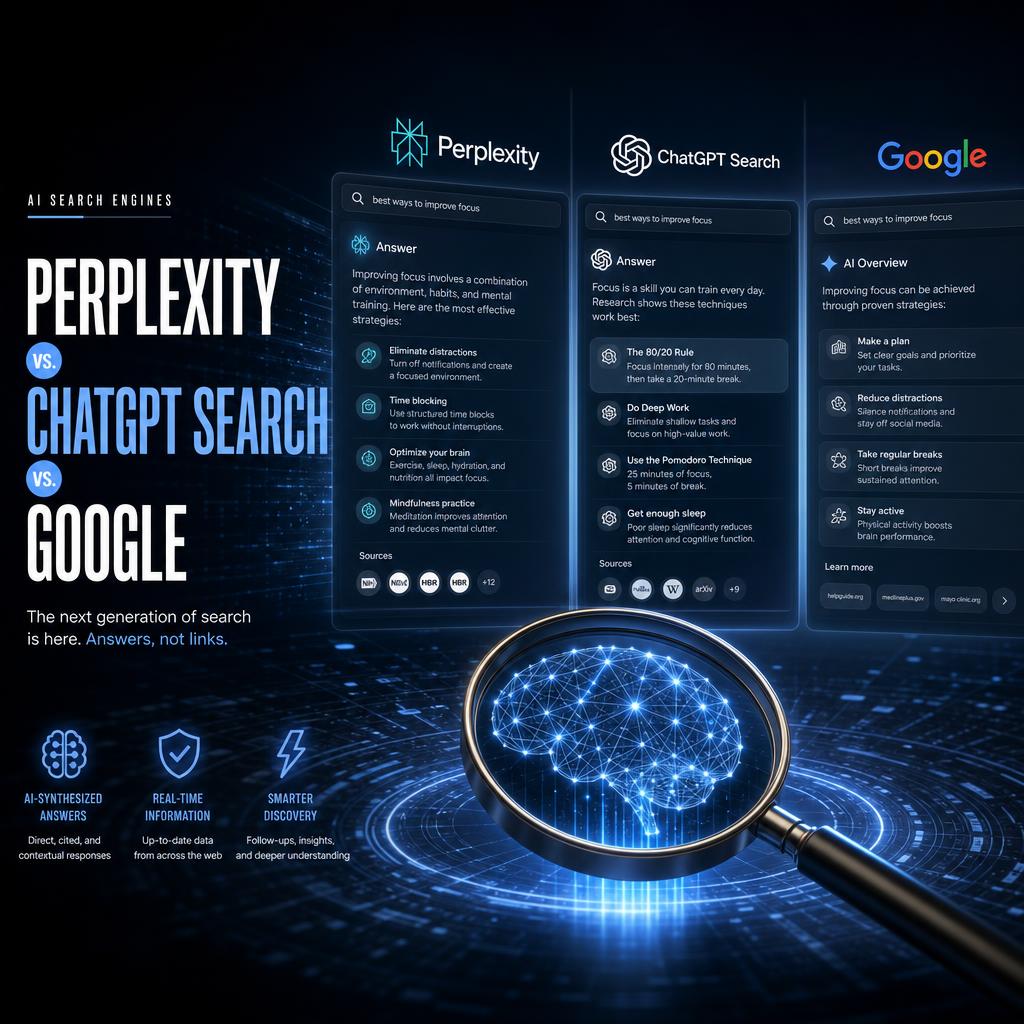
AI search tools can save a great deal of time, but they should change how you verify information, not whether you verify it. Their strengths vary: some are designed for cited research, others for conversation, quick summaries, or code-oriented search.
This guide compares the tools by the task in front of you and makes the trade-offs clear, including where a conventional search result or the original source is still the better answer.
Why AI Search Is Different From Traditional Search
Traditional search engines return documents. You click, read, and extract the answer yourself.
AI search engines return synthesized answers. They have already read the relevant documents, extracted the key information, and composed a direct response. Sources are cited, but the heavy lifting is done.
The advantages are significant:
- Research that took 30 minutes of tab-opening and reading takes 2 minutes
- Complex questions that require synthesis across multiple sources get direct answers
- Follow-up questions build on previous context — it is a conversation, not a series of one-off queries
The risks are real too:
- AI can misread sources, blend information incorrectly, or miss nuance
- Recency varies — some tools have real-time web access, others have knowledge cutoffs
- Source quality is not always transparent
Knowing when to trust AI search — and when to verify — is the skill this guide aims to build.
Perplexity AI
Perplexity is the purest AI search engine: it was designed from the ground up to replace the search box, not to bolt AI onto an existing product.
How it works: You ask a question, Perplexity issues multiple web searches, reads the results, synthesizes a response, and cites every sentence to a source. The Sources panel on the right shows exactly which websites were consulted.
Standout features:
Spaces — Create a persistent research project with saved searches, notes, and context. A Space about "competitive analysis of CRM tools" accumulates research across multiple sessions, and Perplexity knows the context of each new question you ask within it.
Deep Research — An agentic mode that performs 20–30 web searches, reads dozens of sources, and produces a structured long-form report. Used by researchers, consultants, and investors for tasks that previously required hours of manual research.
Focus modes — Switch from the general web to specific sources: Academic (peer-reviewed papers), YouTube, Reddit, Wolfram|Alpha (math and science), News (recency prioritized), or Shopping.
Pro Search — Triggers a multi-step research process for complex questions, with follow-up web searches based on initial findings.
Pricing: Free tier (5 Pro searches/day), Pro at $20/mo (unlimited Pro searches, Deep Research)
Best for: Research-heavy queries, journalism, academic research, competitive intelligence
Weakness: Source quality varies — Perplexity searches the open web, and low-quality sites can appear in results. Always verify important claims.
ChatGPT Search
OpenAI integrated real-time web search into ChatGPT in late 2024. ChatGPT Search is not a standalone product — it is a mode toggle inside ChatGPT. When you ask a question that requires current information, ChatGPT automatically decides whether to search the web.
How it differs from Perplexity:
ChatGPT Search benefits from the full conversational capability of GPT-4o. While Perplexity is purpose-built for search, ChatGPT Search excels at queries that combine retrieved information with reasoning, generation, or analysis.
Best use cases for ChatGPT Search:
- "Search for the latest data on X and then write a report in my company's voice"
- "Find the current pricing for these 5 tools and put them in a comparison table"
- "What happened with [news event]? Now give me three angles I could write about it."
The combination of retrieval and generation in one interface is ChatGPT Search's competitive advantage.
Source handling: Citations appear as inline footnotes, and a Sources panel lists the consulted URLs. Source visibility is less prominent than Perplexity's, which can make verification harder.
Pricing: Available to all ChatGPT users (Free and Plus). Pro users get more search queries.
Best for: Queries that require both current information AND generation/analysis in the same response
Weakness: Less transparent about which searches it performs; search trigger is automatic, not always clear when it fires.
Google AI Overviews
Google's AI Overviews appear at the top of search results for an increasing percentage of queries. When you search something on Google, you may see an AI-synthesized summary above all the traditional results.
Key difference from Perplexity and ChatGPT: You are not interacting with an AI search interface — you are seeing AI-synthesized summaries within the traditional Google search UX. You still see all the traditional blue links below.
Follow-up mode: Google added a conversational follow-up feature to AI Overviews — you can ask follow-up questions and the AI continues in context, similar to Perplexity.
Strengths:
- Deeply integrated into the search habits of billions of users (no new tool to learn)
- Backed by Google's search quality algorithms
- Strong source freshness for news and trending topics
- Shopping-aware: product queries trigger AI summaries with pricing context
Weaknesses:
- Has produced publicly embarrassing hallucinations (advising users to eat rocks, incorrect medical information)
- Less transparent source attribution than Perplexity
- Conversational depth is shallower than dedicated AI search tools
- Does not match Perplexity or ChatGPT Search for research-intensive tasks
Pricing: Free (part of Google Search)
Best for: Quick factual lookups, news queries, shopping research, anything you would have googled anyway
You.com
You.com is a lesser-known but technically sophisticated AI search engine with three modes:
- Smart mode: AI-powered search results with synthesis and citations
- Genius mode: Agentic research with multi-step web searches and report generation (similar to Perplexity Deep Research)
- Create mode: AI-assisted creation of content from search results
You.com supports custom AI agents (YouAgents) where you can build specialized research workflows. It also has a more developer-friendly API than competitors and better customization for teams.
Pricing: Free tier, Pro at $15/mo
Best for: Developers, teams wanting custom search workflows, users who want more control over the search process
When to Use Which Tool
| Query Type | Best Tool |
|---|---|
| Deep research report (30+ min topic) | Perplexity Deep Research |
| Current news and events | Google AI Overviews or Perplexity with News focus |
| Academic / peer-reviewed sources | Perplexity Academic mode |
| Research + write/generate in same flow | ChatGPT Search |
| Quick factual lookup | Google AI Overviews |
| Reddit discussions on a topic | Perplexity Reddit mode |
| Competitive intelligence | Perplexity Spaces |
| Code questions | ChatGPT (no need for web search usually) |
| Shopping research | Google AI Overviews or ChatGPT Search |
| Developer/API workflows | You.com |
How AI Search Is Changing SEO
For content creators and website owners, AI search has major implications. When Perplexity synthesizes an answer citing 5 sources, the user often does not click through. Traffic to information pages is declining.
What this means for your content strategy:
- Be the definitive source. AI search surfaces authoritative, well-structured content more reliably than thin content.
- Use structured data. FAQ schema, How-to schema, and Article schema help AI search identify and cite your content correctly.
- Write for extraction. Clear headings, direct answers in the first sentence of each section, and specific data points (numbers, dates, names) make your content more quotable.
- Target unique insights. AI search synthesizes widely available information well. First-party research, proprietary data, and expert opinions are harder to synthesize and more valuable as citation targets.
The Bottom Line
AI search is not replacing traditional search — yet. But it is already the right first stop for a large category of research-heavy queries. Perplexity is the best standalone tool. ChatGPT Search is the right choice when generation follows research. Google AI Overviews are useful for the queries you already make on Google. Use all three strategically rather than picking one exclusively.
Frequently Asked Questions About AI Search Engines
What is the best AI search engine in 2026?
For in-depth research with citations, Perplexity AI is the best choice. For questions where you need both research and generated content (drafts, summaries, analysis), ChatGPT Search is superior. For quick factual lookups during everyday browsing, Google AI Overviews is the most convenient since it's built into Google Search. You.com is best for developer and coding queries.
Is Perplexity AI free to use?
Yes, Perplexity has a generous free tier with unlimited basic searches. The free tier uses a smaller model and has limited Pro Search (deeper multi-step reasoning) queries per day. Perplexity Pro at $20/month gives unlimited Pro Searches, access to GPT-4o and Claude, image upload, and API access.
How does AI search differ from traditional Google Search?
Traditional Google Search returns a list of blue links you click through to find your answer. AI search synthesises an answer directly from multiple sources and presents it as a coherent response with citations. For complex questions requiring research across several sources, AI search is significantly faster. For navigational searches (finding a specific website), traditional search is still faster.
Will AI search engines replace Google?
AI search has captured a significant share of research-heavy and complex queries in 2025-2026. Google is responding with AI Overviews, which now appears on the majority of searches. For most users, the likely outcome is not Google being replaced but Google becoming an AI search engine itself. Perplexity and ChatGPT Search will continue growing for power-user research workflows.
Do AI search engines hallucinate or make up sources?
All AI search engines can misread, misquote, or misattribute sources — particularly for niche topics or recent events. Perplexity is generally the most citation-reliable because it shows specific source passages. Always click the cited sources for any claim you plan to act on or publish. Never use AI search as the sole reference for medical, legal, or financial decisions.
Can AI search engines access real-time information?
Yes — this is a key advantage over base ChatGPT or Claude. All four major AI search engines (Perplexity, ChatGPT Search, Google AI Overviews, You.com) have real-time web access and can answer questions about current events, recent product releases, live pricing, and breaking news. Perplexity also shows the publication date of its sources.
Tags
Written by

Sourabh Gupta
Data Scientist & AI Tools Specialist · 5+ years in AI/ML
Sourabh tests every AI tool he writes about — hands-on, with real use cases. His background in data science means he goes beyond marketing claims to benchmark actual performance, cost, and reliability for developers and creators.
Full bio & editorial process →