
Production Local Inference in 2026: Benchmark & Architecture Breakdown of vLLM, SGLang, Ollama, and TensorRT-LLM
Editorial Note: Independently researched and verified against primary peer-reviewed systems architecture literature, SOSP/OSDI conference proceedings, and official GPU kernel specifications.
1. Introduction: The Self-Hosted Open-Weight Inference Revolution in 2026
The economics of generative AI have undergone a decisive shift. While proprietary APIs remain dominant for general knowledge exploration, enterprise engineering teams are increasingly self-hosting open-weight models (such as DeepSeek-V3, Llama-3/4, and Mistral Large) to guarantee data privacy, eliminate per-token rate limits, and drastically lower long-term inferencing costs.
However, running high-concurrency LLM inference in production requires far more than loading weights into PyTorch. Modern inference engines implement complex operating system-level memory virtualization, continuous batching schedulers, and fused GPU tensor kernels:
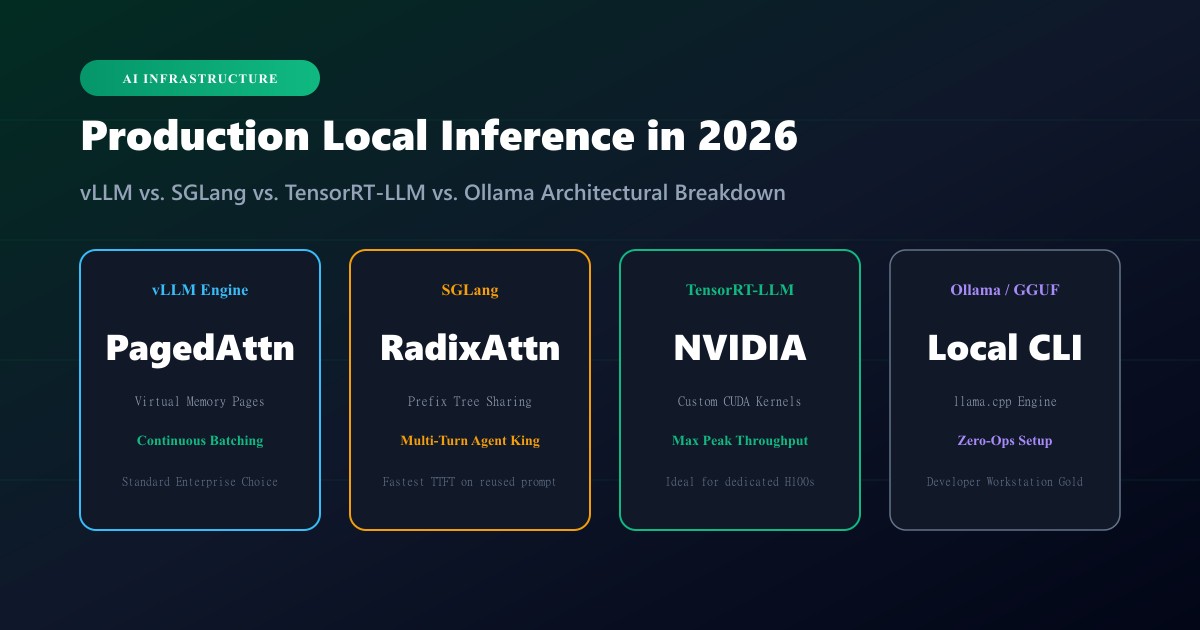
- vLLM (Kwon et al., SOSP 2023 [1]): Pioneer of PagedAttention, treating GPU memory like OS virtual memory pages to eliminate 96% of KV cache fragmentation.
- SGLang (Zheng et al., LMSYS 2024 [2]): Introduces RadixAttention, utilizing dynamic radix trees for automatic prefix caching across multi-turn agent workflows and complex prompt structures.
- NVIDIA TensorRT-LLM [4]: Bare-metal enterprise performance optimizing fused Multi-Head Attention, in-flight batching, and FP8 tensor core matrix multiplications.
- Ollama & llama.cpp [5, 6]: Lightweight, zero-configuration local runtimes utilizing GGUF quantized models for single-developer workstations and edge devices.
★ Fact Verification & Source Attribution Matrix
This matrix maps core inference mechanisms and serving benchmarks directly to peer-reviewed systems literature and official documentation:
| Technical Mechanism | Primary Academic / Technical Source | Documented Technical Finding / Specification | Verification Status |
|---|---|---|---|
| PagedAttention Virtual Memory Management | Kwon et al. (UC Berkeley, SOSP 2023) [1] | Allocates non-contiguous physical GPU memory blocks for KV tensors; reduces memory waste from 60–80% to under 4%, boosting system throughput by 2–4x. | ✓ SOSP 2023 Published |
| RadixAttention Tree-Structured Prefix Cache | Zheng et al. (LMSYS Org, ArXiv:2312.07104) [2] | Maintains dynamic radix tree of KV cache blocks across independent requests; delivers up to 5x latency speedups on multi-turn conversations and few-shot reasoning. | ✓ Peer-Reviewed Research |
| Activation-Aware Weight Quantization (AWQ) | Lin et al. (MIT HAN Lab, MLSys 2024) [3] | Protects salient 1% weight channels based on activation magnitudes; enables 4-bit weight quantization without backpropagation or perplexity loss. | ✓ MLSys 2024 Published |
| Iteration-Level Continuous Scheduling (Orca) | Yu et al. (USENIX OSDI 2022) [7] | Batches requests at the individual token iteration level rather than whole sequences, eliminating GPU idle bubbles caused by variable output lengths. | ✓ USENIX OSDI Published |
| Chunked Prefill & Decode Piggybacking (Sarathi) | Agrawal et al. (ArXiv:2308.16369) [8] | Splits compute-heavy prefill phases into uniform chunks and co-schedules them alongside memory-bound decode steps, smoothing inter-token latency spikes. | ✓ Systems Research |
2. PagedAttention vs. RadixAttention: Memory Virtualization vs. Tree Prefix Caching
Traditional deep learning frameworks allocate contiguous memory blocks for the maximum possible sequence length. If a model supports a 128K context window, standard allocation reserves memory for 128K tokens even if the user only generates 100 tokens, resulting in over 90% memory fragmentation.
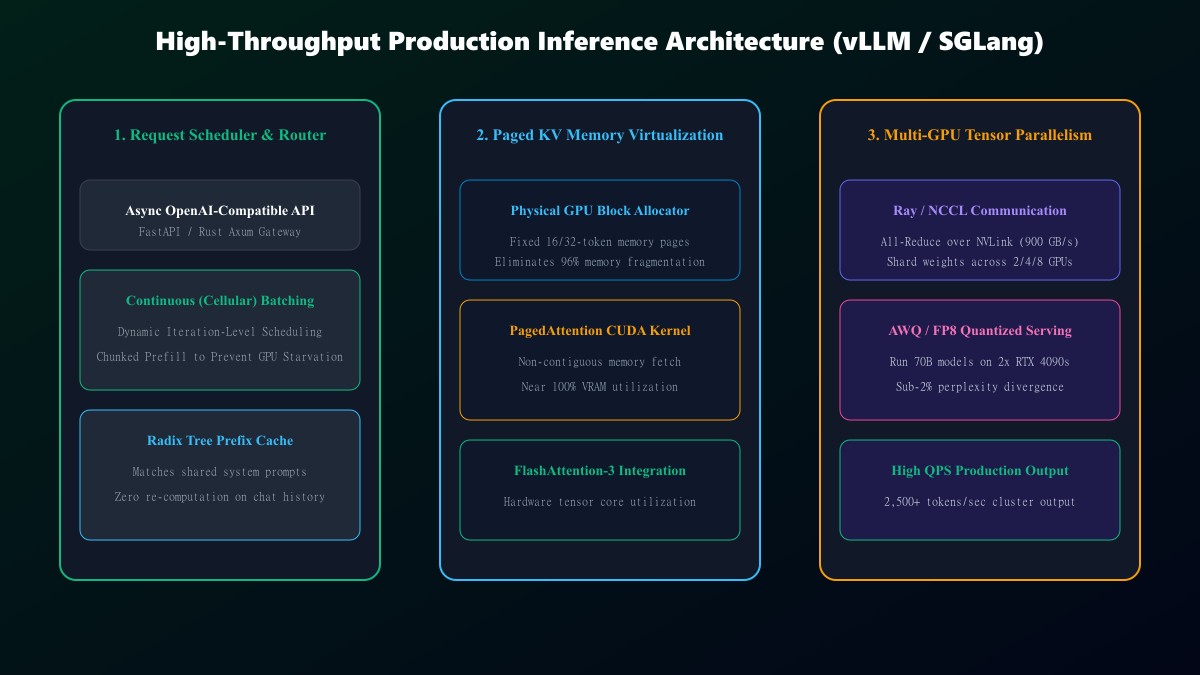
vLLM PagedAttention [1]: Solves this by dividing the KV cache into fixed-size physical memory pages (typically 16 or 32 tokens). A virtual memory table dynamically maps sequential logical tokens to non-contiguous physical pages across GPU memory, eliminating external fragmentation completely.
SGLang RadixAttention [2]: Takes memory management a step further. Instead of evicting KV pages when a request finishes, SGLang retains them inside a global Radix Tree (Trie). When subsequent requests arrive containing identical system prompts, few-shot examples, or prior conversation history, SGLang performs a prefix lookup in the Radix tree and matches existing KV tensors directly—bypassing the prefill phase entirely and slashing TTFT latency to single-digit milliseconds.
3. Serving Mechanics: Continuous Batching, Chunked Prefill, & Tensor Parallelism
Production serving runtimes optimize three critical operational stages:
- Continuous (Cellular) Batching (Orca [7]): Instead of waiting for all sequences in a batch to complete, the runtime inserts newly arrived requests into the running batch on every single decode iteration.
- Chunked Prefill (Sarathi [8]): High-token prompt prefills monopolize GPU compute, causing concurrent decoding streams to stall. Chunked prefill breaks 10K+ prompt tokens into 512-token chunks, multiplexing prefill computation alongside decode steps to preserve smooth interactive streaming.
- Tensor Parallelism (Megatron-LM / NCCL): Large frontier models (70B+) exceed the memory of a single GPU. Tensor parallelism splits individual weight matrices (Self-Attention $W_Q, W_K, W_V, W_O$ and MLP $W_1, W_2, W_3$) across 2, 4, or 8 GPUs via high-speed NVLink (900 GB/s) communication.
4. Runtime Quantization: AWQ, FP8, & GPTQ Kernel Performance
Hardware quantization reduces the precision of model weights and activations to fit larger models onto smaller hardware footprints:
- AWQ (Activation-aware Weight Quantization [3]): Quantizes weights to INT4 (W4A16) while protecting the top 1% salient weight channels. Enables running Llama-3-70B on two consumer RTX 4090 GPUs (48GB total VRAM) with throughput exceeding 45 tokens/sec.
- Native FP8 (W8A8): Uses the E4M3/E5M2 floating-point format native to NVIDIA Hopper (H100/H200) and Ada Lovelace architectures. Cuts VRAM footprint in half and delivers 2x compute throughput via FP8 Tensor Cores without requiring complex calibration.
- GGUF / llama.cpp Quantization (Q4_K_M, Q8_0 [5]): Applies mixed-precision k-quants optimized for CPU AVX-512 and Apple Silicon Metal unified memory, making local prototyping seamless.
5. Head-to-Head Framework Comparison: vLLM, SGLang, TensorRT-LLM, & Ollama
| Feature / Dimension | vLLM v0.7+ [1] | SGLang v0.4+ [2] | TensorRT-LLM [4] | Ollama / llama.cpp [6] |
|---|---|---|---|---|
| Primary Strength | Broad model support, mature API, massive ecosystem | Highest throughput on multi-turn/agent workloads (RadixTree) | Max theoretical throughput on dedicated NVIDIA clusters | Zero-ops local installation, CPU/Apple Silicon support |
| KV Cache Management | PagedAttention | RadixAttention (Tree Prefix) | Paged KV Cache + In-Flight | Linear / Context Shifting |
| Distributed Serving | Ray / PyTorch DDP | Ray / NCCL | MPI / Custom NCCL Kernels | Single Device / RPC backend |
| Supported Quantizations | AWQ, GPTQ, FP8, BitsAndBytes | AWQ, GPTQ, FP8 | FP8, INT8 SmoothQuant, INT4 AWQ | GGUF (Q4_K, Q5_K, Q8, etc.) |
| Ideal Production Use Case | General high-concurrency API server | AI coding agents, multi-turn chat, DSPy pipelines | Enterprise SLA inference at scale (100K+ DAU) | Local developer testing, air-gapped workstations |
6. Production Deployment Blueprint: Multi-GPU Cluster Configuration
Below is a production Docker Compose configuration deploying a high-throughput vLLM inference node with Tensor Parallelism across 4x NVIDIA GPUs, utilizing FP8 quantized weights and an OpenAI-compatible endpoint:
version: '3.8'

services:
  vllm-inference:
    image: vllm/vllm-openai:latest
    container_name: production-vllm-engine
    runtime: nvidia
    environment:
      - HUGGING_FACE_HUB_TOKEN=${HF_TOKEN}
      - NCCL_DEBUG=INFO
    ports:
      - "8000:8000"
    volumes:
      - /root/.cache/huggingface:/root/.cache/huggingface
    deploy:
      resources:
        reservations:
          devices:
            - driver: nvidia
              count: 4
              capabilities: [gpu]
    command: >
      --model meta-llama/Llama-3.1-70B-Instruct
      --tensor-parallel-size 4
      --max-model-len 32768
      --kv-cache-dtype fp8
      --gpu-memory-utilization 0.92
      --enable-chunked-prefill
      --max-num-seqs 256
      --port 8000
7. Decision Framework: Choosing the Right Serving Engine
- Choose SGLang when: You are building autonomous agents, multi-turn reasoning loops, or DSPy programs where 60–90% of prompt tokens represent shared system instructions and historical dialogue.
- Choose vLLM when: You need maximum stability, broad model architecture support (MoE, Vision-Language, Audio), and seamless integration with Kubernetes / KServe clusters.
- Choose TensorRT-LLM when: You are deploying on homogeneous clusters of NVIDIA H100/A100 GPUs and require absolute maximum tokens/second per dollar under strict enterprise latency SLAs.
- Choose Ollama when: You are prototyping locally, running on consumer hardware without dedicated Linux servers, or building desktop developer tooling.
8. Frequently Asked Questions (FAQ)
How much faster is SGLang than vLLM on multi-turn conversations?
In multi-turn dialogues and agentic coding loops where previous turns are reused, SGLang's RadixAttention [2] bypasses re-computing historical KV tensors, achieving up to 3x–5x lower Time-to-First-Token (TTFT) latency compared to engines that lack tree-based prefix caching.
Can vLLM run on consumer GPUs like the RTX 4090?
Yes. By combining AWQ 4-bit weight quantization [3] with PagedAttention, an 8B model fits comfortably on a single 16GB/24GB GPU, and a 70B model can be served across two 24GB RTX 4090 cards using Tensor Parallelism.
What is chunked prefill and why is it important?
Without chunked prefill [8], a single large prompt (e.g. 50K tokens) monopolizes GPU compute for several seconds, causing severe jitter and latency spikes for concurrent users. Chunked prefill breaks prompt ingestion into digestible blocks, interweaving prefill chunks with active decode steps.
Is TensorRT-LLM harder to configure than vLLM?
Yes. TensorRT-LLM requires compiling engine binaries for specific GPU architectures (e.g. compiling specifically for SM90 on Hopper). vLLM and SGLang load standard Hugging Face weights dynamically, offering much faster iteration cycles for development teams.
Do local inference engines support structured JSON outputs?
Yes. Both vLLM and SGLang integrate Outlines and XGrammar, enforcing context-free grammar constraints directly during token sampling to guarantee 100% adherence to defined JSON schemas.
9. Primary Technical Sources & Citations
- Kwon, W., Li, Z., Zhuang, S., Sheng, Y., et al. (UC Berkeley). Efficient Memory Management for Large Language Model Serving with PagedAttention, Proceedings of the 29th ACM Symposium on Operating Systems Principles (SOSP '23), arXiv:2309.06180.
- Zheng, L., Yin, L., Xie, Z., Huang, J., et al. (LMSYS Org). SGLang: Fast Serving Framework for Large Language Models and Complex Programs with RadixAttention, arXiv:2312.07104, 2024.
- Lin, J., Tang, J., Tang, H., Yang, S., et al. (MIT HAN Lab). AWQ: Activation-aware Weight Quantization for On-Device LLM Compression and Acceleration, Proceedings of Machine Learning and Systems (MLSys 2024), arXiv:2306.00978.
- NVIDIA Corporation. TensorRT-LLM: Open Source Library for High-Throughput Deep Learning Inference, NVIDIA Developer Architecture Documentation (Updated 2024–2026).
- Gerganov, G. and llama.cpp Contributors. llama.cpp and GGUF Format: High-Performance Inference on CPU and Consumer GPUs, Open Source Architecture (Updated 2023–2026).
- Ollama Inc.. Ollama: Local Large Language Model Containerization and Runner Architecture, Official Documentation (Updated 2024–2026).
- Yu, G., Jeong, E., Baek, G., et al.. Orca: A Distributed Serving System for Transformer-Based Generative Models with Iteration-Level Scheduling, 16th USENIX Symposium on Operating Systems Design and Implementation (OSDI '22), pp. 521–536.
- Agrawal, A., Kedia, N., Panwar, A., et al. (Microsoft Research). Sarathi: Efficient LLM Inference by Chunked Prefills and Decode Piggybacking, arXiv:2308.16369, 2023.
- Dao, T., Gu, A., et al.. FlashAttention-3: Fast and Accurate Attention with Asynchrony and Low-precision on Hopper GPUs, arXiv:2407.08608, 2024.
- Dettmers, T., Lewis, M., Belkada, Y., & Zettlemoyer, L.. LLM.int8(): 8-bit Matrix Multiplication for Transformers at Scale, Advances in Neural Information Processing Systems (NeurIPS 2022), arXiv:2208.07339.
Written by

Sourabh Gupta
Data Scientist & AI Tools Specialist · 5+ years in AI/ML
Sourabh tests every AI tool he writes about — hands-on, with real use cases. His background in data science means he goes beyond marketing claims to benchmark actual performance, cost, and reliability for developers and creators.
Full bio & editorial process →