
Best AI Coding Assistants in 2026: Cursor vs GitHub Copilot vs Windsurf
Editorial note: Some links in this article are affiliate links — we may earn a commission if you sign up, at no extra cost to you. Every tool is independently tested by our team before being recommended. Read our editorial standards →
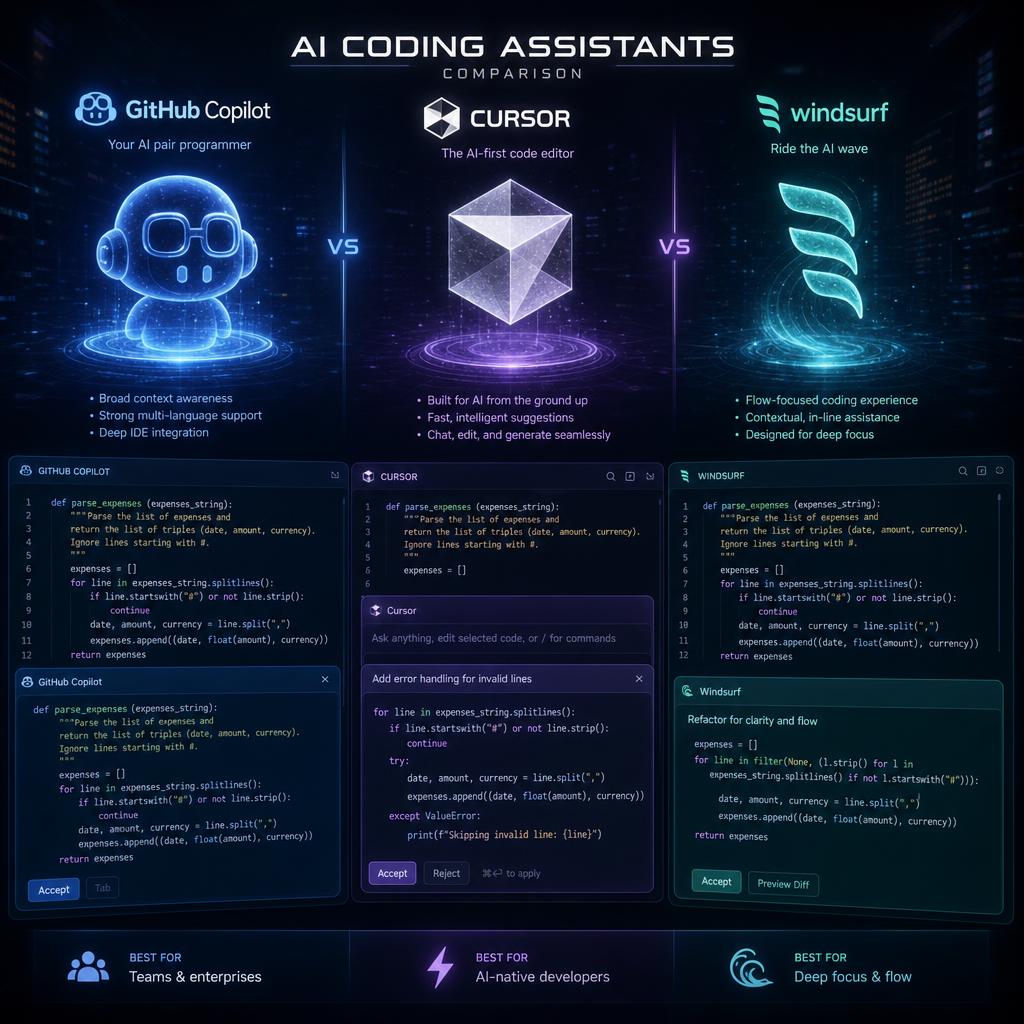
A coding assistant is only helpful when it fits the way a team already builds software. A fast autocomplete tool, a repo-aware agent, and an autonomous coding workspace solve different problems—and the wrong choice can add review work instead of removing it.
This comparison looks beyond demo speed. It focuses on context handling, code review, security controls, pricing, and the roles each tool serves best.
Why AI Coding Assistants Matter More Than Ever in 2026
The average developer using an AI coding assistant ships 55% more code per week and spends 30% less time on boilerplate — according to GitHub's 2025 Developer Survey. But raw productivity isn't the only story. The 2026 generation of tools has crossed a critical threshold: they can now plan, scaffold, and execute entire features autonomously, not just autocomplete your next line.
This shift — from autocomplete to agentic coding — is the defining trend of 2026. Tools like Cursor's Composer, Windsurf's Cascade, and GitHub Copilot Workspace can take a plain-English description of a feature and write code across dozens of files, run tests, fix bugs, and open a pull request. Welcome to the agentic era.
The 8 Best AI Coding Assistants in 2026 — Quick Comparison
| Tool | Price | Best Model | Offline | MCP Support | Context Window | IDE Support | Agentic Mode |
|---|---|---|---|---|---|---|---|
| Cursor | $0–$40/mo | GPT-4o / Claude Sonnet 5 | ❌ | ✅ Full | 200K tokens | VS Code fork | ✅ Composer |
| GitHub Copilot | $0–$39/mo | GPT-4o / Claude / Gemini | ❌ | ⚠️ Limited | 128K tokens | VS Code, JetBrains, Neovim, Xcode | ✅ Workspace |
| Windsurf | $0–$15/mo | Codeium + Claude | ❌ | ⚠️ Beta | 128K tokens | VS Code fork | ✅ Cascade |
| Amazon Q Developer | $0–$19/mo | Claude (AWS-hosted) | ❌ | ✅ | 200K tokens | VS Code, JetBrains, CLI | ✅ Agent |
| Tabnine | $9–$39/mo | Tabnine + local models | ✅ | ❌ | 8K tokens | 20+ IDEs | ❌ |
| JetBrains AI | $10/mo | OpenAI + Grazie | ❌ | ❌ | 128K tokens | JetBrains only | ⚠️ Limited |
| Cody (Sourcegraph) | $0–$19/mo | Claude / GPT-4o | ❌ | ✅ | 100K tokens | VS Code, JetBrains | ✅ |
| Continue.dev | Free/OSS | Any (self-hosted) | ✅ | ✅ Full | Unlimited | VS Code, JetBrains | ✅ |
Deep Dive: Every Major Tool
1. Cursor — Best for Agentic Coding and MCP Extensibility ⭐
Cursor is the AI-native IDE that's taken the developer world by storm. Built as a fork of VS Code, it looks familiar but thinks completely differently. In 2026, Cursor is the #1 choice for solo developers and startups who want the most powerful AI coding experience available.
Key Features
Composer Mode (Multi-File Agentic Editing) Composer is Cursor's crown jewel. Describe what you want in plain English — "build a REST API endpoint that authenticates users with JWT and stores sessions in Redis" — and Cursor writes across your entire codebase: controllers, middleware, tests, config files, and documentation. You approve changes file-by-file with diff-by-diff control, so you stay in the loop without doing the work.
Tab Autocomplete Cursor's Tab autocomplete is context-aware across your entire project, not just the current file. It predicts multi-line completions, function signatures, and even entire class structures. Users report it feels like "coding with a very fast senior engineer looking over your shoulder."
MCP (Model Context Protocol) Extensibility Cursor was one of the first IDEs to embrace MCP — Anthropic's open protocol for giving AI tools access to external data sources and services. With MCP, you can connect Cursor to:
- Your Postgres or MongoDB database (query schemas directly)
- Jira/Linear (turn tickets into code automatically)
- GitHub (fetch PR context, issues, review comments)
- Sentry (read error traces and fix bugs automatically)
- Slack (pull conversation context into your code)
- Custom internal APIs and documentation
Codebase Indexing Cursor indexes your entire repository and uses semantic search to find relevant code when answering questions. Ask "how does authentication work in this app?" and it synthesizes an answer from your actual code — not generic advice.
Inline Chat and Terminal AI Press Ctrl+K anywhere to get AI assistance right where you're working. The terminal integration lets you describe commands in English ("run migrations and seed the database") without memorizing flags.
Cursor Pricing
| Plan | Price | Completions | Models | Team Features |
|---|---|---|---|---|
| Free | $0/month | 2,000/month | GPT-4o mini | Basic |
| Pro | $20/month | Unlimited | GPT-4o, Claude Sonnet 5 | Solo |
| Business | $40/user/month | Unlimited | All models | SSO, audit logs, admin |
Who Should Use Cursor?
- Full-stack developers building complex applications
- Solo founders who need maximum AI leverage
- Developers who want MCP extensibility
- Anyone willing to pay for the best possible AI coding experience
2. GitHub Copilot — Best for Teams and Enterprise
GitHub Copilot remains the most widely deployed AI coding assistant in the world, with over 1.8 million paying users as of 2026. Its deepest advantage is seamless integration with the GitHub ecosystem — where most professional code already lives.
Key Features
Multi-Model Flexibility Copilot's 2026 upgrade lets you switch between GPT-4o, Claude Sonnet 5, and Gemini 1.5 Pro mid-conversation. This is unique — no other hosted tool offers this level of model choice within a single subscription.
Copilot Workspace (Agentic Planning) Copilot Workspace turns a GitHub Issue into a full implementation plan. It proposes file changes, explains its reasoning, and lets you edit the plan before execution. Great for teams using GitHub Issues as their primary task tracker.
Copilot Chat for Architecture Ask high-level questions directly in VS Code or JetBrains: "What's the best way to add real-time features to this Express app?" Copilot gives architecture-level advice grounded in your codebase.
PR Review Assistance Copilot reviews pull requests automatically, flagging security issues, performance problems, and style inconsistencies. For teams, this is a massive time-saver during code review.
Wide IDE Support VS Code, JetBrains IDEs (IntelliJ, PyCharm, GoLand, WebStorm), Neovim, Xcode, Eclipse, and more. If you use it, Copilot probably supports it.
GitHub Copilot Pricing
| Plan | Price | Users | Key Features |
|---|---|---|---|
| Free | $0/month | Individual | 2,000 completions, 50 chat messages |
| Individual | $10/month | 1 | Unlimited completions, all models |
| Business | $19/user/month | Teams | Policy management, audit logs |
| Enterprise | $39/user/month | Large teams | Fine-tuning on private code, SAML SSO |
Who Should Use GitHub Copilot?
- Teams already using GitHub for version control
- Enterprises needing SOC 2 compliance and audit trails
- Developers who work across multiple IDEs
- Organizations who want model flexibility (GPT-4o vs Claude vs Gemini)
3. Windsurf by Codeium — Best Value and Best Free Option
Windsurf is Codeium's flagship AI IDE, and it's made a remarkable impression in 2026 by offering genuinely powerful features at zero cost. If you're a student, freelancer, or just AI-curious, Windsurf deserves your attention.
Key Features
Cascade Mode (Full Feature Autonomy) Cascade is Windsurf's agentic coding engine. Unlike simpler autocomplete tools, Cascade handles entire features from start to finish — reading your codebase, understanding architecture, writing code, running terminal commands, and iterating based on error output. It's remarkably capable for a tool that's free.
Flow Paradigm (Context-Aware Editing) Flow is Codeium's approach to contextual AI — the model tracks your recent edits, cursor movements, and open files to understand what you're trying to do right now, not just what you've typed. This makes suggestions feel more relevant and less generic.
Supercomplete Windsurf's Supercomplete predicts not just your next line but your next action — whether that's writing a function, adding an import, or navigating to another file. It's the most forward-looking autocomplete in the market.
Windsurf Pricing
| Plan | Price | Features |
|---|---|---|
| Free | $0/month | 5 Cascade flows/day, 5 user prompts/day, unlimited Supercomplete |
| Pro | $15/month | Unlimited Cascade, 10 user actions/flow, priority models |
From our testing: These tools have shifted from simple auto-complete helpers to agents capable of handling entire feature implementations with minimal guidance.
Who Should Use Windsurf?
- Students and hobbyists who want powerful AI coding for free
- Developers testing the waters before committing to a paid tool
- Anyone who values a clean, VS Code-like interface with AI built in
4. Amazon Q Developer — Best for AWS Workloads
Amazon Q Developer (previously CodeWhisperer, now significantly upgraded) is the go-to choice for developers building on AWS. Its deep integration with AWS services, documentation, and security scanning makes it uniquely valuable for cloud-native teams.
Key Features
- AWS-native context: understands AWS APIs, IAM policies, CloudFormation, CDK, and service integrations
- Security scanning: automatically scans code for vulnerabilities using Amazon's internal security expertise
- CLI agent: interact with AWS CLI using natural language
- Agent mode: plan and execute multi-step AWS tasks autonomously
Amazon Q Developer Pricing
| Plan | Price | Key Features |
|---|---|---|
| Free | $0/month | 50 code suggestions/day, 5 security scans |
| Pro | $19/user/month | Unlimited, full agent mode, organization policies |
5. Tabnine — Best for Privacy-Conscious Teams
Tabnine's defining feature in 2026 is privacy: it can run entirely on-premises using local models, with zero code leaving your network. For regulated industries (finance, healthcare, legal), this is often non-negotiable.
Key Features
- Local AI models: runs on your machine or private server — code never sent to external APIs
- Team learning: learns your team's codebase and coding style over time
- 20+ IDEs supported: the broadest IDE support of any tool on this list
- SOC 2 Type II certified
Tabnine Pricing
| Plan | Price | Features |
|---|---|---|
| Basic | $0/month | Short completions, basic models |
| Pro | $9/month | Full completions, chat, context |
| Enterprise | $39/user/month | On-premises, admin controls, SSO |
6. JetBrains AI Assistant — Best for JetBrains Power Users
If you live in IntelliJ, PyCharm, GoLand, or WebStorm, JetBrains AI Assistant is the most deeply integrated option. It understands project structure, run configurations, and test frameworks at a deeper level than any third-party plugin.
Pricing: Bundled with JetBrains All Products Pack (~$10/month extra, or included in some plans)
7. Cody by Sourcegraph — Best for Large Codebases
Cody excels in enterprise monorepos where other tools struggle with context. Sourcegraph's code intelligence platform gives Cody access to your entire codebase — not just what's open in your editor.
Pricing: Free (VS Code) | Enterprise $19/user/month
8. Continue.dev — Best Open-Source Option
Continue.dev is a fully open-source VS Code and JetBrains extension that connects to any LLM — local models via Ollama, commercial APIs, or your own hosted inference. It's the most flexible option for teams who want full control.
Pricing: Free (open source). Pay only for whatever model API you use.
MCP Support Deep Dive
The Model Context Protocol (MCP) — developed by Anthropic and now adopted broadly — is the 2026 standard for connecting AI coding assistants to external data. Think of it as a universal plugin system for AI tools.
What MCP Enables
Instead of copying and pasting error logs into your AI chat, MCP lets Cursor (or another MCP-compatible tool) directly read your:
- Database schemas and live data
- Error tracking platforms (Sentry, Datadog)
- Issue trackers (Jira, Linear, GitHub Issues)
- Documentation and internal wikis
- CI/CD pipelines and test results
MCP Support by Tool
| Tool | MCP Status | Notable MCP Integrations |
|---|---|---|
| Cursor | ✅ Full, mature | Databases, Jira, GitHub, Sentry, Notion |
| Continue.dev | ✅ Full | Any custom MCP server |
| Cody | ✅ Full | Sourcegraph context, custom |
| Amazon Q | ✅ | AWS services, internal tools |
| GitHub Copilot | ⚠️ Extensions only | GitHub ecosystem |
| Windsurf | ⚠️ Beta | Limited integrations |
| Tabnine | ❌ | Not supported |
| JetBrains AI | ❌ | Not supported |
Security and Privacy for Enterprise
Key Questions to Ask
- Does my code leave my network? (Critical for IP-sensitive work)
- Is the vendor SOC 2 / ISO 27001 certified?
- Is training data opt-out available?
- Can you run on-premises or in your own VPC?
- What's the data retention policy for prompts and completions?
Enterprise Security Comparison
| Tool | SOC 2 | Data Retention | On-Premises | Zero Data Training |
|---|---|---|---|---|
| GitHub Copilot Enterprise | ✅ | 28 days | ❌ | ✅ (opt-out) |
| Cursor Business | ✅ | 30 days | ❌ | ✅ |
| Tabnine Enterprise | ✅ | None (local) | ✅ | ✅ |
| Amazon Q Pro | ✅ | Configurable | Via VPC | ✅ |
| Continue.dev | Self-hosted | You control | ✅ | ✅ |
Which AI Coding Assistant Should You Choose?
By Role
| Role | Recommended Tool | Reason |
|---|---|---|
| Solo Developer / Freelancer | Cursor Pro | Best agentic coding, MCP, value |
| Startup Team (GitHub) | GitHub Copilot Business | Team features, multi-model |
| Enterprise (Security-First) | Tabnine Enterprise | On-premises, SOC 2, no data leak |
| AWS Developer | Amazon Q Developer Pro | AWS-native context, security scanning |
| Student / Budget | Windsurf Free | Genuinely powerful, $0 |
| Data Scientist | Cursor or Continue.dev | Jupyter support, Python/R intelligence |
| JetBrains User | JetBrains AI + Copilot | Best IDE-native experience |
| Open-Source Enthusiast | Continue.dev | Full control, any model |
Real Workflow Tips: Writing Better Prompts for AI Coding
Great AI coding results depend as much on your prompting as on the tool. Here's what works:
The STAR Framework for Coding Prompts
- S — Situation: Describe what your code currently does
- T — Task: State exactly what you want to add or change
- A — Approach: Suggest the pattern or library to use
- R — Result: Define what "done" looks like (tests passing, feature working, etc.)
Example (bad): "Add authentication"
Example (good): "Add JWT authentication to this Express.js app. Use the jsonwebtoken library we already have installed. Create a middleware that validates the token on protected routes, attach the decoded user object to req.user, and return a 401 if the token is missing or invalid. Write a test using our existing Jest setup."
Common Mistakes to Avoid
- ❌ Asking for too much in one prompt (break it into steps)
- ❌ Not providing existing code context (paste the relevant files)
- ❌ Accepting the first suggestion without review (always read the diff)
- ❌ Using AI for security-critical code without expert review
- ❌ Ignoring AI-generated test failures (they're often revealing real bugs)
2026 Trends: What's Next for AI Coding
1. Agentic Coding Goes Mainstream
The shift from autocomplete to full-task agents is accelerating. By late 2026, expect AI agents to handle entire GitHub issues autonomously, from planning to PR — with humans approving, not writing.
2. Local Models Become Viable
Llama 4 and other open-weight models are closing the gap with commercial APIs. Continue.dev and Tabnine's local mode are growing fast as teams want privacy without sacrificing quality.
3. Context Windows Expand Further
200K tokens is today's maximum. By end of 2026, million-token contexts will be standard, allowing AI to hold your entire codebase in memory simultaneously.
4. AI-Native Testing
The next frontier: AI that doesn't just write code, but automatically writes comprehensive test suites, runs them, fixes failures, and iterates — with no human input beyond a feature description.
FAQ
Q: Is GitHub Copilot still worth it in 2026 when Cursor is so much more powerful? A: Yes, for teams. Copilot's GitHub integration, multi-IDE support, and enterprise compliance features make it the safer, more scalable choice for organizations. Cursor is better for individual power users.
Q: Can I use multiple AI coding assistants at the same time? A: You can, but it gets messy. Most developers pick one primary tool. A common combo is Cursor (main IDE) + GitHub Copilot (for PR reviews and GitHub Workspace).
Q: Is Windsurf actually free? What's the catch? A: The free tier is real but limited: 5 Cascade flows/day and 5 user prompts/day. For light use or learning, it's genuinely sufficient. Heavy daily use needs the $15/month Pro plan.
Q: What is MCP and do I need it? A: MCP (Model Context Protocol) lets your AI coding tool access external data — databases, issue trackers, error monitoring. If you want truly contextual AI assistance (not just file-level), MCP is a game changer. Cursor has the best MCP support today.
Q: Which tool is best for Python and data science? A: Cursor handles Python and Jupyter notebooks excellently. Continue.dev is a strong alternative if you want local models or custom LLMs. Tabnine also has solid Python support with privacy benefits.
Q: Does using AI coding assistants make you a worse programmer? A: Evidence says no — developers who use AI tools consistently report deeper understanding because they can explore more approaches quickly. The key is reviewing AI output critically rather than accepting it blindly.
Q: How does Tabnine's local mode work technically? A: Tabnine Enterprise can run a quantized model (typically a 7B or 13B parameter model) on your own server or developer machines. Code completions are processed locally — nothing leaves your network. This requires decent hardware: at minimum a server with 16GB RAM or 8GB VRAM.
Q: Will AI coding assistants replace developers? A: No — but they're changing what developers do. The 2026 developer spends less time on boilerplate and syntax, and more time on architecture, system design, and product decisions. AI handles the "how"; developers focus on the "what" and "why."
Conclusion
The AI coding assistant you choose in 2026 will meaningfully impact your productivity, code quality, and even job satisfaction. Here's the quick verdict:
- Best overall: Cursor Pro — unmatched agentic coding, MCP extensibility, and model quality
- Best for teams: GitHub Copilot Business — ecosystem integration, multi-model, enterprise-ready
- Best free option: Windsurf — genuinely powerful at $0
- Best for privacy: Tabnine Enterprise — on-premises, no data leakage
- Best for AWS: Amazon Q Developer — cloud-native intelligence
Whatever you choose, commit to it for 30 days. The productivity gains from mastering one AI coding tool deeply outweigh the marginal gains from switching between tools. The future of coding is here — pick your co-pilot and fly.
Check Live Coding Scores on LLM Pulse
LLM Pulse tracks HumanEval and coding scores for every model in this list — updated weekly with real benchmark data:
- Claude Opus 4.7 — Coding score 84/100, HumanEval 95%
- GPT-5.5 Pro — Coding score 85/100, MATH 99.5%
- DeepSeek-V4-Pro-Max — Top open-source coding model
- Compare any two coding models head-to-head
- Find the best LLM for your coding stack
→ See all coding model rankings on LLM Pulse
Ultimately, your choice should depend on whether you prioritize deep IDE integration or seamless platform compatibility.
Tags
Written by

Sourabh Gupta
Data Scientist & AI Tools Specialist · 5+ years in AI/ML
Sourabh tests every AI tool he writes about — hands-on, with real use cases. His background in data science means he goes beyond marketing claims to benchmark actual performance, cost, and reliability for developers and creators.
Full bio & editorial process →