


An AI support agent can answer quickly and still leave the customer with an unresolved problem. The buyer's job is to distinguish a fast response, a billable outcome, and a genuinely completed request. Those three measures do not always describe the same thing.
That distinction is especially important when comparing Intercom with Fin, Zendesk, and Gorgias. Their billing language and account arrangements differ. A price per outcome cannot be compared fairly without knowing what qualifies, what other charges remain, and what happens when a human takes over.
This guide uses official pricing and help documentation checked on October 2, 2026. It provides research-based recommendations for SaaS and ecommerce teams. It does not claim hands-on resolution rates or reproduce vendors' customer-success figures as expected results for your business. Examples below are proposed tests and illustrative calculations.
Build your shortlist around the support system you need
| Situation | Candidate to investigate first | Purchasing question |
|---|---|---|
| You want Fin alongside a supported existing helpdesk or Intercom | Intercom / Fin | Which events generate outcome charges? |
| Your team already works in Zendesk | Zendesk AI agents | Which resolution platform and allowance apply? |
| Order-related ecommerce support dominates the queue | Gorgias | Which actions are permitted, and which fees overlap? |
An existing helpdesk is part of the decision. Replacing it affects historical tickets, routing, reporting, and employee habits. Include those migration costs before deciding that a lower advertised AI rate makes a move worthwhile.
1. Intercom and Fin: read the definition of an outcome
Intercom lists Fin at $0.99 per outcome. Its stated outcomes include a customer confirming resolution, a customer not requesting further help after an answer, or completion of a Procedure, including handoffs. It charges once per conversation. Intercom's platform pricing combines seats and usage; Fin can also be purchased for supported existing helpdesks, with a minimum commitment. Intercom pricing
This definition matters because an outcome is not necessarily a conversation completed without human involvement. Before estimating staffing savings, separate the types of outcomes expected in your workflow. A useful handoff may save effort, but it should not be counted as if the human team did no work.
At the listed rate, 1,000 billable outcomes would cost $990 for that usage component. That hypothetical calculation excludes helpdesk subscriptions, applicable channel usage, and other costs. Obtain a complete quote for your configuration rather than presenting the outcome charge as the whole support bill. Intercom cost components
For a SaaS trial, choose questions about account setup, a documented feature limitation, and a request needing human approval. Ask the vendor to show the billable classification for each completed interaction. Then have your own reviewer judge whether the customer actually received the right result.
Shortlist Fin when its integration route and workflow fit your support operation. The evaluation should include the handoff experience: what context reaches the human agent, what the customer sees, and whether either person has to repeat work.
2. Zendesk: establish which resolution model your account uses
Zendesk's public pricing page lists automated-resolution allowances and additional usage rates. However, its linked documentation distinguishes an older platform from resolution tiers introduced on May 18, 2026. Existing customers can remain on the earlier platform until they move. This makes the account's billing version a necessary part of the quote. Zendesk pricing, Zendesk's earlier resolution platform
In the newer documentation, assisted escalations and contained resolutions do not draw from the resolution allowance. Verified resolutions depend on the platform's verification process. A human-completed escalation and a verified automated resolution therefore belong in different categories. Confirm the applicable definitions and commercial terms with your account details. Zendesk resolution tiers
For a business already using Zendesk, the first trial should preserve the current support process as a comparison. Select a narrow group of questions that agents answer from established documentation. Measure how those requests move through the system with AI enabled and how exceptions return to the team.
Avoid changing routing, help-center content, staffing, and automation coverage simultaneously. If all four change, it becomes difficult to explain an improvement or a failure. Start with a scope small enough that a support lead can inspect the conversations.
The reason to investigate Zendesk first in an existing Zendesk environment is practical: you can evaluate changes against familiar ticket handling. That is an editorial recommendation, not a claim that its model is more accurate than competitors. A move to another platform still needs to justify the migration work.
3. Gorgias: useful ecommerce scope, with overlapping fees to understand
Gorgias documents AI Agent for shopping assistance and post-purchase support, including order tracking, returns, and cancellations. It describes configurable, opt-in actions in connected tools and rules for human handover. Those capabilities make order-related work a relevant evaluation scenario. Gorgias AI Agent explained
Its current billing guide says an AI-resolved ticket can incur both a helpdesk ticket fee and an additional automation fee. If AI hands the conversation to a human, only the ticket fee applies in the example given. Some older accounts follow a legacy model, so check the subscription rather than relying on an older review. Gorgias billing guide
This is a meaningful difference from treating the advertised automation rate as an all-inclusive price. Ask for a sample invoice showing ordinary human-handled tickets, AI-completed tickets, and any separate channel charges. Use your recent support mix to estimate volume in each category.
For an ecommerce pilot, create test cases for a shipped order, an unshipped order, a return outside the ordinary window, and a customer whose identity has not been established. Define the acceptable action before running the test. An accurate explanation of the returns policy is different from permission to process a return.
Start with narrow action permissions. For example, you might initially permit order-status answers while sending address changes and refund exceptions to staff. Expand only after reviewing actual cases and confirming that the store's rules are represented correctly.
Gorgias is worth investigating when ecommerce operations dominate the queue. A SaaS team whose questions mainly involve account permissions and technical troubleshooting should require an equally specific demonstration of those workflows before choosing it.
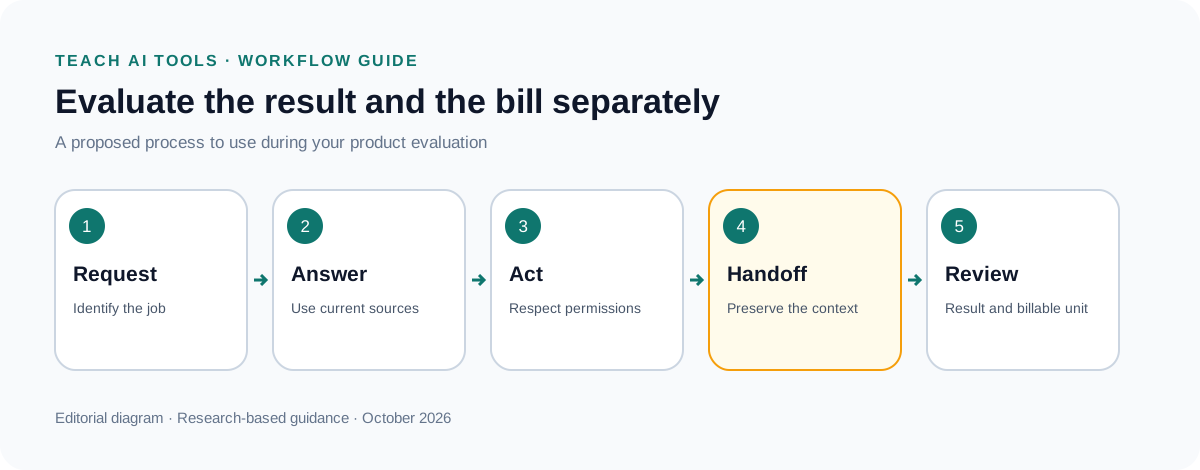
Compare billing with a realistic conversation sample
Take a sample of fifty recent, appropriately handled support requests and remove unnecessary personal information before using them in an evaluation. Group them by the actual job: factual question, order or account action, exception requiring approval, and complaint requiring human judgment.
Do not select only the easiest questions from the help center. Include a question with outdated wording, a request containing two problems, and a customer who returns after the first answer failed. Those cases reveal more than a clean demonstration involving a single FAQ.
For each platform, record four separate results: the answer given, the action taken, the human work remaining, and the vendor's billable classification. This lets you compare business outcomes even when the vendors use different terms on invoices.
Keep the raw counts visible. “Thirty requests were answered correctly without further staff work” is more informative than an unexplained automation percentage. Document what happened to the remaining twenty and whether the customer had an easy way to get help.
Fix the knowledge source before expecting reliable answers
An assistant needs a clear statement of the policy it is expected to apply. If the website says returns are accepted for thirty days but an old help article says fourteen, resolve the conflict before launch. Otherwise, even a well-written response may reflect the wrong source.
Assign an owner and review date to important support documents. Start with pricing, refunds, shipping, cancellation, account access, and product limitations. Make exceptions explicit rather than leaving experienced agents to remember them informally.
For SaaS documentation, identify which plan, role, or product version an instruction applies to. For ecommerce, separate ordinary delivery estimates from guarantees and explain what staff should do when a parcel is missing. These distinctions give both AI and human agents better material to work with.
After a product or policy change, retest the related questions. Updating a document is not evidence that every connected workflow now answers correctly. Verify the customer-facing result and keep a record of the check.
Human handoff is part of the product
A customer should be able to reach a person when the request needs one. During the trial, explicitly ask for human help, present conflicting information, and describe a problem outside the approved knowledge. Observe the transition rather than accepting a feature checkbox.
The handoff should preserve the customer's question, relevant context, attempted steps, and any promised follow-up. It should also make clear whether a human is available now or will respond later. An apparently instant reply that hides a long wait can damage the experience.
Give the receiving agent a way to correct the record. If AI misclassified the issue, the human should not have to fight that classification throughout the rest of the case. Include staff feedback in the pilot review, especially for conversations the dashboard labels successful.
Measure savings without disguising the remaining work
Calculate total monthly cost using the platform subscription, AI usage, channel fees, setup effort, knowledge maintenance, and quality review. Then compare that with the same workload under the current process.
Use cost per correctly completed request as an internal metric, with your own explicit definition of “completed.” Keep it separate from the vendor's billing unit. Also track repeat contacts and the handling time of escalated cases. A smaller human queue is not necessarily an easier queue if it contains all the difficult exceptions.
Set spending and rollout limits for the pilot. Review both ordinary days and a busier period before projecting annual savings. Seasonal sales, product incidents, and policy changes can alter the mix of requests more than the average monthly volume suggests.
Which tool should your team evaluate first?
Investigate Intercom/Fin for a compatible helpdesk route and clearly specified outcomes, Zendesk when your existing environment offers a practical place to test its applicable resolution model, and Gorgias for order-focused ecommerce workflows with controlled actions.
Make the purchase only after the team can explain the complete bill and demonstrate accurate answers, appropriate actions, and usable handoffs. A credible support pilot should show which requests AI can handle, which still need people, and how the business will notice when either part stops working well.