


A bakery managing three social accounts and an agency managing twelve clients can both ask for the best AI social media tool. They should probably buy different products. The bakery needs a dependable calendar and help turning offers into posts. The agency also needs approvals, separate client reporting, and a way to prevent the wrong person from publishing on the wrong account.
The useful question is where your publishing process gets stuck. If writing takes too long, an AI assistant may help. If clients approve posts through scattered messages, generating captions faster will leave that bottleneck intact. If you cannot connect posts to enquiries or sales, publishing more frequently may simply produce more unexplained activity.
This guide compares Buffer, Metricool, and Hootsuite around those decisions. It draws on official pricing and product documentation checked on October 2, 2026. These are research-based recommendations, without hands-on performance scores. Prices below exclude any applicable taxes; annual equivalents require an annual commitment.
The shortlist: choose by the work you need to finish
| Your main need | First tool to evaluate | Decision to resolve during the trial |
|---|---|---|
| A manageable publishing queue for a small brand | Buffer | Does per-channel pricing fit your account count? |
| Several client brands and recurring reports | Metricool | Does the chosen tier include your networks and approvals? |
| Coordinated publishing and customer conversations | Hootsuite | Do team controls justify the full quoted cost? |
These are starting points, not a ranking based on measured growth. None of the documentation reviewed establishes that one product will increase your particular account's reach. Growth also depends on the offer, the creative work, and whether the audience finds the posts useful.
1. Buffer: a sensible starting point for a small publishing operation
Buffer's free plan supports three channels and ten queued posts per channel at a time. That is a queue capacity: published posts free up space. Its AI Assistant is included. Essentials is displayed at $5 per channel per month, billed annually; Team is $10, with unlimited team members and approval workflows. Paid subscriptions charge for all connected channels, including the first three. Buffer pricing
That structure makes counting accounts essential. In a hypothetical setup with six channels, Essentials works out to $360 annually, while Team works out to $720, before taxes. A channel is a connected social account, so adding another client's Instagram and Facebook accounts adds two channels. These calculations use the displayed annual rates and assume no special discount. Buffer plan details
My recommendation is to shortlist Buffer when one person owns the calendar or a small team has a straightforward approval process. An independent consultant could prepare a week's posts in one sitting, review the copy against the original notes, and schedule the finished material. The purchasing decision then becomes whether the paid queue and collaboration options remove a recurring constraint.
During the trial, publish the formats you actually use. A text update is a poor substitute for testing a carousel, a short video, or a post that needs a particular tag. Write down any step that still requires opening the native social app. The tool's value depends on the complete route from approved asset to published post.
Skip an immediate upgrade if the free queue already covers your routine. Spend a week measuring the time spent preparing, approving, and publishing. Paying for more capacity is reasonable when queue limits interrupt work; it is less useful when the missing ingredient is a clear content plan.
2. Metricool: worth evaluating for multiple brands and reporting
Metricool organizes its plans around brands. Its free tier includes one brand and 20 posts per month, with LinkedIn and X excluded. The annual USD pricing displays Starter at $20 per month for up to five brands. Advanced starts at $53 per month for up to fifteen brands and lists roles, approvals, and team/client management. X connectivity is an additional cost. Metricool pricing
Notice the difference between a monthly publication allowance and a queue limit. Someone publishing daily can run out of a monthly allowance even when only a few future posts are scheduled. A queue limit instead constrains how far ahead they can prepare. Comparing the headline numbers without identifying the unit can lead to the wrong subscription.
For a small agency, evaluate Metricool with one actual reporting cycle. Select a client whose goals are specific: booking consultations, selling event tickets, or generating qualified messages. Build the report you would send to that client, then check how much interpretation you still need to add.
A chart showing rising impressions does not explain whether the campaign worked. Add the offer, audience, posting dates, and the action you wanted people to take. If the client needs enquiries, document how enquiries are counted. This makes the reporting process useful even when a particular week produces disappointing results.
Be careful about buying Starter solely because five brands fit its capacity. If the person paying you must approve every post, the approval requirement may determine the tier. Write your required workflow before comparing prices: draft, internal review, client review, scheduled, published. Then attempt to reproduce it during the trial without relying on informal messages outside the process.
Metricool is a promising candidate when managing several brands is the central problem. It deserves less priority when you only need occasional personal posts and would rarely use its reporting structure.
3. Hootsuite: evaluate the coordination features, not just the calendar
Hootsuite's Standard plan is positioned for individuals and smaller businesses. Its Advanced page describes approval workflows, shared calendars, conversation assignments, automatic routing, and reporting features for coordinated teams. Those distinctions make the relevant plan more important than the Hootsuite name alone. Hootsuite Standard, Hootsuite Advanced
I would consider it when publishing and responding are connected operational jobs. Imagine a retailer running a launch across several regions. Marketing prepares announcements, regional staff check availability, and service staff receive questions after publication. The expensive mistake is an approved-looking post that promises stock a region does not have.
Use that scenario in the demonstration. Ask who can edit the draft, who approves it, and how someone learns that a scheduled post has changed. Then send a sample customer question and follow it through assignment and response. A polished calendar demonstration does not answer those questions.
Request a written quote covering your actual users, profiles, required workflows, and add-ons. I have not included a universal Hootsuite price because the useful comparison is the configured plan that meets those requirements. An agency needing only scheduled publication should establish a concrete benefit before accepting a substantially larger subscription.
The practical reason to pay for coordination is fewer dropped responsibilities. Estimate how often your current process causes duplicated replies, missed approvals, or late publishing. That gives the trial a measurable purpose and gives the person approving the budget something more solid than a feature count.
What AI should do in your content process
Use AI on a brief that already contains facts. For a café, that might include the dish, price, availability dates, location, and booking link. Ask for versions with different opening lines or lengths. Then verify that every version preserves the details.
For example, a useful instruction is: “Write three Instagram captions for this Friday's vegetarian lunch special. Keep the £12 price and noon-to-three availability unchanged. Do not add ingredients, discounts, or health claims. End with the supplied booking link.” The constraints make review easier because the assistant has a defined job.
Avoid starting with “write something engaging about our business” and treating the result as finished. That leaves the system to invent the substance. A caption can sound polished while announcing an offer you never approved.
Assign a human reviewer to product claims, customer quotations, and promotional conditions. For a small business, that may be the owner. For an agency, record who supplied each claim and who approved the final wording. This is also useful when a sponsored post contains statements provided by the sponsor.
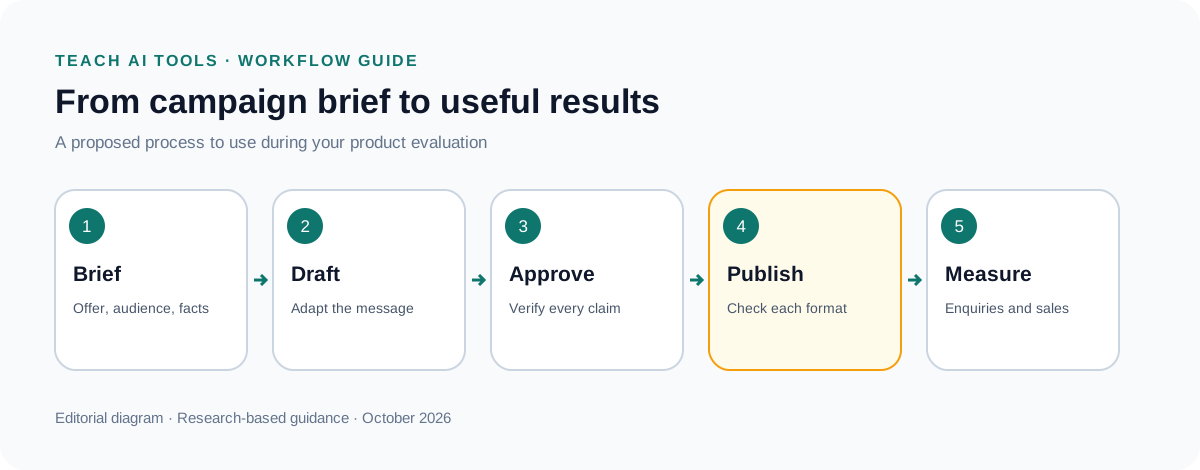
A two-week trial that produces a purchasing decision
Choose twelve planned posts across your real channels. Include straightforward updates, a time-sensitive offer, a video, and a post requiring approval. Keep the original assets and briefs identical when evaluating alternatives.
Track four things: preparation time, approval time, publishing corrections, and reporting time. Start the clock when the brief is ready and stop when the finished result is usable. Counting only AI generation time misses the work spent rewriting weak suggestions or repairing formatting.
Record the reason for every correction. A wrong date is different from a stylistic preference. A failed publish is different from a deliberate native-app finishing step. This helps you distinguish problems with the tool from an incomplete internal process.
At the end, ask the person who will use the product daily to recreate next week's calendar without assistance. If ordinary work still requires a specialist to intervene, include that dependency in the buying decision.
Measure growth without giving the scheduler all the credit
Use a simple campaign sheet with the post link, audience, offer, creative format, and destination. Add a consistent campaign tag to links where appropriate, and record qualified enquiries separately from clicks. A spike in low-intent traffic is not equivalent to new business.
Compare similar campaigns over a useful period rather than declaring a winner from one successful post. If you change the offer, creative format, posting frequency, and tool at once, you cannot confidently attribute the result to the software.
For sponsored content, agree on deliverables you can control: the number of posts, required disclosures, publication dates, and reporting format. Avoid promising a fixed number of sales simply because the scheduler includes AI. The sponsor should be buying a clearly described placement and a credible editorial process.
The cost checklist before checkout
Count connected accounts, brands, users, and approval participants separately. List required networks and formats. Check the billing interval, renewal amount, add-ons, and what happens when someone leaves the team. Save the final quote alongside the plan description so future comparisons use the same scope.
Also test whether you can retrieve the material you need when changing tools: approved copy, media, reports, and scheduled dates. Plan the handover before your subscription becomes the only place that information exists.
Choose Buffer first for a small, clear publishing workflow; Metricool for a brand-based agency comparison; and Hootsuite when team coordination and customer conversations warrant a fuller evaluation. Buy the product that reduces the work your team actually struggles with. A larger collection of AI features is useful only when it helps you publish accurate, relevant content consistently.