AI for Game Developers: Why the Generated Code Breaks and the Workflow That Actually Ships
Editorial note: Some links in this article are affiliate links — we may earn a commission if you sign up, at no extra cost to you. Research guides are distinguished from documented firsthand reviews in our editorial standards. Read our editorial standards →
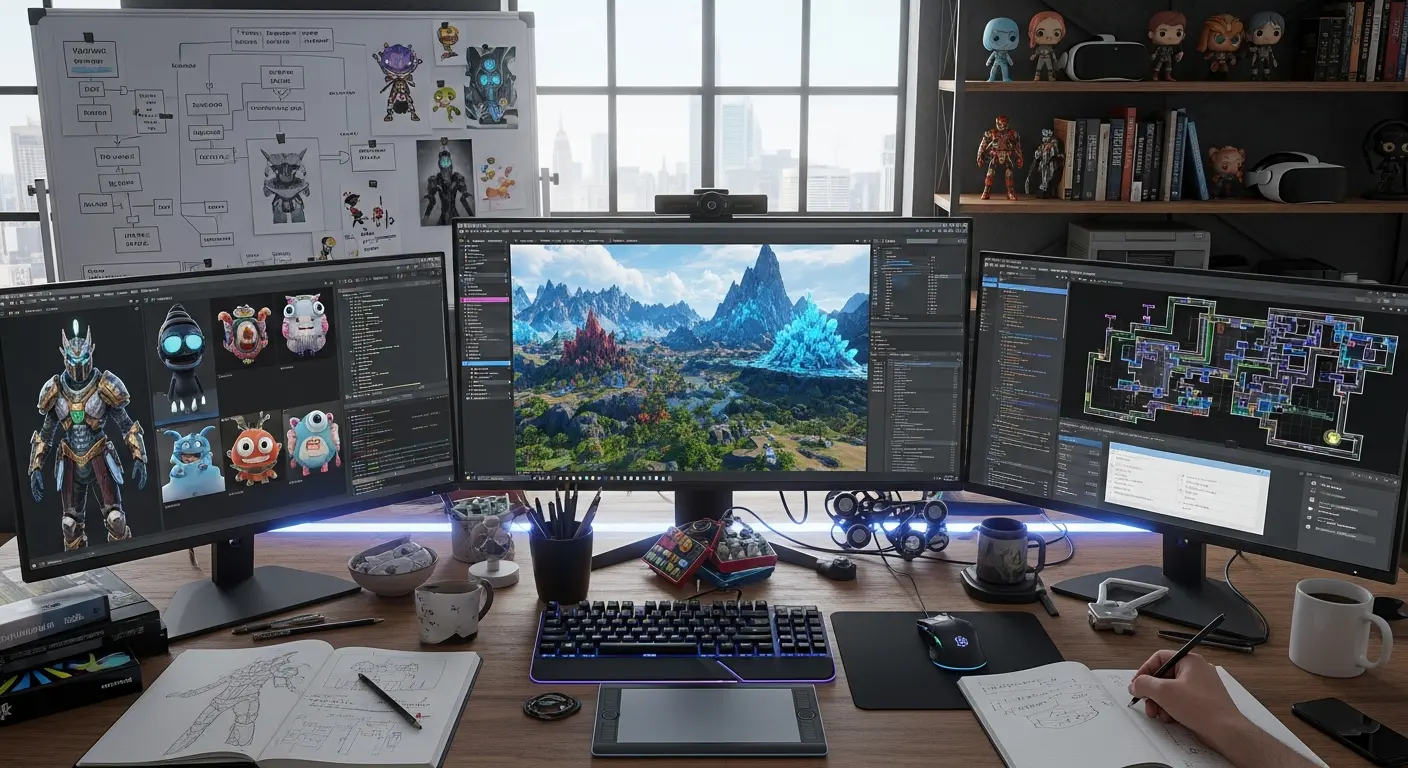
Every game developer who has used AI code tools in 2026 has had the same experience: the code looks correct, runs without errors, and then breaks something else three days later in a way that's annoying to trace.
AI for Game Developers: Why the Generated Code Breaks and the Workflow That Actually Ships
This is not random. AI-generated game code fails in predictable patterns for predictable reasons. Understanding those patterns is what separates developers who use AI tools to ship faster from developers who spend the same amount of time debugging AI output as they would have spent writing the code themselves.
Here's what's actually happening, which tools handle it best, and the workflow patterns that consistently produce shippable results.
The Tools and Their 2026 Pricing
| Tool | Use Case | Pricing |
|---|---|---|
| GitHub Copilot | In-editor autocomplete, line and block completion | $10/mo (Individual), $19/mo (Business) |
| Cursor | AI-native editor, codebase-aware composer | $20/mo (Pro), $40/mo (Business) |
| Claude 3.5 Sonnet (API) | Architecture design, complex problem solving | $3/M input, $15/M output |
| ChatGPT Plus | General coding Q&A, algorithm help | $20/mo |
| Tabnine | Privacy-first autocomplete, on-premise option | Free (basic), $12/mo (Pro), $39/mo (Enterprise) |
| JetBrains AI Assistant | In-IDE AI for Rider/CLion Unity/Unreal devs | Included in JetBrains All Products ($28.90/mo) |
The tools that cause the most issues are also the most powerful: Cursor's composer mode and Claude pasted with large context. The tools that cause the fewest issues — Copilot, Tabnine — are also the most limited. The relationship between capability and breakage risk is not coincidental.
Why AI-Generated Game Code Breaks: The Specific Reasons
Reason 1: No Game Engine Context
Generic AI models (GPT-4o, Claude, Copilot) were trained on code from across the internet, including game engine documentation and Stack Overflow answers. The problem is that game engine APIs evolve faster than the training data can track.
Unity's Input System has gone through three major versions since 2020. Copilot frequently generates code using the old Input Manager (Input.GetAxis, Input.GetButtonDown) when the project is configured for the new Input System. Both compile. The old API silently does nothing in projects using the new system.
Unreal Engine's Blueprint and C++ APIs have similar issues — generated C++ often references deprecated delegates, incorrect UObject lifecycle methods, or GameplayAbility System patterns from older plugin versions.
The pattern: AI generates syntactically correct code that uses deprecated or incorrect APIs for your specific engine version. It compiles. It doesn't work.
The fix: Include your engine version and your project's specific API choices in every prompt. "I'm using Unity 6 with the new Input System and URP. Never use Input.GetAxis or the old Input Manager." Adding this context to your system prompt or Cursor's .cursorrules file catches most of these errors.
Reason 2: Physics and Collision Is Fundamentally Hard to Generate
Physics interactions — character controllers, collision detection, rigidbody forces, raycast logic — are the category where AI-generated code is most likely to produce something that works in isolation and breaks in combination.
The reason is systemic complexity. A rigidbody-based character controller needs to handle: standing on slopes, stepping over small obstacles, not falling through thin geometry at high velocities, interacting with moving platforms, and responding to physics impulses from other objects. Each of these is solvable individually. Generated code handles them individually. The interactions between the solutions are where everything falls apart.
AI models don't have a physics simulation running internally. They produce code that looks like it will work based on pattern matching to similar code in their training data. Whether the forces, velocities, and collision masks actually produce the behavior you expect at runtime is something only the runtime can tell you.
The fix: Never use AI-generated code for your character controller or core physics systems without running it through a dedicated test scene first. Use AI for the components around physics (UI, inventory, save systems, audio triggers) and write your own physics code or use a well-tested third-party solution.
Reason 3: Implicit Dependencies Between Systems
Game systems are more interconnected than typical software. The animation system depends on the character state machine. The character state machine depends on the input system. The save system needs to know about both. The AI assistant that generates your save system doesn't know how your animation state machine is structured unless you show it.
The specific failure mode: AI generates a save system that serializes character state. The character state enum in the generated code has different values than the enum you already defined elsewhere. Everything compiles. Loading a save file crashes or silently loads incorrect state.
The fix: When asking AI to generate code that touches existing systems, paste the existing system's interface — the relevant classes, enums, and method signatures — into the context first. Don't explain the system; show it. Claude with 40K tokens of context produces dramatically better integration code than Claude with a description.
The Code Categories Where AI Consistently Helps
High-Value, Low-Risk
UI code: Menus, HUD elements, inventory screens, dialogue boxes. UI code is self-contained, well-documented in engine documentation, and doesn't interact with physics or game state in complex ways. Copilot is excellent at Unity UI Toolkit and Unreal UMG widget code.
Save and serialization systems: JSON serialization, binary save formats, PlayerPrefs wrappers. These are mechanical problems with well-established patterns. AI produces reliable save system code when you give it your data models to serialize.
Audio management: Audio mixer integration, sound effect triggers, music layering systems. Audio code is relatively isolated from other game systems. AI generates good audio manager implementations.
Shader code (HLSL/GLSL): This is where AI provides disproportionate value. Shader programming is specialized, well-documented, and the syntax is strict enough that AI-generated shaders either work or produce obvious compilation errors. Copilot is excellent at writing custom HLSL shaders for Unity URP/HDRP.
Medium-Value, Moderate-Risk
Enemy AI behavior trees and state machines: AI generates reasonable behavior tree structures and state machine implementations. The risk is game-feel — whether the AI behaves interestingly and fairly is a design judgment that requires iteration, not code correctness.
Procedural generation: Dungeon generation, terrain algorithms, loot tables. These are algorithmic problems that AI handles well. The risk is that the algorithm produces technically correct output that's boring or unbalanced.
Low-Value, High-Risk
Character controllers and physics: As described above — high failure rate, difficult to debug.
Networking code: AI-generated multiplayer code has subtle race conditions and desync issues that don't appear in single-player testing. Use dedicated networking middleware (Mirror, Netcode for GameObjects, Photon) rather than AI-generated custom networking.
The Workflow Pattern That Actually Ships
The teams and solo developers using AI tools most effectively in 2026 follow this pattern:
1. Lock your architecture first, AI-generate second. Write the interfaces and data models yourself. Define your enums, your core types, your system boundaries. Then use AI to generate the implementations.
2. Use AI for the outer layers, write the core manually. Your character controller, your game loop, your core systems — write these yourself. Use AI for the systems that plug into the core: UI, audio, inventory, save/load.
3. Always run generated code in an isolated test scene before integrating. AI-generated physics, AI, or camera code gets a dedicated test scene before it touches your main scene. Two days of debugging a scene interaction is prevented by 20 minutes of isolated testing.
4. Give AI the interfaces, not descriptions. "Here's my IWeapon interface and my existing weapons — generate a new FlamethrowerWeapon that implements it" produces dramatically better code than "generate a flamethrower weapon."
The developers shipping AI-assisted games in 2026 aren't the ones trusting AI the most. They're the ones who know exactly what to trust it for.
Compare Cursor, Copilot & Every AI Coding Tool for Game Dev
The AI Game Dev Tools Dashboard ranks Cursor, GitHub Copilot, Rosebud AI, and 30 more tools with AI scoring and side-by-side comparisons — find the right AI code assistant for your engine and workflow.
Open AI Game Dev Tools Dashboard →Tags
Written by

Sourabh Gupta
Author at Teach AI Tools
Sourabh tests every AI tool he writes about — hands-on, with real use cases. His background in data science means he goes beyond marketing claims to benchmark actual performance, cost, and reliability for developers and creators.
Full bio & editorial process →