Why Anthropic Is Running Claude on SpaceX's GPUs -- And What It Means for Your Rate Limits
Editorial note: Some links in this article are affiliate links — we may earn a commission if you sign up, at no extra cost to you. Research guides are distinguished from documented firsthand reviews in our editorial standards. Read our editorial standards →
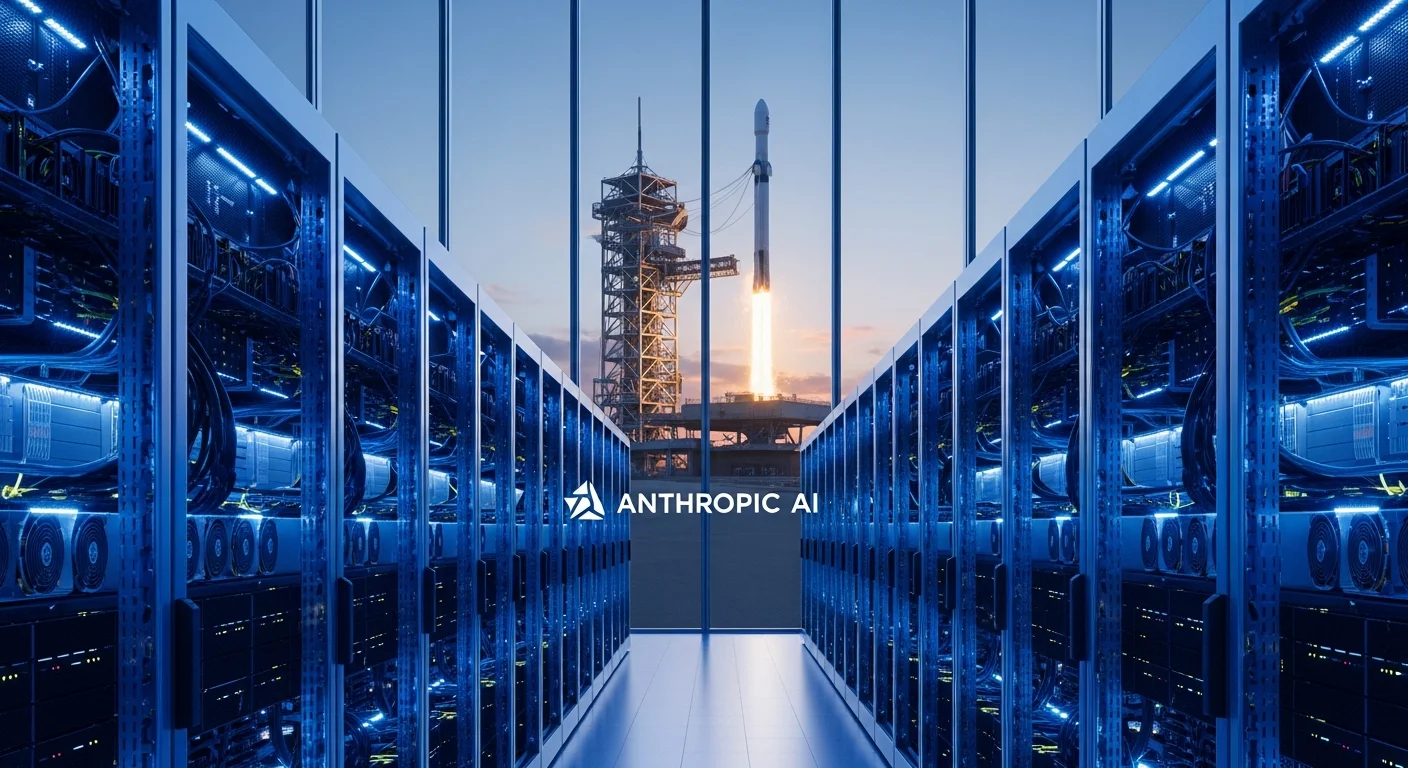
The deal is strange on the surface. Anthropic -- an AI safety company backed by Google and Amazon -- is now routing Claude traffic through Colossus, the Memphis supercomputer cluster originally built for Elon Musk's xAI.
Why Anthropic Is Running Claude on SpaceX's GPUs -- And What It Means for Your Rate Limits
But once you understand the business pressures on both sides, the logic is almost obvious.
Here is what actually happened, and why it matters if you are paying for Claude API access.
The Part Nobody Explained
Most coverage focused on the headline -- compute partnership, rate limits doubling, Anthropic capacity expanding. What they skipped is the part that explains why it happened at all.
Three things converged in early 2026.
SpaceX/xAI had idle GPUs. When Musk positioned xAI as OpenAI's main competitor, he built out Colossus aggressively -- tens of thousands of H100s in Memphis, with more arriving. The problem is that Grok's actual user adoption did not match the ambition. Download numbers for the Grok app tracked well below ChatGPT and Claude across every major app intelligence platform through Q1 2026. A cluster built for frontier-model training and inference at massive scale was running at a fraction of its commercial load.
Anthropic was capacity-constrained in a way that was costing them contracts. Several large enterprise deals in the $500K-$2M ARR range hit friction at procurement because Anthropic could not guarantee the throughput SLAs that enterprise teams expected. A legal ops team processing 40,000 documents a month cannot operate under rate limits designed for consumer chatbots. Claude's quality was winning evaluations; the infrastructure story was losing signatures.
The economics worked for both sides. SpaceX gets utilization revenue on hardware that would otherwise depreciate while sitting underloaded. Anthropic gets burst capacity without the 18-month lead time and capital commitment of building their own cluster.
The partnership is arms-length and limited in scope. Anthropic is not moving core training workloads to Colossus, and the deal gives xAI no insight into Claude's architecture or training data. But for inference, the arrangement is commercially sound.
What "Rate Limits Doubling" Actually Means in Practice
The announcement phrasing -- "Claude rate limits have doubled" -- is technically accurate and practically misleading at the same time.
Here is the breakdown by tier as of May 2026:
| Tier | Previous Limit | Updated Limit | Who It Affects |
|---|---|---|---|
| Claude.ai Free | 20 msgs/day | 40 msgs/day | Casual users |
| Claude.ai Pro ($20/mo) | ~100 msgs/4hrs | ~200 msgs/4hrs | Individual professionals |
| API Tier 1 (new accounts) | 40K tokens/min | 80K tokens/min | Developers prototyping |
| API Tier 2 (paid, $100+) | 80K tokens/min | 160K tokens/min | Teams and startups |
| API Tier 4+ (enterprise) | Custom | Custom (higher floor) | Enterprise contracts |
The doubling matters most for the API tiers. For enterprise teams who were hitting ceilings on document-processing pipelines, this is a meaningful change -- you can now push twice the throughput before needing a manual limit increase request.
For casual Claude.ai users, going from 20 to 40 messages per day is nice but is unlikely to change your workflow. If you were hitting the old limit regularly, you were already on Pro.
The xAI and Grok Context That Explains the Power Dynamics
It is worth being precise about the state of Grok heading into this deal, because the coverage has been uneven.
Grok 3 launched in February 2026 and genuinely impressed on reasoning benchmarks -- particularly math and code. In side-by-side evaluations, Grok 3 Ultra competed with o3 and Gemini 3.1 Ultra on tasks that rewarded step-by-step formal reasoning. The model itself is serious.
The problem is distribution and retention, not capability.
The Grok app's monthly active user numbers have never crossed the threshold that would justify Colossus running at full inference load. X (formerly Twitter) is the primary distribution channel, and while that gives Grok built-in reach, it does not convert to sustained API consumption or enterprise contracts at the rate that Google-distributed Gemini or Microsoft-distributed OpenAI models achieve.
Enterprise procurement teams in 2026 buy AI infrastructure with an eye on vendor stability, support SLAs, and ecosystem tooling. xAI's enterprise sales motion was, as of early 2026, still maturing. That is a one-to-two-year sales cycle lag that is normal for any new enterprise entrant.
What it means for Colossus: the cluster had headroom. Selling that headroom to Anthropic while xAI builds its enterprise pipeline is rational capital management, not a sign of distress.
Why This Changes Anthropic's Enterprise Story
Before May 2026, the typical enterprise evaluation of Claude went something like this:
- Capability evaluation: Claude usually wins or ties on document-heavy, nuanced tasks
- Safety/compliance evaluation: Claude wins consistently on Constitutional AI, auditability, refusal behavior
- Infrastructure evaluation: this is where deals got complicated
Teams with hard throughput requirements were told to contact enterprise sales for custom limits. That conversation takes weeks. Meanwhile, the OpenAI team had a standard rate limit table they could put in front of procurement without a separate conversation.
With Colossus capacity absorbed into the infrastructure stack, Anthropic's sales team can now commit to standard SLA tiers that cover most enterprise cases without a custom negotiation. That removes friction at exactly the stage of the sales cycle where deals were stalling.
What This Does Not Change
A few things worth naming directly.
Claude's pricing did not change. Rate limits doubled. The per-token cost at each API tier is the same. If you were building cost models for Claude-based pipelines, those models are still valid.
This is not Anthropic abandoning its own infrastructure build-out. The Colossus arrangement is supplemental, not a pivot. Think of it as a variable capacity layer that buys time while owned infrastructure scales.
The xAI relationship is transactional, not strategic. Anthropic and xAI are competitors at the model layer. This is a hardware utilization deal, similar in structure to how cloud providers sell spare capacity to competing cloud tenants.
The Practical Takeaway If You're Building on Claude
If you are on API Tier 2 or above and your pipeline was bumping against rate limits before May 2026, test your throughput now. The increase is live, not phased. You should see the change without any configuration update on your side.
If you are still on Tier 1 and have been holding off on scaling because of limit concerns, this is a reasonable moment to move to Tier 2. The jump from 80K to 160K tokens/minute changes what is possible for document-processing and multi-agent workflows.
If you are evaluating Claude for enterprise and you stalled on the infrastructure question, the conversation with Anthropic's sales team looks different now. The floor on committed SLAs is higher than it was six months ago.
For everyone else: the Anthropic/SpaceX story is interesting business context, but it does not change the core model evaluation. Claude is still the better choice for document-heavy, nuanced, source-grounded tasks. That evaluation framework did not shift because of a compute deal.
Tags
Written by

Sourabh Gupta
Author at Teach AI Tools
Sourabh tests every AI tool he writes about — hands-on, with real use cases. His background in data science means he goes beyond marketing claims to benchmark actual performance, cost, and reliability for developers and creators.
Full bio & editorial process →