


Choose a similarity checker when you need to find reused wording; choose an AI detector when your question is about possible AI assistance. Neither replaces checking citations. The phrase “AI plagiarism checker” mixes those jobs, so buying the wrong report can leave the original concern unanswered.
For students, my first recommendation is the draft-checking service your institution permits, plus a record of your writing process. For an independent editor needing both source matches and AI screening, Copyleaks Personal is the clearest combined-service option to evaluate here. If you already pay for Grammarly and mainly need writing assistance with source-overlap checks, try its available plagiarism feature before buying another subscription. Researchers considering a manuscript similarity check should compare iThenticate's individual credits with any institutional access they already have.
These recommendations follow documented features, cost and workflow. We ran no independent accuracy tests and do not rank a “most accurate” detector. Vendor pages were checked on October 12, 2026. The annotated example below is an editorial review of a real source quotation, not a screenshot or result from a vendor scan.
Decision table: access, cost, report and suggested use
| Tool or category | Who can access it? | Verified price or buying route | What you are getting | Our suggested use |
|---|---|---|---|---|
| Turnitin Feedback Studio / Similarity | Institutions; students and staff through their institution | Institution-specific quote; no direct individual subscription | Similarity matches; AI-writing features depend on licensing and enablement | Schools needing an assignment and review workflow |
| Copyleaks Personal | Individual subscribers | $16.99 USD monthly; $13.99/month equivalent with annual billing, $167.88 annually | Combined text similarity and AI detection | Independent editors needing both report types |
| GPTZero | Free and paid individual accounts; team options | Free; regional annual pricing observed: Premium ₹599/month, Professional ₹1,199/month, billed annually | AI screening; paid workflow features and separate plagiarism feature | Evaluating AI-related flags with writing-process evidence |
| Grammarly Pro | Individuals and teams; institution access may also exist | $30 USD monthly; $144/year, equivalent to $12/month | Writing assistance with access to a plagiarism-checking agent | Writers already using Grammarly who want attribution checks |
| iThenticate individual credits | Researchers, authors and other individual buyers | Single $125 USD; Multiple $300, excluding taxes | Manuscript similarity checking; individual credits do not include AI detection | Occasional research-manuscript screening |
| Free AI checkers, including QuillBot | Individual web users | QuillBot's AI detector is free; free uploads are one file at a time | AI classification, not automatically a source-match report | Learning what an AI screening report looks like without subscribing |
GPTZero prices above are the INR regional display observed during this review, not universal USD prices or currency conversions. Annual monthly equivalents require annual billing. The other quoted dollar prices are USD; local rates, tax and contracts can differ. A free AI detector should not be described as a free plagiarism checker unless it actually supplies source comparisons.
Sources: Turnitin purchasing guidance, Copyleaks pricing, GPTZero pricing, Grammarly Pro cost, iThenticate packages, and QuillBot free detector access.
What each report can answer
| Report type | Useful evidence | Question it does not settle on its own |
|---|---|---|
| Similarity report | Matching passage and comparison source | Whether the quotation or reuse violates the applicable rules |
| AI-writing report | A classification and flagged text | How the writer actually produced the draft |
| Citation review | Original source, attribution and claim context | Whether unrelated passages are also well supported |
Suppose an essay contains a properly attributed quotation. A similarity report may highlight it because the wording matches. That is useful information, but the next step is inspecting the quotation and citation, not changing the wording until the highlight disappears.
Conversely, a newly written paragraph can include an invented reference and have no matching source. A low similarity result would not resolve that problem. Open the reference and check the claim. This is why the report type matters more than a reassuring colour or percentage.
Plans, languages and file limits that affect the choice
Turnitin: institutional access, with separate AI requirements
Turnitin's current purchasing guide says Feedback Studio and Similarity are not sold directly to individuals. Ask your institution whether it offers access and whether students may submit drafts. Do not assume a school's subscription gives every student unrestricted self-checking. The assignment settings and institutional workflow determine that access.
For the AI Writing Report specifically, the current official requirements are: a file under 100 MB, at least 300 words of long-form prose, no more than 30,000 words, and DOCX, PDF, TXT or RTF format. Supported languages are listed as English, Spanish, Japanese and Arabic. These are AI-report requirements, not a complete list of the requirements for every Turnitin similarity submission. Source: Using the AI Writing Report.
A scanned PDF should not be treated as equivalent to a text document merely because its filename ends in PDF. Check that the text is available for analysis and that the assignment accepts the file. For poetry, code, tables or brief bullet points, the documented long-form-prose requirement makes the AI report an unsuitable default.
Recommendation: institutions should evaluate Turnitin for their course submission and review process. Students should use the institution's approved route. An individual editor seeking a standalone purchase should look at a directly available service instead.
Copyleaks: a concrete option for combined checking
Copyleaks lists Personal at $16.99 monthly with 100 credits, up to 25,000 words or 100 images. Annual Personal is $167.88, displayed as $13.99/month, with 1,200 credits and up to 300,000 words or 1,200 images. These share a meter; the “or” matters. The pricing page distinguishes annual and monthly allowances, so the annual total should not be described as a 300,000-word monthly entitlement.
Pro is $99.99 monthly or $899.88 annually, equivalent to $74.99/month, and includes 25 seats. The page advertises text AI detection in 30+ languages and plagiarism detection in 100+ languages. Education and enterprise options use custom pricing. These are vendor feature claims, not independent accuracy findings. Source: Copyleaks plans.
For integration buyers, the Copyleaks API technical specifications list formats including PDF, DOCX, DOC, TXT and RTF for plagiarism scans. They also document a 500,000-word maximum and format-specific size limits. Those are API specifications: they should not be silently presented as the Personal web uploader's limit.
Recommendation: start by evaluating Personal for a solo editing workload that needs both source comparison and AI screening. Pro's seat allocation is relevant to a team, not an automatic reason for a student to upgrade. Confirm how the checkout allocates credits across the billing period before purchasing an annual plan.
GPTZero: free screening and paid volume tiers
The live pricing page displayed Free at 10,000 words per month, Premium at 300,000, and Professional at 500,000 during this review. Premium's comparison table lists 50,000 characters per scan and 50-file batches; Professional lists 150,000 characters and 250-file batches. Monthly word allowances, per-scan characters and batch file counts are different limits. Source: GPTZero pricing.
Its official file-format description names PDF, DOCX and TXT. Its FAQ names English, Spanish, French and German among supported languages. This establishes named support, not equal performance in every language or writing genre.
Recommendation: use Free to evaluate the AI-report workflow on material you are permitted to upload. Consider paid access when the volume, report downloads or batch workflow solves a real need. If similarity checking is your primary requirement, confirm the current eligibility of GPTZero's separate plagiarism feature rather than assuming the free AI scan includes source matching.
There is a documentation discrepancy worth making explicit: the FAQ describes large scan and batch capabilities when signing up, while the pricing comparison assigns the larger limits to Professional. This guide uses the plan-specific pricing table for the stated limits; confirm the entitlement on your own account before buying for batch processing.
Grammarly: useful for an existing writing workflow
Grammarly's support page lists Pro at $30 per month, $60 per quarter or $144 per year. Regional checkout pricing can differ. Its current plagiarism-checker guide says the agent is available to Pro and Plus subscribers in docs and Superhuman Go; administrative settings can affect team access. Sources: Pro cost and plagiarism-checker access.
Recommendation: if you already use an eligible paid account for editing, evaluate the included source-overlap workflow first. Paying the full subscription solely for occasional checks deserves a comparison with a dedicated service. This guide does not invent an upload allowance, language list or scan-volume guarantee for Grammarly where the cited access documentation does not establish one.
iThenticate: a distinct manuscript purchase
iThenticate's Single package is $125 for one manuscript up to 25,000 words. Multiple is $300 for up to three manuscripts or one up to 75,000 words. Credits are valid for 12 months and the page lists five free revisions. Crucially, the individual packages state that AI writing detection is not available. Source: iThenticate individual pricing.
Recommendation: consider it for an occasional research manuscript when no suitable institutional license is available and similarity screening is the task. It is not an inexpensive monthly student checker, and it is not a route to buying an individual Turnitin AI report. Researchers should check whether their department or publisher already provides an approved service before purchasing credits.
Worked example: clearing a properly quoted match
Here is a teacher-authored paragraph using a real public source. The opening quoted definition is from the US Geological Survey; the following explanation is editorial text:
The USGS defines condensation as “The process that changes gaseous water (water vapor) to liquid water.” This identifies a change of state, so an introductory explanation should distinguish water vapour from the liquid droplets represented in a cloud diagram. (US Geological Survey, Glossary of Water Cycle Terms, “Condensation” entry.)
Reference: USGS, Glossary of Water Cycle Terms, accessed October 12, 2026. Adapt the reference format to the assignment's required citation style.
Illustrative match: assume a similarity report highlights the quoted definition and links to that USGS entry. We did not submit this paragraph to a vendor or measure a similarity percentage. The annotation shows how a reviewer would assess that specific match if it appeared.
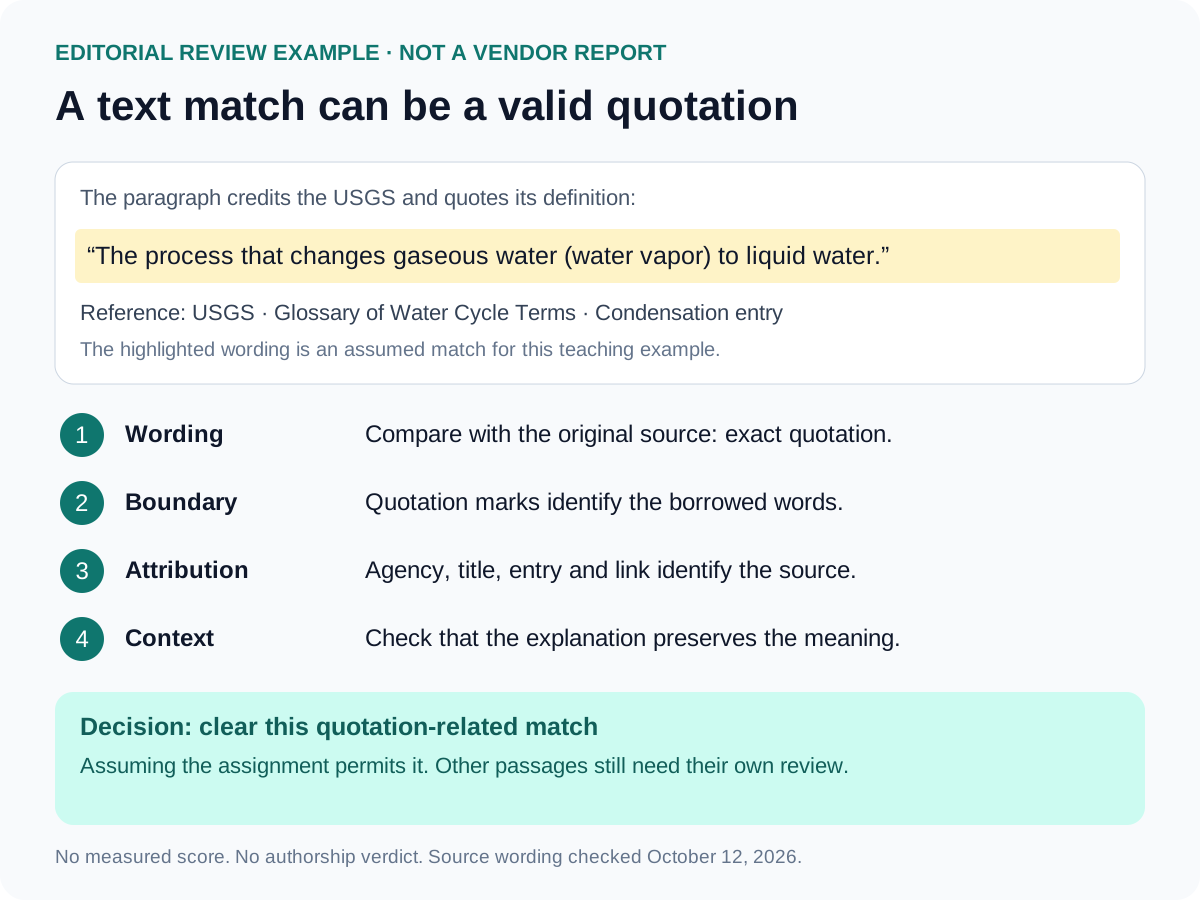
Open the annotation at full size.
| Annotation | What the reviewer checks | Finding in this example |
|---|---|---|
| 1. Exact wording | Open the linked source and compare the quoted words | The definition is reproduced accurately |
| 2. Quotation boundary | Is the reused wording marked as a quotation? | Quotation marks identify the borrowed definition |
| 3. Attribution | Can the reader identify and reach the original source? | The agency, title, entry and source link are provided |
| 4. Claim context | Does the surrounding explanation preserve the source's meaning? | It describes the same gas-to-liquid change |
| 5. Decision scope | What can be concluded about this passage? | Treat this match as an attributed quotation, assuming the assignment permits it |
A suitable review note is: “Reviewed the highlighted definition against the USGS entry. Quotation and attribution are present. No correction required for this match under the stated quotation policy.” The note clears the specific source-overlap concern; it does not certify every citation in the document or settle a separate AI-use question.
If the same words appeared without quotation marks, the citation alone would not clearly identify verbatim borrowing. The appropriate revision would be adding quotation marks and correct attribution, or writing a genuinely independent explanation with the source still credited. Replacing a few words to make a detector stop highlighting the passage would miss the reason for the review.
Turnitin's own similarity guidance confirms that correctly quoted and referenced text can still match. Its report helps locate matching material; the reviewer determines whether that use is appropriate. Source: Understanding the similarity score.
If you are a student: prepare evidence before a flag
Keep a normal record of how the assignment developed. Save the initial outline, research notes, source list, intermediate drafts and the final submitted version. Where your writing app supplies version history, retain it rather than flattening everything into a single final copy. Date your notes as you work; do not manufacture a retrospective history.
Record quotations separately from your own notes. Include the page or section and enough bibliographic information to locate the source again. This makes citation checking easier before submission and gives you a practical way to explain a match later.
If the assignment permits AI assistance, keep the relevant prompts and outputs and explain what you used them for in the required disclosure. If it prohibits that assistance, follow the rule. A grammar tool, an outline generator and an AI-written paragraph may be treated differently by the policy, so ask about those distinctions while there is time to act on the answer.
Before uploading to an optional checker, establish whether your institution permits it and how that service handles submissions. You do not need to buy Turnitin access from an unofficial reseller to assemble a useful evidence pack. Nor do you need to upload an unpublished dissertation to several services just to collect reassuring percentages.
If a concern is raised, request the relevant passage, source match or report and the applicable rule. Respond to the specific issue with your drafts, sources and explanation. Version history is supporting evidence, not a universal certificate of authorship, but it is more informative than a screenshot showing a different detector's lower score.
A review workflow for teachers and editors
Use five steps: policy → match → context → discussion → decision. First identify the rule and the question. An uncited source overlap, unsupported factual claim and possible prohibited AI assistance are different concerns and should not be recorded as one undifferentiated “AI plagiarism” allegation.
Next inspect the exact text and comparison source. Record the document version and report date. Note exclusions and settings where available: quotation or bibliography filtering can change a similarity summary. Comparing two percentages produced with different settings is not a controlled comparison.
Then check attribution and meaning. A correct citation needs to point to a source that exists and supports the particular claim. For a number, identify the population, unit and period. For a quotation, check the words and context. A reference list that looks plausible is only a starting point.
Discuss unresolved concerns with the writer. Ask a concrete question such as “Which source supports this figure?” or “How did you develop this paragraph?” Record the response alongside the evidence. Finally make a reasoned decision under the actual policy, separating the observed facts from interpretations.
Turnitin warns that its AI model can misclassify text and should not alone support adverse action against a student. GPTZero similarly advises against using its results to punish students and recommends broader writing-process assessment. These are verified vendor limits, stated here once rather than repeated throughout the buying comparison. Sources: Turnitin AI report and GPTZero FAQ.
What to test before buying
Evaluate the workflow on documents you own or have permission to use. A useful set includes a correctly quoted passage, an uncited copy from a known source and an independently written passage with references. Save the expected source and the settings. This is a workflow check, not enough material to establish a statistical accuracy rate.
For similarity checking, ask whether the report exposes the source and exact overlap clearly enough to review. For AI screening, ask whether it identifies the analysed text, explains the output and fits your review policy. For both, check supported inputs, language, volume and the cost of the work you actually do.
Students usually need clear citations and an approved draft process. Editors often need readable source comparisons and predictable scanning costs. Institutions additionally need access controls, integration and a consistent route for resolving concerns. Select for those requirements instead of a vendor's largest advertised accuracy number.
Questions readers ask
Can a free AI checker detect plagiarism?
An AI classification does not supply a copied source by itself. GPTZero Free and QuillBot's free detector are ways to inspect AI-related output; do not confuse that with a verified source-matching entitlement. When plagiarism is the question, look for the comparison source, not just a classification label.
What similarity percentage is acceptable?
There is no universal number established by this comparison. A short uncited passage can matter more than a larger set of properly quoted excerpts. Use the assignment or publication rules and review the actual matches. The worked example demonstrates why a highlighted passage can require no correction.
Which should an individual editor evaluate first?
Our suggested starting point is Copyleaks Personal when both source matching and AI screening are required. An existing eligible Grammarly account is worth evaluating for an editing-led workflow. For occasional scholarly similarity checks, compare iThenticate credits with institutional access. These are feature-and-cost recommendations, not tested accuracy rankings.