AI Email Marketing Tools: Boost Campaigns 10x in 2026
Editorial note: Some links in this article are affiliate links — we may earn a commission if you sign up, at no extra cost to you. Research guides are distinguished from documented firsthand reviews in our editorial standards. Read our editorial standards →
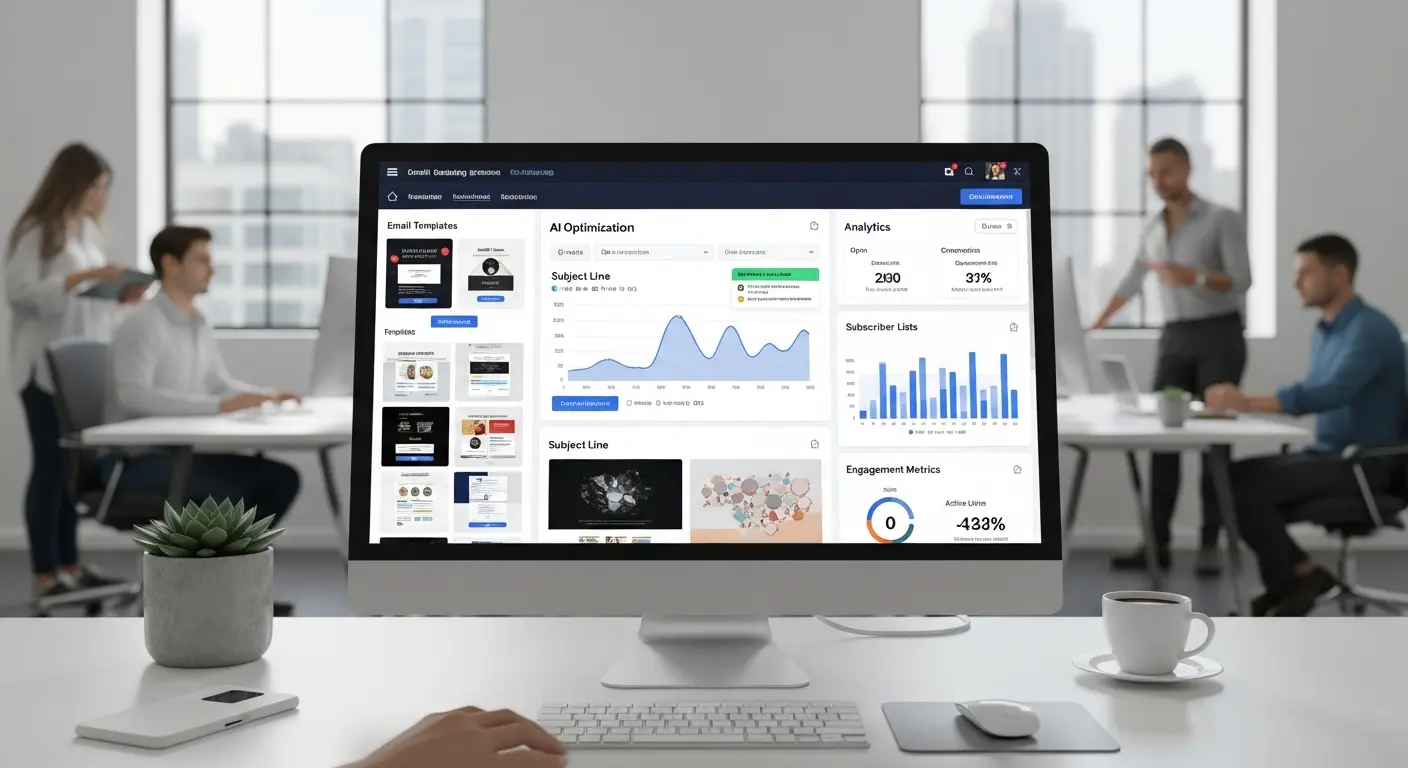
Email marketing remains one of the highest ROI marketing channels, returning $42 for every dollar spent. AI-powered email marketing tools are multiplying these returns by personalizing content at scale, optimizing send times, and automating complex campaigns that previously required teams of marketers.
AI Revolutionizes Email Marketing
AI-powered email marketing tools are multiplying these returns by personalizing content at scale, optimizing send times, and automating complex campaigns that previously required teams of marketers.
Performance Reality: Marketers using AI email tools report 40-60% higher open rates, 35-50% better click-through rates, and 25-40% more conversions compared to traditional email marketing.
Top AI Email Marketing Tools
1. Mailchimp (with AI Features)
What It Does: Popular email marketing platform with increasingly sophisticated AI-powered features for optimization and automation.
AI Features:
- Smart recommendations for send times
- Subject line optimization
- Content suggestions based on audience
- Predictive segmentation
- Automated customer journeys
Time savings have not been measured for this guide. Compare the complete workflow, including setup, corrections, review, and export, using your own representative tasks.
Success Metric: Users report 10-25% improvement in open rates using AI send-time optimization.
2. ActiveCampaign
What It Does: Advanced marketing automation platform with powerful AI for personalization and predictive sending.
AI Features:
- Predictive sending (AI determines best send time per contact)
- Win probability scoring
- Automated segmentation
- Content personalization
- Campaign performance prediction
Best For: Growing businesses, complex automation needs, B2B Pricing: Starting at $29/month Performance Impact: 30-50% improvement in engagement with AI-optimized sends
Pro Tip: Use predictive sending for every campaign - it analyzes each subscriber's engagement history to send at their optimal time.
3. Phrasee (AI Copywriting for Email)
What It Does: Specializes in AI-generated email subject lines, preview text, and body copy optimized for engagement.
AI Features:
- AI-generated subject lines
- Preview text optimization
- Push notification copy
- Brand voice learning
- Multi-variant testing at scale
Best For: Enterprise brands, high-volume senders, optimization focus Pricing: Enterprise (contact for quote) Results: Clients report 15-40% uplift in open rates with AI-generated subject lines
Case Study: Virgin Holidays increased email engagement by 2x using Phrasee's AI copywriting.
4. Seventh Sense
What It Does: AI-powered send-time optimization that integrates with HubSpot and Marketo.
AI Features:
- Individual-level send time optimization
- Frequency throttling
- Engagement prediction
- Deliverability improvement
- A/B testing automation
Best For: HubSpot/Marketo users, B2B marketers Pricing: Starting at $80/month (5,000 contacts) Impact: Average 7% increase in open rates, 10% in click rates
Unique Angle: Unlike batch-and-blast, sends each email at individually optimized times throughout the day.
5. Persado
What It Does: Enterprise-grade AI copywriting platform that generates and tests emotional language at scale.
AI Features:
- Emotion-based copy generation
- Language scoring
- Multi-language optimization
- Creative generation at scale
- Performance prediction
Best For: Enterprise brands, global campaigns, large-scale testing Pricing: Enterprise (contact for quote) Proven Results: Mars Inc. increased email engagement by 58% using Persado
6. Copy.ai (Email Marketing Module)
What It Does: AI writing assistant with specialized tools for email marketing campaigns.
AI Features:
- Email sequence generation
- Subject line variants (dozens in seconds)
- Email body copy creation
- CTA optimization
- Tone and length customization
Time savings have not been measured for this guide. Compare the complete workflow, including setup, corrections, review, and export, using your own representative tasks.
Practical Use: Generate 20 subject line variations in 30 seconds, A/B test the top 2.
7. Optimove
What It Does: Relationship marketing platform with AI-powered predictive analytics and campaign orchestration.
AI Features:
- Customer lifetime value prediction
- Churn prediction
- Next-best-action recommendations
- Micro-segmentation
- Campaign optimization
Return on investment has not been measured for this guide. Estimate costs using your own workload, licensing, setup, review, and correction effort; compare these with documented outcomes.
8. Zeta Global (formerly Boomtrain)
What It Does: AI-driven marketing platform specializing in personalized email content and timing.
AI Features:
- Content personalization per individual
- Predictive analytics
- Real-time optimization
- Cross-channel orchestration
- Sentiment analysis
Best For: Media companies, publishers, content-heavy brands Pricing: Enterprise solutions Performance: Claims 3-4x improvement in engagement vs traditional campaigns
AI Applications in Email Marketing
Subject Line Optimization
AI Capability: Analyze millions of subject lines to predict open rates before sending.
Tools: Phrasee, Copy.ai, Mailchimp AI Impact: 15-40% increase in open rates Example: Generic: "Our Summer Sale" → AI-Optimized: "Emma, your exclusive 40% off ends tonight ⏰"
Send Time Optimization
AI Capability: Determine optimal send time for each individual subscriber based on their past behavior.
Tools: Seventh Sense, ActiveCampaign, Mailchimp Impact: 7-15% increase in open rates How It Works: AI learns when each subscriber typically opens emails and sends accordingly
Content Personalization
AI Capability: Dynamically insert personalized content blocks based on subscriber data and behavior.
Tools: ActiveCampaign, Optimove, Zeta Global Impact: 20-40% increase in click-through rates Personalization Levels:
- Basic: Name, location
- Advanced: Product recommendations, content preferences
- AI-Powered: Predicted interests, behavioral triggers
List Segmentation
AI Capability: Automatically segment subscribers into micro-segments based on 100+ behavioral and demographic signals.
Tools: ActiveCampaign, Mailchimp, Optimove Impact: 30-50% better relevance and engagement Segments Created: Hundreds of micro-segments vs 5-10 manual segments
Predictive Analytics
AI Capability: Predict which subscribers are most likely to convert, churn, or engage.
Tools: Optimove, ActiveCampaign, Seventh Sense Applications:
- Win probability scoring
- Churn risk identification
- Lifetime value prediction
- Optimal email frequency
Business Value: Focus efforts on high-probability opportunities
Workflow Integration
Small Business Workflow
Tool Stack: Mailchimp + Copy.ai Monthly Cost: $20-60
Process:
- Generate email copy with Copy.ai (15 min vs 2 hours)
- Create campaign in Mailchimp (15 min)
- Let AI optimize send times (automatic)
- AI generates subject line variants for A/B testing (automatic)
- Review performance insights powered by AI (10 min)
Time savings have not been measured for this guide. Compare the complete workflow, including setup, corrections, review, and export, using your own representative tasks.
Medium Business Workflow
Tool Stack: ActiveCampaign + Seventh Sense Monthly Cost: $100-300
Process:
- AI automatically segments audience (automatic vs 4 hours manual)
- Create campaigns with predictive sending (30 min vs 3 hours)
- AI personalizes content per subscriber (automatic)
- Seventh Sense optimizes individual send times (automatic)
- AI surfaces insights and recommendations (review 20 min)
Time savings have not been measured for this guide. Compare the complete workflow, including setup, corrections, review, and export, using your own representative tasks.
Enterprise Workflow
Tool Stack: ActiveCampaign/Marketo + Phrasee + Seventh Sense Monthly Cost: $1,000-Reader community
Process:
- AI generates and tests multiple copy variants (Phrasee)
- AI creates micro-segments from customer data (automatic)
- Predictive models identify best opportunities (automatic)
- AI personalizes content for each subscriber (automatic)
- Individual-level send-time optimization (Seventh Sense)
- Continuous AI-powered optimization and learning
Team Impact: 2-3 person team accomplishes what required 8-10 people Performance Lift: 50-80% vs traditional enterprise email
Frequently Asked Questions
Q: Will AI-written emails sound robotic or generic? A: Not with modern tools. AI learns your brand voice and creates natural-sounding copy. Many brands see better performance with AI copy because it's optimized for engagement, not just creativity.
Q: How much technical knowledge is needed to use AI email tools? A: Minimal. Tools like Mailchimp and ActiveCampaign have user-friendly interfaces. If you can use traditional email tools, you can use AI-powered ones. Most advanced features are automated.
Q: Can AI handle complex, multi-step email sequences? A: Yes. Tools like ActiveCampaign excel at complex automation. AI can manage dozens of branching paths based on subscriber behavior, something nearly impossible manually.
Q: How quickly can I see results from AI email tools? A: Many see improvements in first campaign (send-time optimization). More sophisticated benefits (personalization, segmentation) show results within 2-4 weeks as AI learns your audience.
Q: Are AI email tools affordable for small businesses? A: Yes. Free tiers exist (Mailchimp, Copy.ai free plan), and paid plans start at $13-29/month. ROI typically positive within first month.
Performance varies with the product, task, language, input quality, and evaluation method. This guide does not establish a universal accuracy rate. Validate outputs against reviewed reference examples and record errors before relying on them.
ROI Calculation
Traditional Email Marketing (500-person team):
- Time savings have not been measured for this guide. Compare the complete workflow, including setup, corrections, review, and export, using your own representative tasks.
- Time savings have not been measured for this guide. Compare the complete workflow, including setup, corrections, review, and export, using your own representative tasks.
- Performance: 20% open rate, 2% CTR, 1% conversion
- Monthly cost: $1,375
- Revenue per campaign: Varies by business
AI-Assisted Email Marketing:
- Time savings have not been measured for this guide. Compare the complete workflow, including setup, corrections, review, and export, using your own representative tasks.
- Tool costs: $50-150/month
- Performance: 28% open rate (+40%), 3% CTR (+50%), 1.4% conversion (+40%)
- Monthly cost: $450-550
- Revenue per campaign: 40% increase
Return on investment has not been measured for this guide. Estimate costs using your own workload, licensing, setup, review, and correction effort; compare these with documented outcomes.
Implementation Roadmap
Month 1: Foundation
- Choose primary platform (Mailchimp or ActiveCampaign)
- Set up basic automation and segments
- Enable AI send-time optimization
- Start A/B testing AI-generated subject lines
Investment: $30-60/month Expected Results: 15-25% performance improvement
Month 2: Expansion
- Add AI copywriting tool (Copy.ai or similar)
- Implement predictive sending
- Create AI-powered segmentation
- Develop automated nurture sequences
Investment: $80-150/month Expected Results: 30-45% performance improvement
Month 3: Optimization
- Analyze performance data
- Refine AI-powered segments
- Scale successful automated campaigns
- Implement advanced personalization
Investment: Same as Month 2 Expected Results: 40-60% performance improvement vs baseline
Best Practices
Do's:
- ✅ Start with AI send-time optimization (easiest win)
- ✅ A/B test AI-generated copy vs human-written
- ✅ Let AI learn for 2-4 weeks before judging performance
- ✅ Combine AI insights with human creativity
- ✅ Use AI for personalization at scale
- ✅ Monitor deliverability closely when increasing volume
Don'ts:
- ❌ Rely 100% on AI without human oversight
- ❌ Ignore your existing successful campaigns
- ❌ Over-email subscribers (AI can't fix annoying frequency)
- ❌ Skip testing AI recommendations
- ❌ Forget to maintain list hygiene
- ❌ Ignore unsubscribe patterns
Conclusion
AI email marketing tools are no longer nice-to-have - they're essential for competitive email performance in 2026. The combination of AI-powered copywriting, send-time optimization, predictive analytics, and hyper-personalization enables small teams to achieve enterprise-level results.
Your Action Plan:
- This Week: Sign up for Mailchimp or ActiveCampaign free trial
- Week 2: Enable AI send-time optimization on all campaigns
- Week 3: Test AI-generated subject lines
- Month 2: Implement full AI-powered personalization and segmentation
The email marketers winning in 2026 are those leveraging AI to work smarter, personalize at scale, and optimize every element of their campaigns. Start your AI email journey today and watch your engagement and conversions soar.
Related Resources:
Tags
Written by

Sourabh Gupta
Author at Teach AI Tools
Sourabh Gupta is responsible for Teach AI Tools. Research guides and documented firsthand reviews are identified separately. An author profile is not evidence of testing; look for sources, test records, and limitations in the article.
Full bio & editorial process →