Why a 65-Person Game Can Credit Only 6 Designers and 3 Programmers
Editorial note: Some links in this article are affiliate links — we may earn a commission if you sign up, at no extra cost to you. Research guides are distinguished from documented firsthand reviews in our editorial standards. Read our editorial standards →
Why a 65-Person Game Can Credit Only 6 Designers and 3 Programmers
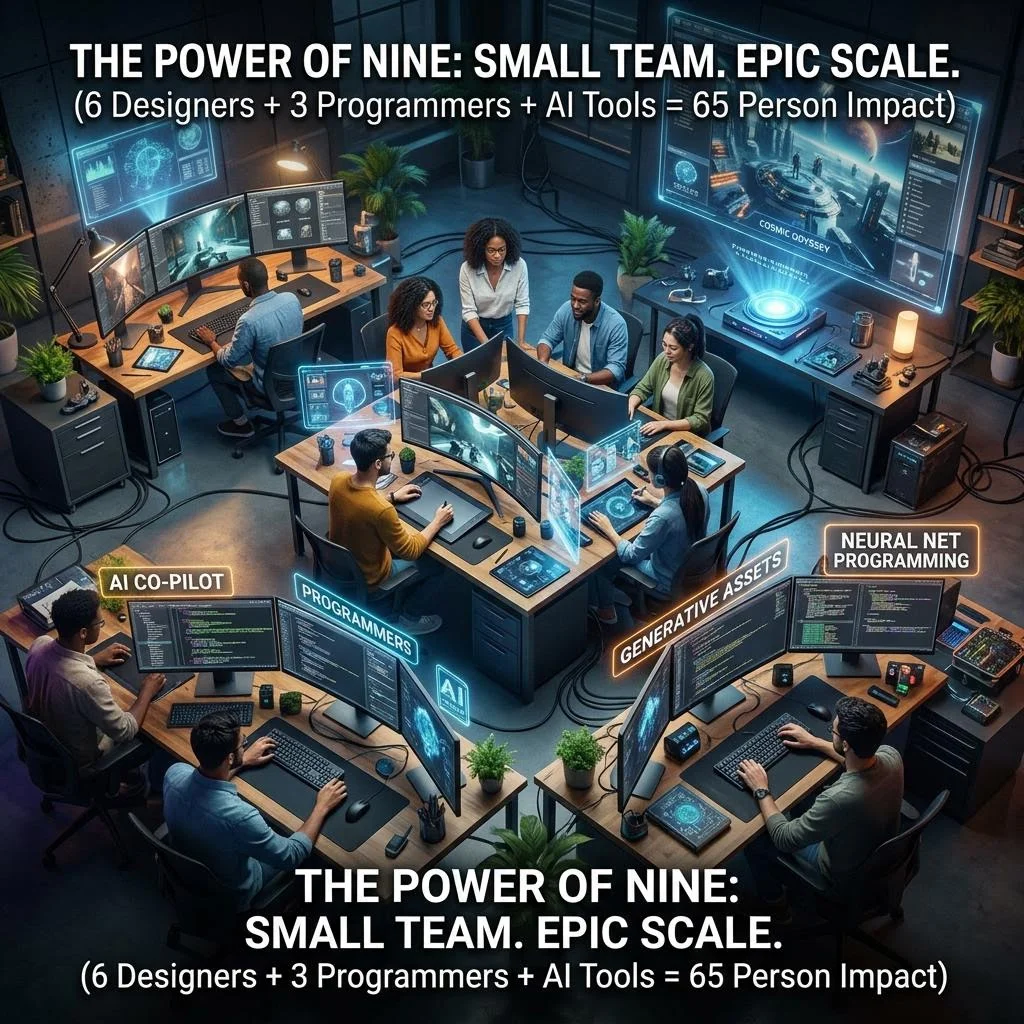
The phrase "6 designers 3 programmers 65 people game credits" sounds like a contradiction until you know how credits are built. A GDC 2026 talk about a Japanese RPG described a shipped project with 6 designers, 3 programmers, and 65 credited people overall. That sounds lopsided only if you assume credits map cleanly to the day-to-day team. They usually do not.
A credit roll is part staffing record, part legal record, part studio custom. It can include core developers, short-term contractors, outsource partners, voice talent, QA, localization, production support, and sometimes people from publishing or executive teams. So the useful question is not "where are the missing programmers?" It's "which jobs were handled outside the core design-and-code group?"
The simplest explanation: most credited people were doing work outside core systems
If a project credits 65 people and only 9 of them are listed as designers or programmers, that leaves 56 contributors in other roles. On a mid-size game, that is not unusual.
Those names often include:
- artists and animators n- technical artists and VFX staff
- UI and UX contributors
- composers, sound designers, audio implementers, and voice directors
- QA testers and QA leads
- localization translators, editors, and LQA testers
- producers and project managers
- cinematic, mocap, or performance capture staff
- platform certification support
- marketing, community, legal, and publishing support
- outsource studios and middleware partners
Credits compress all of that into a single scroll. They rarely tell you who was full-time for three years versus who joined for a short delivery phase.
Credits are not a neutral document
According to discussions on Game Development Stack Exchange, studios have wide latitude in how they assign credits. There is no single enforced industry standard that every company must follow.
The IGDA Game Crediting Guidelines are recommendations, not binding rules. One commonly cited guideline suggests that contributors who worked less than 40% of the project's total workdays, or fewer than eight months, whichever is shorter, should be listed under "Additional" role categories rather than primary role listings. That framework exists, but adoption is inconsistent.
This means two people can do similar work and receive different credit labels depending on studio policy. One studio may list someone as "Designer." Another may place the same person under "Additional Design." A contractor who solved a critical pipeline problem may appear beside someone who spent years on the project, or may be omitted from the main role grouping entirely.
That is why game credits are a weak tool for estimating who made the key creative or technical decisions.
Why only 3 programmers may have been enough
The most interesting detail from the GDC talk was not the low programmer count by itself. It was the production setup that made that count plausible.
Reportedly, the game's combat content was built so designers could author skills directly in Unreal Engine Blueprints. That included animation triggers, camera behavior, particles, audio cues, and damage logic. If that summary is accurate, the programmers were not spending their days hand-implementing every attack or status effect. They were building the rules and tooling that let designers ship content without waiting in a queue.
The talk also described a turn structure split into multiple phases, with scripting hooks exposed at each stage. That kind of setup matters because it removes programmer dependency from routine content work. A designer can place logic at turn start, turn end, or on specific combat events without asking engineering to write a custom patch every time.
Another reported detail was a change that made Blueprint variables private by default. That is a small technical choice with a big production effect: it reduces accidental dependencies and catches sloppy content-side usage earlier. The same goes for edit-time validation on save. If designers get immediate feedback when data is malformed, fewer bugs become engineering work later.
The broader point is straightforward: three programmers can support a lot of content if they are building internal tools, safe scripting boundaries, and reusable systems. A bigger programming team is not automatically more productive if content creators still need engineering help for every new asset or encounter.
What those other 56 people likely did
Here is the practical breakdown readers usually want when they see a 65-name credit roll.
Art and animation usually consume more headcount than outsiders expect
Many players overestimate the share of a game's staff who are writing code. On content-heavy projects, visual production often absorbs more labor than programming. Character models, environments, rigging, effects, cutscene animation, lighting, and UI all require specialized work. Even if some of it is outsourced, those contributors still appear in the credits.
QA grows late in production
QA headcount often spikes near content completion, certification, and release prep. That makes testing one of the biggest reasons a credit roll looks much larger than the core team. Testers may be internal, external, or both. They can include platform compliance testing, regression passes, localization QA, and issue verification.
Localization adds a surprising number of names
If a game ships in several languages, credits can expand quickly. Translation, editing, cultural review, dubbing, voice recording, subtitle timing, and linguistic QA may each involve separate vendors or teams. Players often treat localization as a footnote, but on the credits page it can occupy a major share of the list.
Audio and performance work is fragmented by design
Music, sound design, implementation, voice casting, performers, recording engineers, and post-production are often split across multiple specialists or vendors. That creates lots of names without implying a giant in-house audio department.
Producers, coordinators, and certification staff keep the project shippable
These roles are easy to dismiss until a project misses a build deadline or fails console certification. Producers, associate producers, build managers, and submission specialists do not usually shape the game's public identity, but they often determine whether it reaches release at all.
What the ratio does and does not prove
A credit ratio like 6 designers, 3 programmers, 65 total does suggest a few things.
It suggests the project had a small core implementation group relative to total credited labor.
It suggests support work was either outsourced, short-term, or handled by specialists outside design and engineering.
It may suggest the technical architecture reduced reliance on engineers for routine content creation.
But it does not prove any of these on its own:
- that the project was cheap
- that the programmers were overloaded
- that the designers had unusual authority
- that the studio was mostly contractors
- that the credit categories were applied consistently
Those are inferences, not facts. To verify them, you would need development timelines, staffing structure, outsourcing details, and the studio's own crediting policy.
A common research mistake: confusing credits with other public numbers
One reason this topic gets muddled online is that searches for team size often surface unrelated numbers. Review counts, player counts, and press mentions are frequently mistaken for staffing figures. A number like 65 may refer to critic reviews in one result and credited personnel in another.
If you are trying to understand a game's actual team structure, the relevant sources are the game's own credits, staff interviews, GDC talks, studio postmortems, and hiring or outsourcing disclosures. Aggregate review pages tell you nothing about who built the game.
What this means for developers using AI tools
For Teach AI Tools readers, the useful parallel is not "AI will replace half the team." It is that tooling changes team ratios when it removes dependency bottlenecks.
If designers can build, test, and validate more of their own content through internal tools, scripting layers, or AI-assisted workflows, a studio may need fewer engineers assigned to implementation support. That does not erase engineering work. It shifts it upstream toward infrastructure, guardrails, validation, and pipeline design.
That is the same pattern described in the GDC example. The programmers created systems that let non-programmers move faster without constantly opening tickets. AI coding assistants can help with that kind of infrastructure work, but they can also create maintenance debt if they produce quick fixes instead of durable tools. The headcount question matters less than the workflow question: who is blocked by whom, and how often?
The useful way to read a credit roll
When you see a game with 65 names but only 6 designers and 3 programmers, read it as a production map, not a clean org chart.
Ask:
- Which contributors were core team members?
- Which were vendors or contractors?
- How much work was concentrated in art, QA, localization, and audio?
- Did the studio build tools that let designers implement content themselves?
- Does the credit policy separate primary roles from additional support in a meaningful way?
That framework will tell you much more than staring at the designer and programmer counts in isolation.
The short answer to the "6 designers 3 programmers 65 people game credits" puzzle is that the other names were not filler. They were the people handling art, testing, localization, production, audio, certification, and outsourced support that made the game shippable.
Tags
Written by

Sourabh Gupta
Author at Teach AI Tools
Sourabh tests every AI tool he writes about — hands-on, with real use cases. His background in data science means he goes beyond marketing claims to benchmark actual performance, cost, and reliability for developers and creators.
Full bio & editorial process →